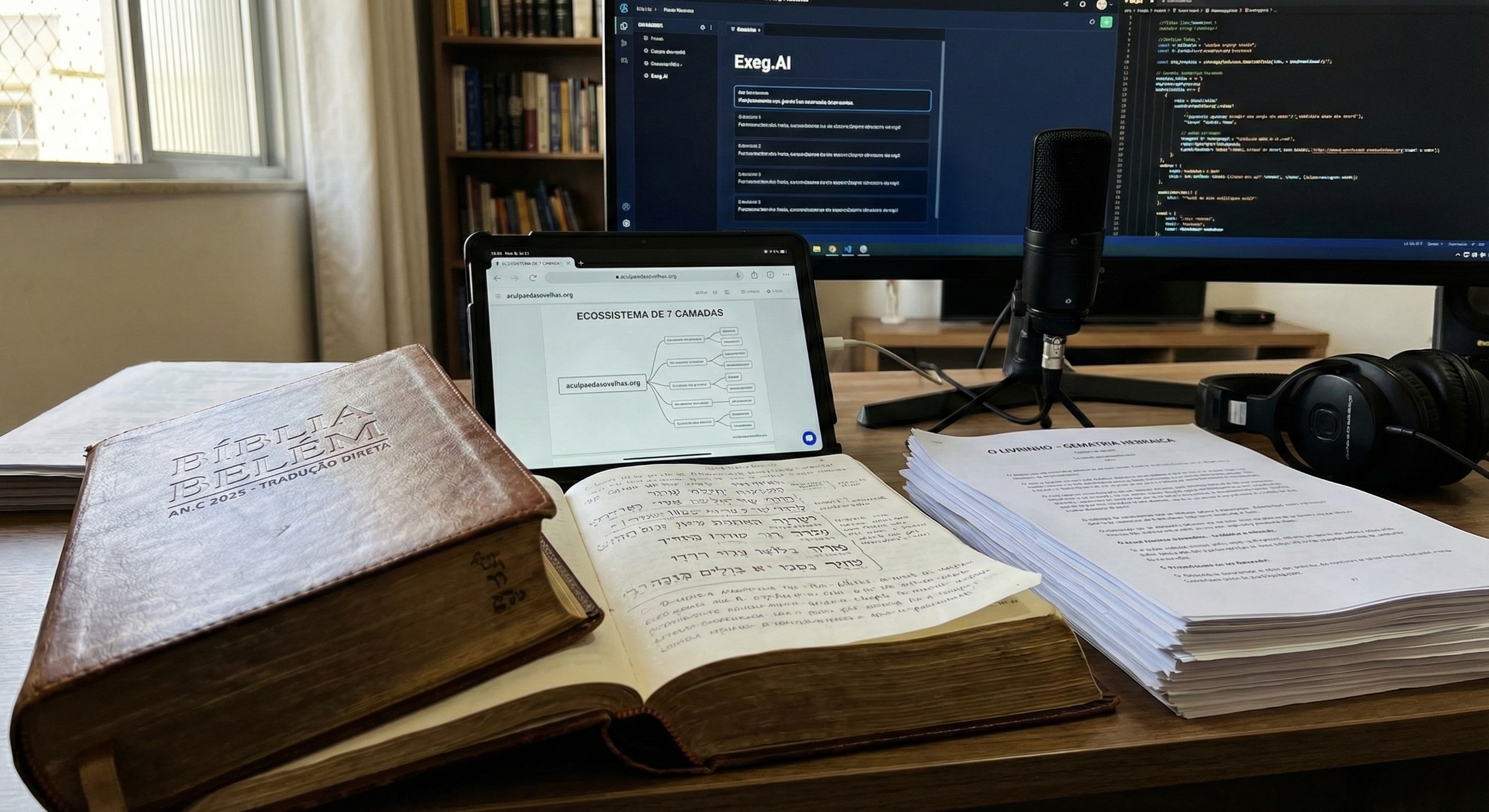
Public source text: WLC (Westminster Leningrad Codex) + Nestle 1904. Translation: Belem-2025 Bible translation — literal, rigid, straight from the public códices.
The Translation That Was Missing
There are dozens of Bible translations in Portuguese. Almeida Corrigida. NVI. NVT. NTLH. Almeida Atualizada. Each one made editorial choices — softened here, harmonized there, interpreted elsewhere. All of them deliver to the reader a processed text.
The Belem-2025 Bible translation is different. It delivers the text raw. Morpheme by morpheme. Without softening. Without harmonization. Without implicit interpretation. The reader receives exactly what the códices say — in rough, uncomfortable, and radically faithful Portuguese.
It is the first rigid literal translation in the Portuguese language. The first of its kind.
The Accepted Códices
The translation works exclusively with public domain códices in the original languages. No Latin. No secondary translations. Only the oldest verifiable sources.
Old Testament
| Codex | Abbreviation | Description |
|---|---|---|
| Westminster Leningrad Codex | WLC | Standard academic Masoretic text — Hebrew + Aramaic |
The WLC is based on the Codex Leningradensis (c. 1008 AD), the oldest complete Masoretic manuscript in existence. It is the basis for virtually all academic editions of the Hebrew OT (BHS, BHQ).
New Testament
| Codex | Abbreviation | Usage |
|---|---|---|
| Nestle 1904 | NA1904 | Critical text — primary source |
| Westcott-Hort 1881 | WH | Critical text — comparison source |
| Textus Receptus 1550 | TR | Ecclesiastical text — comparison source |
The primary source for the NT is Nestle 1904 — a critical edition by Eberhard Nestle based on the collation of Tischendorf, Westcott-Hort, and Weymouth. It is public domain and academically rigorous.
WH 1881 and TR 1550 are used for comparison and recording of textual variants. When there is divergence between texts, the Belem-2025 Bible translation records the variant.
REJECTED Source
| Source | Status | Reason |
|---|---|---|
| Latin Vulgate | REJECTED | Derived translation, not a primary source. Contaminated by ecclesiastical editorial decisions |
| Any modern translation | REJECTED as source | Translations are derivations — the Belem AnC works only with primary sources |
| Non-public domain manuscripts | NOT USED | Verifiability requires public access |
The Translation Method
Step 1: Source Text Identification
The translator identifies the Greek or Hebrew text in the public domain codex. There are no intermediaries.
Step 2: Morphological Analysis
Each word is morphologically analyzed:
- Root/lexeme — dictionary form
- Tense/mood/voice (Greek verbs) or binyan (Hebrew verbs)
- Case/number/gender (nouns, adjectives, pronouns)
- Prefixes and suffixes (especially relevant in Hebrew)
Step 3: Morpheme-by-Morpheme Translation
Each morphological unit receives a Portuguese correspondence. Word order from the original is preserved when possible. When Portuguese grammar requires minimal reordering, it is done — but indicated.
Step 4: Preservation of Designations
Divine designations are kept in their original script with transliteration:
Step 5: Zero Interpretation
The translator does not add interpretive notes in the body of the text. Does not soften strange constructions. Does not harmonize apparent contradictions. If the original text is ambiguous, the translation preserves the ambiguity.
What the Reader Finds
The experience of reading the Belem-2025 Bible translation is deliberately different from any other translation:
| What the reader expects | What the reader finds |
|---|---|
| Fluid and pleasant text | Rough and literal text |
| “God,” “Lord,” “Christ” | Θεός, Κύριος, Χριστός |
| Reorganized sentences | Original order preserved |
| Embedded interpretation | Zero interpretation |
| Explanatory footnotes | No interpretive notes |
This is intentional. The discomfort is a pedagogical tool. When the reader stumbles on a strange construction, they are forced to investigate. When they encounter a Greek designation, they are forced to research. The text does not deliver answers — it delivers questions.
And questions are the engine of all investigation.
The Canon: 66 Books
The Belem-2025 Bible translation works with the Protestant canon of 66 books — 39 from the Old Testament and 27 from the New Testament. The deuterocanonical/apocryphal books are not included.
| Testament | Books | Original Language |
|---|---|---|
| Old Testament | 39 | Hebrew + Aramaic (parts of Daniel and Ezra) |
| New Testament | 27 | Koine Greek |
| Total | 66 | 3 languages |
The Author of the Translation
Belem Anderson Costa is not a theologian. He is a police officer, developer, and studied Letters — without completing the degree.
| Competence | Application in Translation |
|---|---|
| Critical textual analysis | Rigorous examination of códices |
| Morphology | Decomposition of words into morphemes |
| Syntax | Analysis of Greek and Hebrew sentence structure |
| Semantics | Mapping of fields of meaning |
| Pragmatics | Communicational context of passages |
The degree in Letters — not seminary — is deliberate. The translator does not carry the weight of a denominational tradition. He was not trained to read the text from a specific perspective. He acquired competencies to analyze the text as text.
Easter Egg #7: The surname “Belem” (Βηθλέεμ — Bethleem) is a transliteration of the Hebrew בֵּית לֶחֶם (Beth Lechem — “House of Bread”). The author carries in his name the same city where the biblical text records the birth of Ἰησοῦς. The suffix “An.C” in the translation refers to “Antes de Cristo” (“Before Christ”) — but inverted: the translation goes from Christ (from the códices) to the present. “Belem AnC” is, therefore, a signature: from the House of Bread, from before Christ, until now.
The Public API
The Belem-2025 Bible translation does not exist only as static text. It is available via a public REST API:
URL: https://biblia.aculpaedasovelhas.org
| Endpoint | Function |
|---|---|
/api/v1/books | List of all 66 books |
/api/v1/verses/:book/:chapter | Verses of a chapter |
/api/v1/verses/:book/:chapter/:verse | Specific verse |
/api/v1/verses/search?q=term | Text search |
/api/v1/tokens/:verseId/interlinear | Interlinear text (Greek/Hebrew + Portuguese) |
/api/v1/tokens/:verseId/morphology | Token-by-token morphological analysis |
The API allows any developer, researcher, or student to programmatically access the Belem AnC text. Integrate with your own systems. Build tools. Verify each translation.
The API is built with TypeScript (Hono framework) and hosted on Cloudflare Workers with a D1 database. The code is open source.
Open Source: CC BY 4.0
The Belem-2025 Bible translation is licensed under Creative Commons Attribution 4.0 International (CC BY 4.0). This means:
- Anyone can copy and redistribute in any format
- Anyone can adapt, remix, and build upon the material
- For any purpose, including commercial
- As long as proper attribution is given
The reason is simple: if the translation is faithful to the original text, it must be tested by the greatest possible number of people. Access restrictions protect the translator — not the truth. Open source exposes the translator to scrutiny — and that is good.
If there is an error, it will be found. If there is bias, it will be identified. If there is imprecision, it will be corrected. Because public scrutiny is the greatest purifier of Truth.
Integration with exeg.ai
The Belem-2025 Bible translation is the textual corpus of the exeg.ai platform. When the user asks a question to the AI, it consults directly the Belem AnC text — not another translation.
The platform offers:
- Semantic search — finds similar passages by meaning (FAISS)
- Interlinear analysis — Greek/Hebrew text + literal translation side by side
- Easter Egg Engine — detection of lexical patterns between passages
- Intertextual mapping — traceable OT/NT connections
All based on the rigid literal translation. The AI does not soften, does not harmonize, does not interpret. Just like the translation.
The Invitation
The Belem-2025 Bible translation is not for everyone. It is for those who accept the discomfort of literalness. For those who prefer a rough but faithful text to a fluid but interpreted one. For those who want to investigate rather than consume.
Each reader becomes an investigator. Each verse becomes a piece of evidence. Each reading becomes a forensic act.
The text is open. The códices are public. The translation is verifiable. The method is documented.
All that is missing is the investigator.
“You read. And the interpretation is yours.”