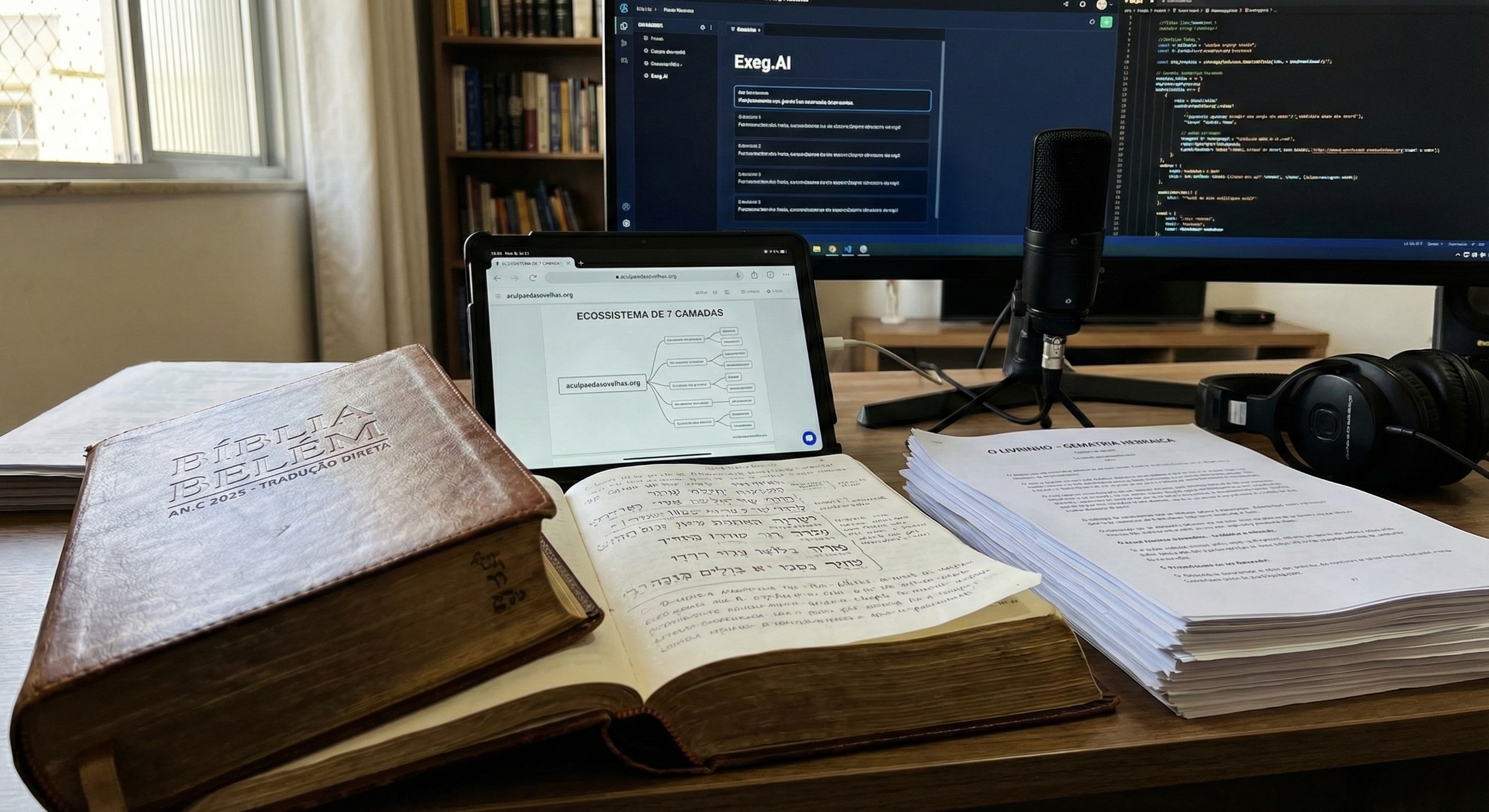
The New Rigid Literal Translation That Returns to the Reader the Right to Judge the Sacred Text
Official name: Belem-2025 Bible translation
Nature: Proprietary translation, with registered rights, carried out directly from the original códices (Hebrew, Aramaic, and Greek) into Portuguese, in a faithful, literal, and rigid format.
1) The Central Problem: Was the Bible “Translated” or “Interpreted”?
Over centuries, Bible translations were produced with a declared objective: to make the text “comprehensible.” But, for Belem Anderson Costa, this objective carried a devastating cost: the replacement of the text by the translator’s choices.
The author argues that traditional translation processes frequently apply:
- Grammatical and syntactic normalizations
- Meaning harmonizations
- Cohesion and fluency adjustments
- Stylistic “corrections”
- Embedded theological decisions
And this set of “improvements” would have caused an effect that is not merely linguistic, but spiritual and civilizational: the progressive dilution of the literal truth of the Sacred Text.
The result, according to the author, was the formation of a religious world where the reader does not read the original, but reads the reading that the translator made of the original.
2) The Proposal: Rigid, Faithful, and Direct Literalness
The Belem-2025 Bible translation is born as a response to this thesis. Belem defines the principle of the project in one sentence:
“From the language of the sacred text directly to the language of the reader.”
The translation is built on the basis of:
- Extreme literalness
- Formal fidelity
- Structural rigidity
- Absence of “improvements”
- Rejection of harmonizations
- Resistance to tradition as a reading filter
The author describes this rigidity as literalness at the TEA level, assuming that pure literal reading is the only truly faithful and morally safe reading.
The consequence is not to produce an “easy” text. The consequence is to produce an honest text.
3) The Reader Returns to the Place of Judge of the Text
For Belem, traditional translation displaced the center of biblical reading:
The Shift
- Before: the reader judges the text
- After: the translator judges the text and delivers his judgment to the reader
The Belem-2025 Bible translation seeks to reverse this. The idea is simple and radical: the reader needs to receive the text raw enough so that they themselves may judge.
This includes:
- Syntactic strangeness
- Unusual constructions in Portuguese
- Uneliminated repetitions
- Ambiguity maintained when it exists in the original
- Rigid and consistent lexical choices
The reader is invited to exercise:
- Their philological intelligence
- Their personal theology
- Their sense of textual coherence
- Their spiritual discernment
And not to absorb “invisible conclusions” from translators and traditions.
4) The Normalization Tool: Support Is Commanded by the Reader
Belem states that the problem is not “using support.” The problem is when support replaces the text and decides for the reader.
For this reason, the project includes a key element: an intelligent normalization tool commanded by the reader.
- The translation remains rigid and literal
- Normalization does not come embedded in the text
- The reader activates normalization when they wish
- The reader chooses the level of support
- The reader decides how much they want to “adapt” for comprehension
The core of the thesis is this:
The translation must not contain the interpretation. The interpretation must be born from the reader before the text.
5) The Great Deception and Apostasy as a Textual Phenomenon
The author sustains a total theological and historical thesis: apostasy and the great deception also happened (and primarily) through the progressive adulteration of the text via translation and tradition.
According to Belem:
- There has not been, in the world, a fully true Church of Jesus Christ
- Because the text was altered by successive layers of translation + tradition
- And this prevented humanity from solving the enigmas and hidden codes of the Sacred Text
- Making the reader’s judgment dependent on external authorities
Apostasy, in this formulation, is not merely “doctrinal deviation.” It is a global structure of deception, fueled by:
- Softened language
- Domesticated meaning
- Religious fear
- Myth and mysticism
- Contours of terror
- A culture of dependence on the “official interpreter”
6) The Unveiling of Jesus Christ: Book 66 as the Key to the World
Belem affirms that Jesus revealed to the apostle John the truth about the Great Deception. And that this text is not correctly understood by the name “Apocalypse.”
He affirms that the true name is: The Unveiling of Jesus Christ
And that the system of deception would have operated once again:
- Renaming the book to “Apocalypse”
- Wrapping it in terror and mysticism
- Transforming the most important book in the history of Jesus Christ into the least read
- Isolating it as “a subject for specialists,” “end of the world,” “fear,” “fanaticism”
On this axis, the thesis is complete:
- The Bible contains everything. Nothing was left out.
- Book 66 is the key.
- But book 66 requires a key.
- And that key was reserved “for the correct time.”
7) The Declared Mission: The Little Book and the Sword That Proceeds from the Mouth
The Belem-2025 Bible translation project is presented as part of a life mission. Belem affirms that, with “O Livrinho - A Culpa é das Ovelhas,” he is announcing to the world that:
- The great deception has already happened
- Apostasy has already consolidated
- The beasts and the false prophet have been exposed
- The prophecies of Daniel and the end times have their identity and structure revealed
- And the antichrist is not an unsolvable mystery
The rhetorical core that the author sustains is:
Jesus Christ has already delivered the truth. And the truth is in the Unveiling of Jesus Christ.
The Bible, then, is not merely a spiritual text. It is a complete system of reality, history, and prophecy.
8) Why This Translation Exists Now
The Belem-2025 Bible translation is positioned as a translation for a specific time. A time where:
- Humanity has tools to read the original with technical support
- The reader can command normalization layers without losing the raw text
- Dependence on religious authorities can be broken
- Interpretation can return to the hands of the reader
- And the text can be read as it was written, without cultural “shields”
In the author’s view, this is not luxury. It is obligation.
9) Conclusion: Literalness as Liberation
The Belem-2025 Bible translation is not just a translation. It is a thesis.
A thesis that declares:
- The truth exists only in the literal text
- The translator cannot be the judge
- The reader needs to recover the right to judge
- And humanity was deceived by a linguistic system disguised as “improvement”
The final proposal is not to soften. It is to expose.
It is not to facilitate. It is to return the source.
It is not to domesticate. It is to reveal.
Amen, amen: the time of the end, the time of the new beginning.