Five Links, One Chain
Public source text: WLC (Westminster Leningrad Codex) + Nestle 1904. Translation: Belem-2025 Bible translation – literal, rigid, straight from the public códices.
Tradition reads DES 13 as a sequence of disconnected symbolic images: a beast, a mark, a number. The forensic reading reveals something different: a functional chain in which each link depends on the previous one and enables the next.
The chain is:
AUTHORITY -> NAME -> MARK -> COMMERCE -> NUMBER
Five links. Each one extracted directly from the Greek text. Each one verifiable verse by verse.
Link 1 – EXOUSIA (Authority)
DES 13:2:
καὶ ἔδωκεν αὐτῷ ὁ δράκων τὴν δύναμιν αὐτοῦ καὶ τὸν θρόνον αὐτοῦ καὶ ἐξουσίαν μεγάλην kai edoken auto ho drakon ten dynamin autou kai ton thronon autou kai exousian megalen “And the dragon gave it his power and his throne and great authority.”
The keyword is ἐξουσία (exousia) – authority, jurisdiction, right to act. The Beast of the Sea does not possess its own authority. It receives it from the dragon. The chain begins with delegation of power.
DES 13:4 confirms:
“They worshiped the dragon because he gave the authority (τὴν ἐξουσίαν) to the beast.”
DES 13:5 reiterates:
“And authority was given to it (ἐδόθη) to act for forty-two months.”
The verb ἐδόθη (edothe) – divine passive – appears repeatedly. The beast operates with delegated power. It is not the source – it is the operator.
Link 2 – ONOMA (Name)
DES 13:1:
καὶ ἐπὶ τὰς κεφαλὰς αὐτοῦ ὀνόματα βλασφημίας kai epi tas kephalas autou onomata blasphemias “And upon its heads names of blasphemy.”
DES 13:6:
καὶ ἤνοιξεν τὸ στόμα αὐτοῦ εἰς βλασφημίαν πρὸς τὸν θεόν, βλασφημῆσαι τὸ ὄνομα αὐτοῦ kai enoixen to stoma autou eis blasphemian pros ton theon, blasphemesai to onoma autou “And it opened its mouth for blasphemy against Theos, to blaspheme his name.”
The beast carries names (ὀνόματα, onomata) and uses its name to blaspheme against Theos. The name is not decorative – it is functional. It is the second link: authority generates the name, and the name is the basis of the system’s identity.
charagma-mark">Link 3 – CHARAGMA (Mark)
DES 13:16:
καὶ ποιεῖ πάντας… ἵνα δῶσιν αὐτοῖς χάραγμα ἐπὶ τῆς χειρὸς αὐτῶν τῆς δεξιᾶς ἢ ἐπὶ τὸ μέτωπον αὐτῶν kai poiei pantas… hina dosin autois charagma epi tes cheiros auton tes dexias e epi to metopon auton “And it makes all… so that a mark be given to them upon their right hand or upon their forehead.”
The word χάραγμα (charagma) means engraving, impression, permanent mark. It comes from χαράσσω (charasso) – to engrave, to carve. It is the same type of engraving described in Exodus 28:36: פִּתּוּחֵי חֹתָם (pituchei chotam) – “engravings of a seal.”
The mark is the third link: authority generates the name, and the name is engraved as a mark on those who belong to the system.
Link 4 – AGORASAI / POLESAI (Commerce)
DES 13:17:
καὶ ἵνα μή τις δύνηται ἀγοράσαι ἢ πωλῆσαι εἰ μὴ ὁ ἔχων τὸ χάραγμα kai hina me tis dynetai agorasai e polesai ei me ho echon to charagma “And so that no one may buy or sell except the one who has the mark.”
The fourth link is economic control. The mark is not merely identity – it is commercial authorization. Without the mark, one cannot operate in the market. The system functions like a license: those who belong, transact; those who do not, are excluded.
Compare with the priestly system: without investiture (which includes the nezer hakodesh on the forehead), the priest could not officiate in the Temple. Without the seal of belonging, one did not participate in the cultic system – which included transactions of sacrifices, tithes, and offerings.
Link 5 – ARITHMOS (Number)
DES 13:17-18:
τὸ χάραγμα, τὸ ὄνομα τοῦ θηρίου ἢ τὸν ἀριθμὸν τοῦ ὀνόματος αὐτοῦ… καὶ ὁ ἀριθμὸς αὐτοῦ ἑξακόσιοι ἑξήκοντα ἕξ to charagma, to onoma tou theriou e ton arithmon tou onomatos autou… kai ho arithmos autou hexakosioi hexekonta hex “The mark, the name of the beast or the number of its name… and its number is six hundred sixty-six.”
The fifth and final link: the number. The text is precise: the mark IS the name OR the number of the name. They are interchangeable forms of the same identification system. The number identifies the name. The name identifies the system. The system controls commerce. Commerce requires the mark. The mark comes from authority.
The Complete Chain Mapped
| Link | Greek | Transliteration | English | Verse | Function |
|---|---|---|---|---|---|
| 1 | ἐξουσία | exousia | Authority | DES 13:2,4,5 | Delegation of power |
| 2 | ὄνομα | onoma | Name | DES 13:1,6,17 | System identity |
| 3 | χάραγμα | charagma | Mark | DES 13:16,17 | Engraving of belonging |
| 4 | ἀγοράσαι/πωλῆσαι | agorasai/polesai | Buy/Sell | DES 13:17 | Economic control |
| 5 | ἀριθμός | arithmos | Number | DES 13:17,18 | Numerical identification |
The chain is not interpretation. It is transcription. Each link is explicitly in the Greek text, with identifiable verse and defined function.
The Chain in the Priestly System
The correspondence with the Yahweh (יהוה — yhwh; trad. “Jehovah”1) system is point by point:
The Hebrew text of Exodus 28:36 and Leviticus 8:9 documents the Name + Mark + Number link —
וּפִתַּחְתָּ֣ עָלָ֔יו פִּתּוּחֵ֖י חוֹתָ֑ם קֹ֖דֶשׁ לַיהוָֽה
“And you shall engrave on it engravings of a seal: HOLINESS TO Yahweh (yhwh) (קֹדֶשׁ לַיהוָה).” — Exodus 28:36
וַיָּ֣שֶׂם עַל־הַמִּצְנֶ֗פֶת אֶל־מ֤וּל פָּנָיו֙ אֵ֣ת צִ֤יץ הַזָּהָב֙ נֵ֣זֶר הַקֹּ֔דֶשׁ
“And he placed on the turban, facing his face, the flower of gold, the crown of holiness (נֵזֶר הַקֹּדֶשׁ).” — Leviticus 8:9
| DES 13 Link | Priestly System | OT Text |
|---|---|---|
| Authority (dragon delegates) | Yahweh (yhwh) institutes priesthood | Ex 28:1 |
| Name (name of the beast) | KODESH LAYHWH (on the plate) | Ex 28:36 |
| Mark (engraving on the forehead) | Nezer hakodesh on the forehead | Ex 28:38 |
| Commerce (buy/sell) | Priests control offerings | Lev 27; Num 18 |
| Number (666) | נזר הקדש = 666 | Standard gematria-o-codigo-numerico-escondido-na-biblia/" class="autolink" title="gematria">gematria |
Five links. Five correspondences. No external source.
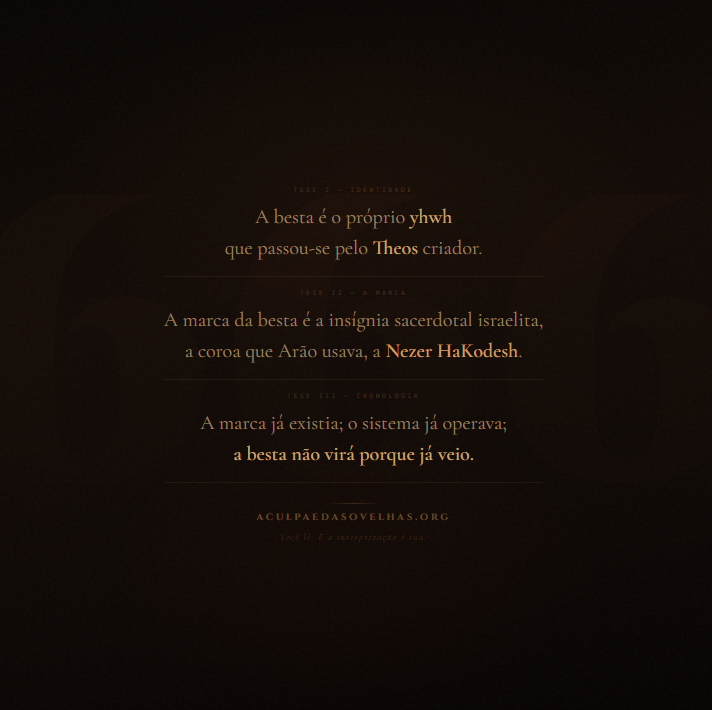
Easter Egg: The functional chain of DES 13 does not describe a future political-economic system. It describes the priestly system of Israel: authority delegated by Yahweh (yhwh), name engraved on the plate, plate on the priest’s forehead, priests controlling the offering system, plate that sums to 666.
It Is Not Symbolism – It Is Mechanism
The distinction is crucial. Symbolism says: “the mark represents oppression.” Mechanism says: “the mark is the third link of a chain that begins with delegated authority and ends with numerical control.”
The text does not use vague symbolic language. It uses technical terms:
- ἐξουσία – legal term for jurisdiction
- χάραγμα – technical term for official engraving
- ἀγοράσαι/πωλῆσαι – literal commercial terms
- ἀριθμός – mathematical term for number
DES 13 describes a system of institutional control with technical precision. The chain is functional – each link enables the next, and the system only operates when all links are active.
Conclusion
DES 13:2-18 is not a collection of disconnected prophetic images. It is a functional chain of five links: Authority -> Name -> Mark -> Commerce -> Number. Each link is extracted from the Greek text with a specific verse. Each link corresponds to the priestly system of Israel described in the OT.
The chain is not symbolism. It is mechanism. And the mechanism is verifiable, traceable, and self-consistent within the 66 canonical books.
“You read. And the interpretation is yours.”
Artificial form: vowels from Adonai (אֲדֹנָי → a, o, a) placed over consonants YHWH — Masoretic qere perpetuum. Medieval Latin readers merged both, producing “YeHoVaH” — a hybrid that never existed as a Hebrew word. The most accepted academic reconstruction is Yahweh /jah.ˈweh/, based on Greek transcriptions (Ιαβε — Clement of Alexandria, ~200 AD; Ιαουε — Theodoret of Cyrus, ~450 AD), abbreviated biblical forms (Yah — הַלְלוּ יָהּ), theophoric names (Yahu/Yeho — Eliyahu, Yehoshua) and Samaritan oral tradition (Yabe/Yawe). ↩︎