The mark that identifies the owner
Public source text: WLC (Westminster Leningrad Codex) + Nestle 1904. Translation: Belem-2025 Bible translation – literal, rigid, straight from the public códices.
DES 13:16:
kai poiei pantas… hina dosin autois charagma epi tes cheiros auton tes dexias e epi to metopon auton “And it makes all… so that a mark be given to them upon their right hand or upon their forehead.”
The word is charagma (G5480). Tradition projects chips, biometrics, future technology. The forensic investigation asks the obvious question: what did this word mean to those who wrote it and those who read it in the first century?
The answer is unequivocal. Charagma is vocabulary of animal ownership – the brand that identifies the owner of a horse, an ox, a slave.
Etymology: from charasso to charagma
The derivation chain is verifiable:
| Term | Function | Meaning |
|---|---|---|
| charasso (charassein) | Root verb | To engrave, carve, stamp (Aristotle fr. 528; Diodorus Siculus 12.26) |
| charagma (G5480) | Resulting noun | The mark produced by engraving – permanent impression |
| charax (G5482) | Derivative | Pointed stake (the instrument that engraves) |
Charasso is not metaphor. It is a physical act: to sharpen, to furrow, to inscribe upon a surface. Charagma is the visible result of that act – the mark that remains.
Anacreontea 26.2 (1st c. BC-AD) uses the term in a literal context:
en ischiois men hippoi pyros charagm’ echousin “On their flanks, horses bear the fire-brand.”
The comparative structure of the poem identifies three recognition systems:
- Horses are recognized by the brand on their flanks
- Medes are recognized by their tiaras
- Lovers are recognized by a mark on the soul
Charagma is, in its primary meaning, vocabulary of ownership. The brand that identifies whose the horse is.
Complete inventory: charagma in the NT
Charagma appears 9 times in the New Testament – 8 in the Unveiling and 1 in Acts:
| # | Verse | Greek text (core) | Function |
|---|---|---|---|
| 1 | ACTS 17:29 | charagmati technes kai enthymeseos anthropou | Graven thing (idol) |
| 2 | DES 13:16 | dosin autois charagma epi tes cheiros tes dexias | Mark imposed on right hand |
| 3 | DES 13:17 | ho echon to charagma, to onoma tou theriou | Mark = name of the beast |
| 4 | DES 14:9 | lambanei charagma epi tou metopou | Mark received on forehead |
| 5 | DES 14:11 | lambanei to charagma tou onomatos autou | Mark of its name |
| 6 | DES 15:2 | tous nikontas ek tou theriou kai ek tou charagmatos | Victors over the mark |
| 7 | DES 16:2 | tous echontas to charagma tou theriou | Those who have the mark |
| 8 | DES 19:20 | tous labontas to charagma tou theriou | Those who received the mark |
| 9 | DES 20:4 | ouk elabon to charagma epi to metopon kai epi ten cheira | Those who did NOT receive |
Eight of the nine uses deal with a single theme: the mark of the beast imposed upon human beings. The ninth – Acts 17:29 – creates an inversion that forensic investigation cannot ignore.
The inversion of Acts 17:29
In Acts, Paul is at the Areopagus of Athens:
ouk opheilomen nomizein… charagmati technes kai enthymeseos anthropou to theion einai homoion “We ought not to think that the Divine is similar to a thing graven [charagma] by art and thought of man.”
The semantic inversion is precise:
| Acts 17:29 | DES 13:16 |
|---|---|
| Humans MAKE charagma (engraving idols) | The beast IMPOSES charagma (branding humans) |
| Direction: human -> idol (creating) | Direction: beast -> human (branding) |
| Humans are AGENTS of the engraving | Humans are the SURFACE of the engraving |
In Acts, humans engrave images of false gods. In the Unveiling, the system of the false god engraves its mark on humans. Humans go from engravers to engraved. From artisans to cattle.
Easter Egg: the same word – charagma – describes the idol engraved by man (Acts 17:29) and the mark engraved on man by the beast (DES 13:16). The idolater becomes the idol. The engraver becomes the engraved.
The neurological connection: kauteriazo (1 Tim 4:2)
The external mark has an internal counterpart. Paul writes to Timothy:
1 Tim 4:1-2:
to de pneuma rhetos legei hoti en hysterois kairois apostesontai tines tes pisteos… en hypokrisei pseudologon, kekauteriasmenwn ten idian syneidesin “But the Spirit expressly says that in later times some will depart from the faith… in the hypocrisy of liars, having been seared in their own consciousness.”
The verb is kauteriazo (G2743) – to brand with a hot iron. It is a lilit-o-nome-que-todas-as-traduções-apagaram/" class="autolink" title="hapax legomenon">hapax legomenon: the sole occurrence in the entire NT. It comes from kauter – the cattle branding iron.
The correspondence with charagma is forensic:
| Dimension | charagma (DES 13:16) | kauteriazo (1 Tim 4:2) |
|---|---|---|
| Mechanism | Engrave, stamp | Burn with hot iron |
| Surface | External: forehead and hand | Internal: consciousness (syneidesis) |
| Result | Visible mark of belonging | Desensitized consciousness |
| Permanence | Permanent (engraving) | Permanent (cauterization) |
| Function | Identifies the OWNER of the body | Identifies the OWNER of the mind |
Both describe permanent marking by force. In DES 13, the mark is on the body. In 1 Tim 4:2, the mark is on the consciousness. The branding iron is the same – what changes is the locus.
A seared consciousness is a consciousness branded by iron. It no longer feels. It no longer reacts. It no longer distinguishes. It has been burned into insensibility – like the skin of a slave who received the owner’s brand so many times that the nerve tissue died.
The FORENSIC SIGNATURE: Axes 3 and 4
The forensic investigation of Yahweh (יהוה — yhwh; trad. “Jehovah”1)’s behavioral profile identifies two axes directly connected to charagma:
AXIS 3 – Right Hand (yamin / dexia)
The right hand in the Yahweh (yhwh) system operates in three functions:
| Function | Text | Reference |
|---|---|---|
| Oath | Yahweh (yhwh) swears by his right hand | Isa 62:8 |
| Covenantal alliance | Right hands of fellowship | Gal 2:9 |
| Military power | The right hand destroys the enemy | Ex 15:6 |
The mark on the right hand (DES 13:16) condenses all three: oath of belonging, alliance with the system, and authorization to operate. Whoever receives the mark on the right hand has made a covenant with the Yahweh (yhwh) system.
AXIS 4 – Forehead (metsach / metopon)
The forehead in the Yahweh (yhwh) system functions as an inscription surface:
| Inscription | Location | Content | Reference |
|---|---|---|---|
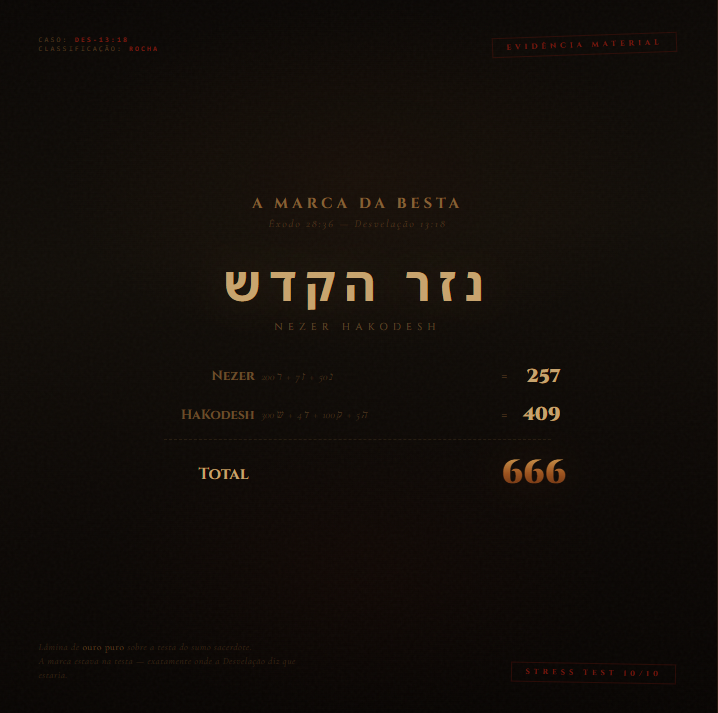
| Priestly crown | Aaron’s forehead | QODESH LAYHWH = 666 | Ex 28:36 |
| Tefillin | Israel’s forehead | Words of Yahweh (yhwh) | Deut 6:8 |
| TAV mark | Faithful’s foreheads | Letter tav (preservation) | Ezek 9:4 |
| Mark of the beast | Everyone’s forehead | Name/number of the beast | DES 13:16 |
| Prostitute’s name | Her forehead | Mysterion Babylon | DES 17:5 |
| Crown of thorns | Jesus’ forehead | Suffering, not power | John 19:2 |
The forehead is the location of identity: whom you serve is written on your forehead. Yahweh (yhwh) inscribed his name first (Ex 28:36 = 666). The Lamb inscribes the name of the true Father afterward (DES 14:1).
Easter Egg: on the same anatomical location – the forehead – Jesus receives thorns and Yahweh (yhwh) inscribes gold. The crown of Yahweh (yhwh) = gold + QODESH LAYHWH = 666 = power. The crown of Jesus = thorns + blood = sacrifice for the sheep. Two crowns. Two systems. One forehead.
Two methods of marking: external vs. internal
The forensic pattern that emerges from the tracking is binary:
The Yahweh (yhwh) system: EXTERNAL marking
| Element | Mechanism | Reference |
|---|---|---|
| Gold plate on forehead | Physical object bound | Ex 28:36-38 |
| Tefillin on hand and forehead | Physical box bound | Deut 6:8 |
| Sign on hand and between eyes | Visible physical mark | Ex 13:9,16 |
| Mark of the beast on hand/forehead | Engraving on skin | DES 13:16 |
| Circumcision in the flesh | Physical cut | Gen 17:11 |
| TAV on forehead | Physical mark | Ezek 9:4 |
Yahweh (yhwh) operates by external imposition: objects, marks, cuts, engravings. The body is the surface where the system inscribes its ownership.
The Jesus system: INTERNAL transformation
| Element | Mechanism | Reference |
|---|---|---|
| Law written on the heart | Interior transformation | Jer 31:33; Heb 8:10 |
| Circumcision of the heart | Internal, not of flesh | Rom 2:29; Deut 30:6 |
| Spirit within | Internal indwelling | Ezek 36:27; John 14:17 |
| Renewed mind | Cognitive transformation | Rom 12:2 |
| Fruit of the Spirit | Internal character manifest | Gal 5:22-23 |
Jesus operates by internal transformation: heart, mind, spirit. The mark is not on the skin – it is in the consciousness. It is not visible – it is manifest through fruit.
The distinction is forensic:
| Criterion | Yahweh (yhwh) system | Jesus system |
|---|---|---|
| Locus | Body (external) | Consciousness (internal) |
| Method | Engraving, branding, binding | Writing on the heart, renewal |
| Nature | Imposed (“makes all…”) | Voluntary (“if anyone wishes…”) |
| Function | Identifies property | Transforms identity |
| Evidence | Visible mark | Visible fruit |
| Permanence | Scar (charagma) | Life (zoe) |
Animal branding: the complete semantic field
The NT vocabulary for “mark on the body” forms a coherent semantic field – and all of it comes from the universe of cattle, slaves, and property:
| Greek term | Transliteration | Meaning | Process | NT Reference |
|---|---|---|---|---|
| charagma | charagma | Engraved/stamped mark | Seal, die, engraving | DES 13:16; Acts 17:29 |
| stigma | stigma | Mark by pricking/piercing | Tattooing, perforation | Gal 6:17 |
| kauteriazo | kauteriazo | Mark by hot iron | Cauterization | 1 Tim 4:2 |
| sphragis | sphragis | Authentication seal | Ring impression | DES 7:3; Eph 1:13 |
Each describes a different method of permanent marking. But all share the same logic: identification of ownership. The horse is branded so that its owner is known. The slave is branded so that he cannot deny who possesses him. The sheep is branded so that it does not mix with another flock.
Easter Egg: the Unveiling applies charagma to “all, small and great, rich and poor, free and slave” (DES 13:16). ANIMAL branding vocabulary applied to human beings. The mark of the beast is not technology. It is possession. You belong to someone.
3 Maccabees 2:29 – the closest historical precedent
The most important pre-NT parallel comes from 3 Maccabees, during the reign of Ptolemy IV (221-204 BC):
tous te apographomenous CHARASSESTHAI kai dia PYROS eis to SOMA parasemo Dionysou kissophyllo “Those who are registered, to be branded [charassesthai] by means of fire on the body with the emblem of Dionysus, the ivy leaf.”
The verb is charassesthai – the exact passive form of charasso, from which charagma derives. The parallel with DES 13:16-17 is structural:
| Element | 3 Maccabees 2:29 | DES 13:16-17 |
|---|---|---|
| Verb | charassesthai (to be branded) | dosin charagma (to give a mark) |
| Method | dia pyros (by fire) | Implied by semantic field |
| Location | eis to soma (on the body) | epi tes cheiros / epi to metopon |
| Symbol | Emblem of Dionysus (ivy) | Name or number of the beast |
| Coercion | Forced registration | “Makes all…” |
| Consequence | Enslavement or death | Cannot buy or sell |
Forced religious branding by fire, with the symbol of a deity, as a condition of civil participation. Those who refused: reduced to slave status or executed.
The Unveiling does not invent the concept. It already existed – and the vocabulary is the same.
Consciousness as a branding surface
The intersection of charagma with kauteriazo reveals a thesis that tradition has not explored: human consciousness is a branding surface.
The system of the beast brands the body (charagma – external, visible, institutional). But before branding the body, the system brands the consciousness (kauteriazo – internal, invisible, neurological). The seared consciousness does not feel the mark on the body. The hot iron on the mind anesthetizes the pain of the hot iron on the skin.
The forensic sequence is:
kauteriazo (seared consciousness)
    |
    v
charagma (mark on body accepted without resistance)
    |
    v
agorasai/polesai (participation in the system without questioning)
Whoever has the consciousness burned does not refuse the mark. Cannot refuse. The capacity to refuse was cauterized along with the nerve tissue of the syneidesis.
Easter Egg: 1 Tim 4:2 describes the neurological PRECONDITION for DES 13:16. The seared consciousness is step ZERO of the functional chain. Before the mark on the body comes the mark on the mind.
Jesus and the living consciousness
If kauteriazo describes a dead consciousness (cauterized, insensible, branded by iron), the system of Jesus proposes the opposite: a living consciousness.
| kauteriazo (yhwh/beast system) | Living consciousness (Jesus system) |
|---|---|
| Cauterized – insensible | Renewed – sensitive (Rom 12:2) |
| Branded by iron – permanent | Written on the heart – relational (Jer 31:33) |
| Cannot distinguish good and evil | Trained to discern (Heb 5:14) |
| Accepts the mark without resistance | Resists through transformation (Rom 12:2) |
| Belongs to the system by imposition | Belongs by choice (John 10:27) |
The Lamb does not cauterize consciousnesses. Does not brand with iron. Does not impose through the skin. The Lamb calls – and “my sheep hear my voice” (John 10:27). Identification is not by external seal but by internal recognition. The sheep does not need a brand – it knows the voice of the Shepherd.
Forensic synthesis table
| Evidence | Source | Classification |
|---|---|---|
| charagma = animal ownership mark | Anacreontea 26.2; LSJ; Thayer | LEXICAL FOUNDATION |
| charagma in NT: 8x Unveiling + 1x Acts | Nestle 1904 | INVENTORY |
| Inversion Acts 17:29 vs DES 13:16 | Semantic analysis | THESIS |
| kauteriazo = hot iron on consciousness | 1 Tim 4:2 (hapax legomenon) | INDICATION |
| Forced religious branding by fire | 3 Macc 2:29 (charassesthai dia pyros) | PROOF |
| Right hand = oath/alliance/power | ASSINATURA_FORENSE_YHWH Axis 3 | PATTERN |
| Forehead = ownership inscription surface | ASSINATURA_FORENSE_YHWH Axis 4 | PATTERN |
| Yahweh (yhwh) marks externally / Jesus transforms internally | Comparative analysis | THESIS |
| Seared consciousness = precondition of the mark | charagma x kauteriazo cross-reference | THESIS |
Conclusion
Charagma is vocabulary of ownership – of cattle, of slaves, of devotees branded by fire. Kauteriazo is the hot iron on the consciousness – the internal mark that precedes the external one. The Yahweh (yhwh) system operates by branding: objects on the forehead, engravings on the hand, circumcision in the flesh, cauterization in the mind. The system of Jesus operates by transformation: law on the heart, renewal of the mind, voice recognized from within.
The question the Unveiling asks is not “what is the mark?” – it is “whose is the mark?”
And the question kauteriazo asks is not “what happened to the consciousness?” – it is “who branded it?”
The mark on the hand says whose you are on the outside. The mark on the consciousness says whose you are on the inside. The system that needs to brand the body to identify its own does not know its own. The Shepherd who knows his sheep by voice does not need a branding iron.
“You read. And the interpretation is yours.”
Artificial form: vowels from Adonai (אֲדֹנָי → a, o, a) placed over consonants YHWH — Masoretic qere perpetuum. Medieval Latin readers merged both, producing “YeHoVaH” — a hybrid that never existed as a Hebrew word. The most accepted academic reconstruction is Yahweh /jah.ˈweh/, based on Greek transcriptions (Ιαβε — Clement of Alexandria, ~200 AD; Ιαουε — Theodoret of Cyrus, ~450 AD), abbreviated biblical forms (Yah — הַלְלוּ יָהּ), theophoric names (Yahu/Yeho — Eliyahu, Yehoshua) and Samaritan oral tradition (Yabe/Yawe). ↩︎