Public source text: WLC + Nestle 1904. Translation: Belem-2025 Bible translation.
The Missing Piece
We have already identified the seven heads as the seven founding patriarchs of the institutional system. Now, the investigation advances to the ten horns.
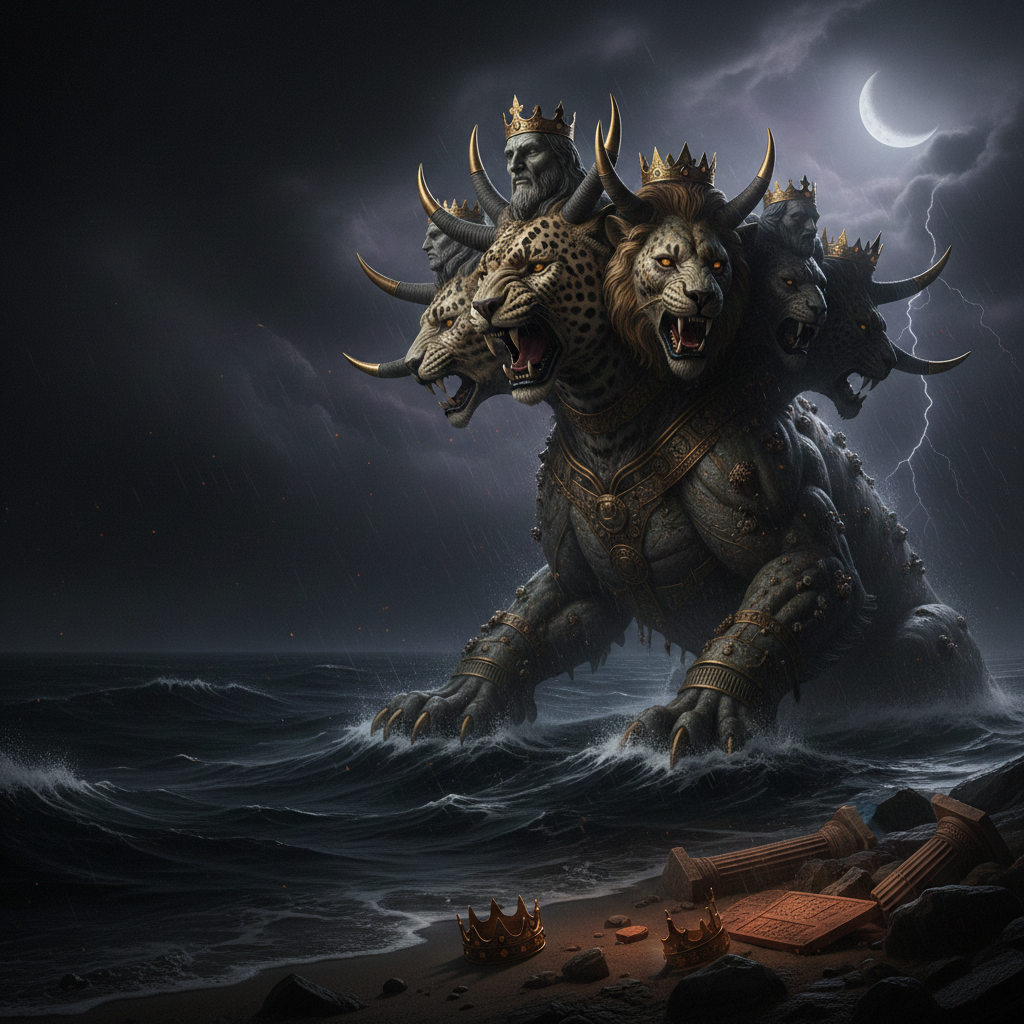
DES 13:1 describes the beast that emerges from the sea:
κέρατα δέκα καὶ ἐπὶ τῶν κεράτων αὐτοῦ δέκα διαδήματα kerata deka kai epi ton keraton autou deka diademata “Ten horns and upon its horns ten diadems (διαδήματα, diademata)”
And DES 17:12 decodes:
καὶ τὰ δέκα κέρατα ἃ εἶδες δέκα βασιλεῖς εἰσιν “And the ten horns that you saw are ten kings (βασιλεῖς)”
Ten horns. Ten diadems. Ten kings. Who are they?
The Tribal Arithmetic
Jacob had twelve sons. But the tribal count of Israel never operated with twelve simultaneous political units. The arithmetic is precise:
Levi Is EXCLUDED from the Territorial Count
Numbers 1:49 is explicit:
אַ֣ךְ אֶת־מַטֵּ֤ה לֵוִי֙ לֹ֣א תִפְקֹ֔ד akh et-matteh Levi lo tifqod “Only the tribe of Levi you shall not count”
Levi receives no territory. Does not operate as a political unit. Is separated for priestly function — it is a head (institutional pillar), not a horn (operational power).
Joseph DIVIDES into Two
Gênesis 48:5 — Jacob adopts Ephraim and Manasseh as his own sons:
אֶפְרַ֙יִם֙ וּמְנַשֶּׁ֔ה כִּרְאוּבֵ֥ן וְשִׁמְע֖וֹן יִהְיוּ־לִֽי “Ephraim and Manasseh, like Reuben and Simeon, shall be mine”
Joseph does not operate as a single tribe. He divides into two operational tribes.
The Calculation
| Operation | Result |
|---|---|
| Sons of Jacob | 12 |
| − Levi (priestly, not territorial) | −1 |
| − Joseph (divided into two) | −1 |
| + Ephraim (son of Joseph) | +1 |
| + Manasseh (son of Joseph) | +1 |
| Total territorial tribes | 12 |
| But the kingdom divides… |
The Division: 10 + 2
1 Kings 11:30-31 records the moment when the prophet Ahijah tears the garment:
וַיִּתְפֹּ֣שׂ אֲחִיָּ֗הוּ בַּשַּׂלְמָ֤ה הַחֲדָשָׁה֙ אֲשֶׁ֣ר עָלָ֔יו וַיִּקְרָעֶ֖הָ שְׁנֵ֥ים עָשָׂ֖ר קְרָעִ֑ים “And Ahijah seized the new garment that was on him and tore it into twelve pieces”
וַיֹּ֣אמֶר לְיָרָבְעָ֗ם קַח־לְךָ֙ עֲשָׂ֣רָה קְרָעִ֔ים “And he said to Jeroboam: Take for yourself ten pieces”
Twelve pieces. Ten go to Jeroboam. The ten northern tribes form their own kingdom — the Kingdom of Israel.
The Ten Horns Are the Ten Tribal Powers
| # | Tribe | Type | Role |
|---|---|---|---|
| 1 | Reuben | Horn | Firstborn, loss of precedence |
| 2 | Simeon | Horn | Absorbed by Judah |
| 3 | Dan | Horn | North, idolatry |
| 4 | Naphtali | Horn | North |
| 5 | Gad | Horn | Transjordan |
| 6 | Asher | Horn | North |
| 7 | Issachar | Horn | North |
| 8 | Zebulun | Horn | North |
| 9 | Ephraim | Horn (from Joseph) | North, capital Samaria |
| 10 | Manasseh | Horn (from Joseph) | Transjordan + North |
The ten operational tribes — the ten political powers that compose the body of the beast. They are extensions of the patriarchs (heads), now multiplied into territorial units with their own authority (diadems).
Horns with Diadems
DES 13:1 specifies that the diadems are on the horns — not on the heads. This is significant.
| Entity | Adornment | Meaning |
|---|---|---|
| Heads (patriarchs) | Names of blasphemy | Foundational authority, not political |
| Horns (tribes) | Diadems (διαδήματα) | Operational political power |
The patriarchs do not wear crowns — they are founding principles. The tribes wear diadems — they exercise executive power. The distinction between head and horn is the distinction between institutional foundation and political operation.
Easter Egg: In DES 12:3, the red Dragon has “seven diadems on its heads.” But in DES 13:1, the Beast has “ten diadems on its horns.” The transfer of diadems from the heads (Dragon) to the horns (Beast) indicates that political power migrated from the founder (Dragon/architect) to the operators (tribes). The Dragon delegates authority to the beast.
“Who Have Not Yet Received a Kingdom”
DES 17:12 adds a crucial detail:
οἵτινες βασιλείαν οὔπω ἔλαβον “Who have not yet received a kingdom”
At the time of the vision, the ten horns are potential, not actual. This is consistent with the fact that, after the Assyrian dispersion (722 BC), the ten northern tribes lost their political expression. They are latent powers — kings without a kingdom, horns without a throne.
But DES 17:12 continues:
ἀλλὰ ἐξουσίαν ὡς βασιλεῖς μίαν ὥραν λαμβάνουσιν μετὰ τοῦ θηρίου “But authority as kings for one hour they receive with the beast”
One hour. Temporary power. Exercised in conjunction with the beast. The ten tribal powers reactivate for a brief period to fulfill a specific function.
The Function of the Ten Horns
DES 17:16-17 reveals what the ten horns do:
καὶ τὰ δέκα κέρατα ἃ εἶδες καὶ τὸ θηρίον, οὗτοι μισήσουσιν τὴν πόρνην “And the ten horns that you saw and the beast, these will hate the prostitute”
The horns turn against the prostitute. The operational tribes destroy the very institution that sustains them. It is systemic self-destruction — the beast devours the prostitute.
daniel">Parallel with Daniel
Daniel 7:7 describes the fourth beast with ten horns. Tradition read them as ten gentile kingdoms. But the forensic investigation notes: Daniel is an Israelite prophet writing about the destiny of Israel. The ten horns of Daniel are the same ten of the Unveiling — the tribal powers that fragment and reconfigure throughout history.
| Daniel 7 | DES 13/17 | Correspondence |
|---|---|---|
| Fourth beast, ten horns | Beast of the Sea, ten horns | Same system |
| Little horn among the ten | Eighth that is of the seven | Power that emerges from the ten |
| Eyes and arrogant mouth | Mouth of blasphemy | Same function |
Conclusion
The ten horns are not ten futuristic gentile kingdoms. They are the ten operational tribal powers of Israel — the political extensions of the patriarchal system that the Unveiling exposes as the Beast of the Sea.
Levi does not count (it is a head, not a horn). Joseph divides into two (Ephraim and Manasseh). The result: ten territorial tribes with diadems — political power delegated by the Dragon to the beast.
The dossier of the horns is filled. Next step: Deuteronomy 33 — the verse that connects everything.
“You read. And the interpretation is yours.”