Public source text: WLC (Westminster Leningrad Codex) + Nestle 1904. Translation: Belem-2025 Bible translation — literal, rigid, straight from the public códices.
Easter Egg Classification
| Field | Value |
|---|---|
| Type | Twin Theme |
| Score | 70/100 |
| Key terms | κόκκινος (kokkinos), αἷμα (haima), μεθύω (methyo) |
| Central text | DES 17:3-6 |
The evidence: three elements, one crime scene
In crime scene analysis, the forensic expert does not examine isolated elements. They seek convergences — points where multiple pieces of evidence meet at the same location. A red stain alone could be paint. An empty bottle alone could be trash. A body alone could be a natural death. But the three together, in the same room, tell a different story.
DES 17 concentrates three Greek terms that, together, form an inseparable forensic unit.
The three elements
1. Κόκκινος (kokkinos) — Scarlet: the color
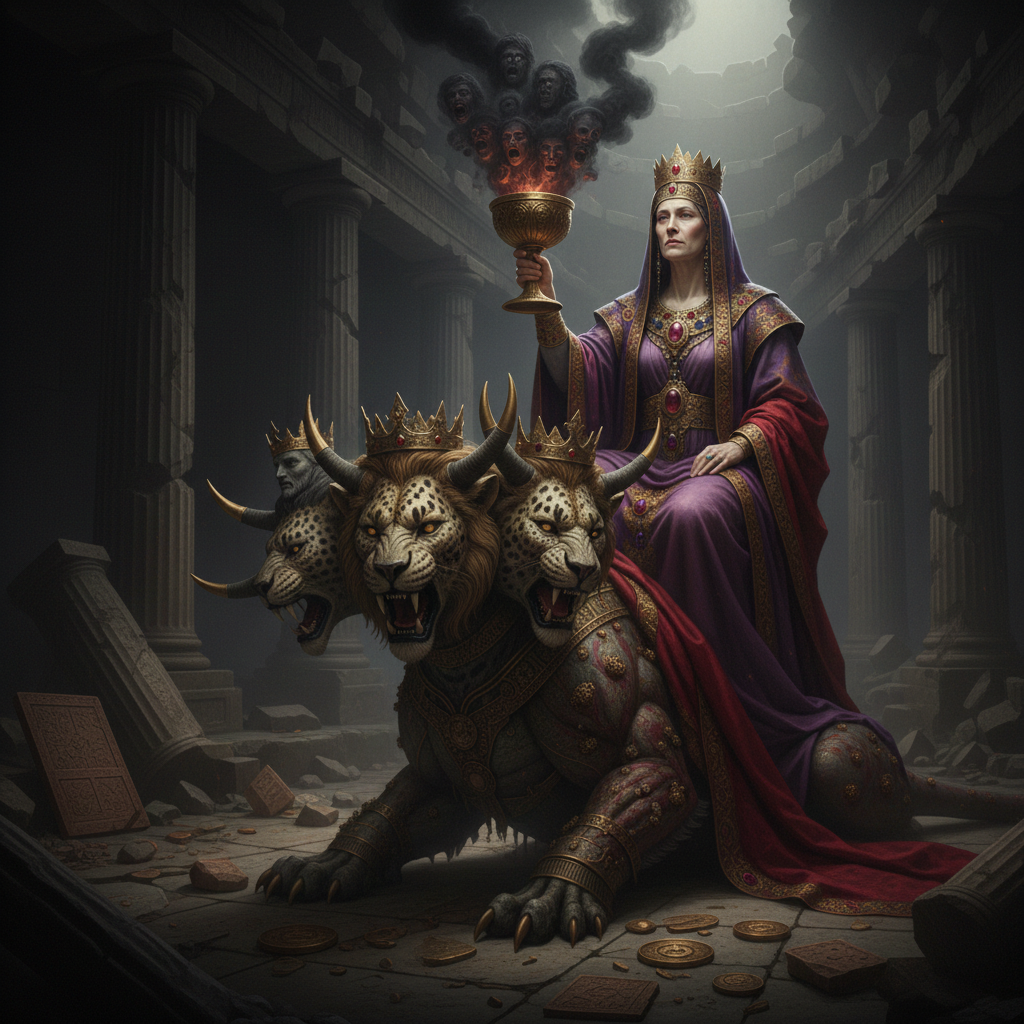
DES 17:3 — “And I saw a woman seated upon a scarlet beast (κόκκινον), full of names of blasphemy…”
DES 17:4 — “And the woman was clothed in purple and scarlet (κόκκινον)…”
The Prostitute is surrounded by scarlet. Her mount is scarlet. Her clothing is scarlet. The color is not an accessory — it is environment. She exists within a red chromatic field.
2. Αἷμα (haima) — Blood: the element
DES 17:6 — “And I saw the woman drunk with the blood (αἵματος) of the saints and with the blood (αἵματος) of the witnesses of Jesus.”
Blood appears twice in the same verse — a repetition that in Greek functions as emphasis. It is not generic blood. It is blood of the saints (ἁγίων, hagion) and of the witnesses (μαρτύρων, martyron) of Jesus.
3. Μεθύω (methyo) — To become drunk: the state
DES 17:6 — “And I saw the woman drunk (μεθύουσαν) with the blood of the saints…”
The participle μεθύουσαν (methyousan) describes a continuous state. The Prostitute did not drink once — she is in a state of drunkenness. The participial form indicates ongoing action: she continues drinking.
The chromatic convergence
| Element | Greek | Forensic function | Verse |
|---|---|---|---|
| COLOR | κόκκινος (kokkinos) | The visible stain | DES 17:3-4 |
| SUBSTANCE | αἷμα (haima) | The biological fluid | DES 17:6 |
| STATE | μεθύω (methyo) | The condition of the subject | DES 17:6 |
The color of the garment = the color of the blood = the color of the drunkenness.
It is not decoration. It is contamination. The Prostitute is literally stained by the blood of those she killed. The scarlet of the garment and the scarlet of the blood are indistinguishable. She wears the evidence of the crime.
The echo in the LXX: Isaiah 1:18
The Septuagint (LXX) of Isaiah 1:18 uses the same term:
“If your sins are like scarlet (κόκκινα), I will make them white as snow…”
Same adjective. Κόκκινα in Isaiah = visible sin, a stain that needs to be removed. Κόκκινον in DES 17 = the garment the Prostitute wears with ostentation.
| Text | Term | Context |
|---|---|---|
| Isaiah 1:18 (LXX) | κόκκινα | Sin that Θεός promises to cleanse |
| DES 17:3-4 | κόκκινον | Garment the Prostitute displays |
What Θεός promises to remove in Isaiah, the Prostitute wears as an insignia in the Unveiling. The color of sin becomes a gala uniform.
The victim identified: μαρτύρων
The blood is not anonymous. DES 17:6 identifies the source: μαρτύρων Ἰησοῦ — “witnesses of Jesus” (genitive plural).
The noun μάρτυς (martys) in first-century Greek meant witness — someone who declares what they saw. Only later did it acquire the meaning of “martyr” (one who dies for their faith). But the Unveiling already operates in the semantic transition: the witnesses of Jesus are the ones who were killed.
EASTER EGG: The trio κόκκινος + αἷμα + μεθύω forms an inseparable chromatic unit. The color of the garment = the color of the blood = the color of sin (Isaiah 1:18 LXX). The system that wears scarlet is literally stained by the blood of its victims.
The dynamics of the trio
| |
The system:
- Appears as luxury (scarlet as garment)
- Produces death (blood of the saints)
- Desires more (continuous drunkenness)
The triad is not static. It is a cycle: the appearance of power requires more blood, which feeds the drunkenness, which sustains the appearance.
Rarity score
| Criterion | Score |
|---|---|
| Convergence of 3 terms in the same text | 16/20 |
| Lexical echo with the LXX (Isaiah 1:18) | 14/20 |
| Chromatic unity (color = substance = state) | 14/20 |
| Identification of the victim (μαρτύρων) | 14/20 |
| Exclusivity of the pattern | 12/20 |
| TOTAL | 70/100 |
The forensic question
If scarlet is the color of sin in Isaiah, and the Prostitute wears scarlet as an insignia of power, and that scarlet is indistinguishable from the blood of the witnesses of Jesus — then what is the difference between the garment and the evidence?
At a crime scene, when the suspect’s clothing is stained with the victim’s blood, the clothing is the proof.
The Prostitute wears the proof. The forensic expert photographs. The reader analyzes.
“You read. And the interpretation is yours.”