Public source text: WLC + Nestle 1904. Translation: Belem-2025 Bible translation – literal, rigid, straight from public códices.
Dossier: BEAST OF THE SEA (τὸ θηρίον ἐκ τῆς θαλάσσης)
Status: CONSOLIDATED Cataloged evidence: 20 (12 PROOFS + 3 AXIOMS + 5 THESES) Stress test: 11/11 passed Classification: Secondary entity — receives power from the Dragon
Notice to the Reader
This dossier presents conclusions that contradict centuries of tradition. The proposed identification does not arise from speculation, but from direct textual correspondence between DES 13:1-10 and passages from the Hebrew corpus where Yahweh (יהוה — yhwh; trad. “Jehovah”1) describes himself. The investigator presents the evidence. The reader evaluates.
The Beast — Complete Profile
DES 13:1-2 presents the most detailed profile of any beast in the Unveiling:
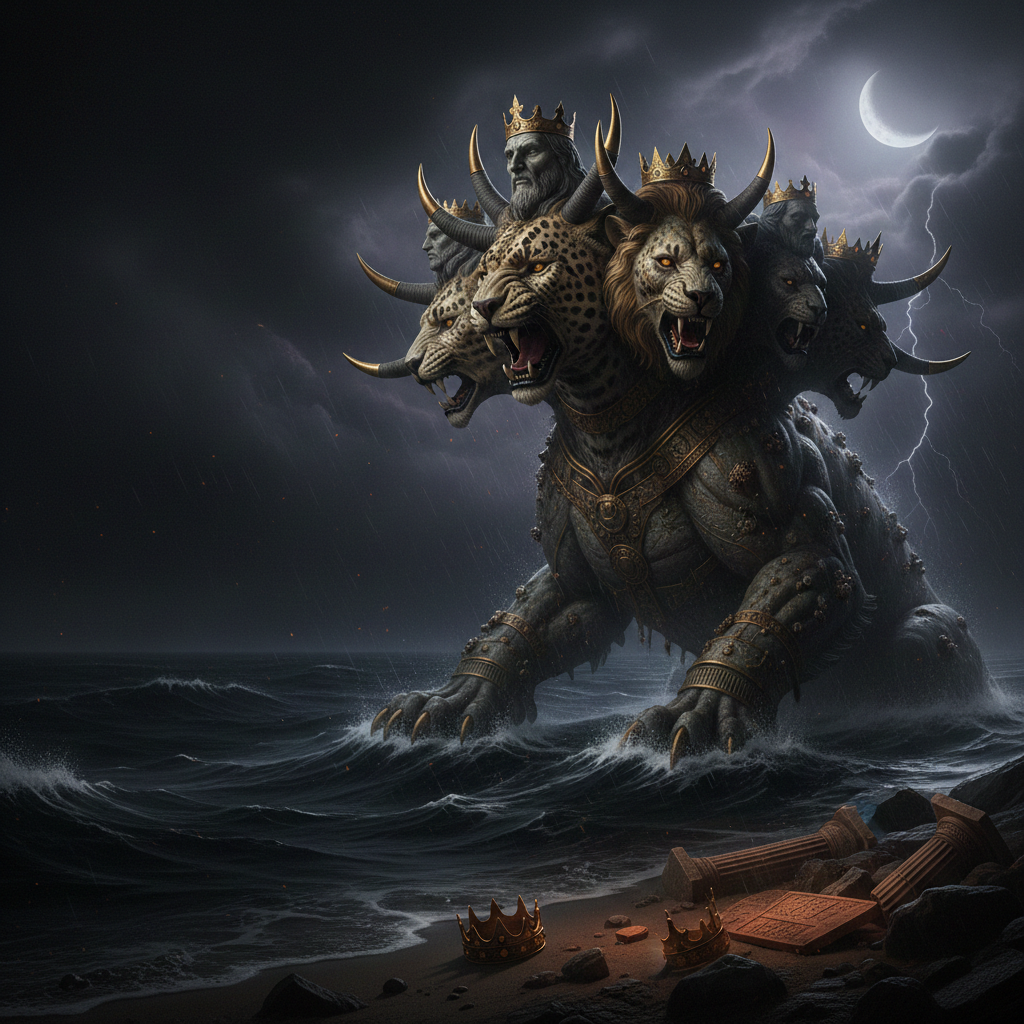
καὶ εἶδον ἐκ τῆς θαλάσσης θηρίον ἀναβαῖνον, ἔχον κέρατα δέκα καὶ κεφαλὰς ἑπτά, καὶ ἐπὶ τῶν κεράτων αὐτοῦ δέκα διαδήματα, καὶ ἐπὶ τὰς κεφαλὰς αὐτοῦ ὀνόματα βλασφημίας. καὶ τὸ θηρίον ὃ εἶδον ἦν ὅμοιον παρδάλει, καὶ οἱ πόδες αὐτοῦ ὡς ἄρκου, καὶ τὸ στόμα αὐτοῦ ὡς στόμα λέοντος.
“And I saw from the sea a beast rising, having ten horns and seven heads, and upon its horns ten diadems, and upon its heads names of blasphemy. And the beast that I saw was like a leopard (πάρδαλις, pardalis), and its feet like those of a bear (ἄρκος, arkos), and its mouth like the mouth of a lion (λέων, leon).”
| Element | Value | Function |
|---|---|---|
| Origin | Sea (θάλασσα, thalassa) | Institutional-historical domain |
| Heads | 7 | Patriarchal lineage |
| Horns | 10 | Tribal kingdoms |
| Crowns | 10 diadems (on the horns) | Distributed sovereignty |
| Composition | Leopard + Bear + Lion | Self-description of Yahweh (yhwh) (Hosea 13) |
Central Evidence: The Sea as Birthplace of Yahweh (yhwh)
The first forensic question is: why the sea?
Tradition reads “sea” as a generic symbol for “nations” or “primordial chaos.” But the Hebrew text offers a precise correspondence.
Exodus 14:30-31:
וַיּוֹשַׁע יְהוָה בַּיּוֹם הַהוּא אֶת־יִשְׂרָאֵל מִיַּד מִצְרָיִם וַיַּרְא יִשְׂרָאֵל אֶת־מִצְרַיִם מֵת עַל־שְׂפַת הַיָּם׃ וַיַּרְא יִשְׂרָאֵל אֶת־הַיָּד הַגְּדֹלָה… וַיִּירְאוּ הָעָם אֶת־יְהוָה וַיַּאֲמִינוּ בַּיהוָה
“And Yahweh (yhwh) saved Israel on that day from the hand of Egypt, and Israel saw Egypt dead upon the shore of the sea (יָם, yam). And Israel saw the great hand… and the people feared Yahweh (yhwh) and believed in Yahweh (yhwh).”
The institutional worship of Yahweh (yhwh) is born at the shore of the sea. Israel begins to believe in Yahweh (yhwh) as a result of a maritime event. The Yahweh (yhwh) system rises from the sea — literally.
The Beast rises from the sea (DES 13:1). Yahweh (yhwh) establishes himself as an object of worship from the sea (EXO 14:31). The topographic correspondence is direct.
Easter Egg #13: The sea of DES 13:1 is not an allegory for nations. It is the יָם סוּף (Yam Suf, Sea of Reeds) of the Exodus. The beast rises from the same sea where Yahweh (yhwh) first revealed himself as worthy of institutional worship.
The Seven Heads — Patriarchal Lineage
If the Beast of the Sea is the Yahweh (yhwh) system, its seven heads must correspond to the patriarchal lineage that sustains this system. The investigation identifies:
| Head | Patriarch | Function in the System | Textual Basis |
|---|---|---|---|
| 1st | Abraham (אַבְרָהָם) | Founder of the covenant | Gen 12, 15, 17 |
| 2nd | Isaac (יִצְחָק) | Continuator of the promise | Gen 26 |
| 3rd | Jacob/Israel (יַעֲקֹב) | Generator of the 12 tribes | Gen 32, 35 |
| 4th | Levi (לֵוִי) | Priestly lineage | Num 3, 18 |
| 5th | Judah (יְהוּדָה) | Royal/Davidic lineage | Gen 49:10, 2 Sam 7 |
| 6th | Joseph (יוֹסֵף) | The wounded/restored head | Gen 37-41 |
| 7th | Moses (מֹשֶׁה) | Legislator/mediator | Ex 3-Dt 34 |
The Wounded Head — Joseph
DES 13:3 records:
μίαν ἐκ τῶν κεφαλῶν αὐτοῦ ὡς ἐσφαγμένην εἰς θάνατον, καὶ ἡ πληγὴ τοῦ θανάτου αὐτοῦ ἐθεραπεύθη
“One of its heads as having been slaughtered to death, and the wound of its death was healed”
ὡς ἐσφαγμένην (hos esphagmenen) — “as having been slaughtered.” The perfect passive participle indicates a resultant state from a past action. The head was given as dead, but did not actually die.
Joseph corresponds precisely:
| Element DES 13:3 | Correspondence in Joseph |
|---|---|
| “As slaughtered to death” | Sold as a slave, presumed dead by his father (Gen 37:33) |
| “The wound was healed” | Elevated to viceroy of Egypt (Gen 41:41-43) |
| “All the earth marveled” | Everyone bows before Joseph (Gen 42:6) |
Joseph’s head is given as dead (sold, presumed dead by Jacob) and then restored (made ruler of Egypt). It is a “mortal wound” healed — exactly as DES 13:3 describes.
No other patriarch has such an explicit apparent-death/restoration cycle.
The Ten Horns — Tribal Kingdoms
DES 13:1 attributes ten horns to the Beast of the Sea. 1 Kings 11:31 provides the correspondence:
וַיֹּאמֶר לְיָרָבְעָם קַח־לְךָ עֲשָׂרָה קְרָעִים כִּי כֹה אָמַר יְהוָה… הִנְנִי קֹרֵעַ אֶת־הַמַּמְלָכָה מִיַּד שְׁלֹמֹה וְנָתַתִּי לְךָ אֵת עֲשָׂרָה הַשְּׁבָטִים
“And he said to Jeroboam: take for yourself ten pieces, for thus says yhwh… behold I am tearing the kingdom from the hand of Solomon and giving to you the ten tribes.”
Ten tribes. Ten horns. Ten kingdoms. The numerical correspondence is exact. The horns of the Beast of the Sea are the tribal kingdoms of Israel — the political apparatus of the Yahweh (yhwh) system.
The Tripartite Composition — Hosea 13:7-8
The most devastating evidence is the animal composition of the beast. DES 13:2 describes: leopard, bear, lion. Hosea 13:7-8 records Yahweh (yhwh) speaking in the first person:
וָאֱהִי לָהֶם כְּמוֹ שָׁחַל עַל־דֶּרֶךְ כְּנָמֵר אָשׁוּר׃ אֶפְגְּשֵׁם כְּדֹב שַׁכּוּל וְאֶקְרַע סְגוֹר לִבָּם וְאֹכְלֵם שָׁם כְּלָבִיא
“And I am to them like a lion; on the road like a leopard (נָמֵר, namer) I will lurk. I will meet them like a bear (דֹּב, dov) deprived of cubs, and I will tear the enclosure of their heart, and devour them there like a lioness (לָבִיא, lavi).”
| Animal DES 13:2 | Greek | Animal Hosea 13:7-8 | Hebrew | Speaker |
|---|---|---|---|---|
| Leopard | πάρδαλις (pardalis) | Leopard | נָמֵר (namer) | Yahweh (yhwh) |
| Bear | ἄρκος (arkos) | Bear | דֹּב (dov) | Yahweh (yhwh) |
| Lion | λέων (leon) | Lioness/Lion | לָבִיא (lavi) | Yahweh (yhwh) |
Three animals. Same combination. In Hosea, it is Yahweh (yhwh) speaking about himself. In the Unveiling, it is the description of the Beast of the Sea.
No other entity in the 66 canonical books describes itself simultaneously as leopard, bear and lion. Only yhwh. The correspondence is exclusive.
Easter Egg #13b: Tradition needs three empires (Babylon, Persia, Greece — imported from Daniel 7) to explain the three animals. Yahweh (yhwh) needs one verse. The complexity is not in the text — it is in the refusal to read it within its own corpus.
The Delegation — Received Power
DES 13:2b is the verse that redefines everything:
καὶ ἔδωκεν αὐτῷ ὁ δράκων τὴν δύναμιν αὐτοῦ καὶ τὸν θρόνον αὐτοῦ καὶ ἐξουσίαν μεγάλην
“And the dragon gave it his power, and his throne, and great authority.”
The Beast of the Sea operates with delegated power. Yahweh (yhwh), in this investigation, is not the ultimate source — he is an operator with authority received from the Dragon (Satan).
The complete hierarchical chain:
Dragon (Satan)
  └── delegates power, throne, authority
        └── Beast of the Sea (yhwh / patriarchal system)
              └── operates through Israel
                    └── produces the religious system (Judaism)
Stress Test — 11 Criteria
The identification Beast of the Sea = Yahweh (yhwh) was submitted to 11 validation criteria:
| # | Criterion | Result |
|---|---|---|
| 1 | Coherent origin (sea = Exodus) | PASSED |
| 2 | 7 heads = patriarchal lineage | PASSED |
| 3 | 10 horns = 10 tribes | PASSED |
| 4 | Wounded head = Joseph | PASSED |
| 5 | Tripartite composition = Hosea 13 | PASSED |
| 6 | Received power (DES 13:2) | PASSED |
| 7 | Blasphemy on the heads (divine claim) | PASSED |
| 8 | Universal worship (DES 13:4) | PASSED |
| 9 | Duration of 42 months (DES 13:5) | PASSED |
| 10 | War against the saints (DES 13:7) | PASSED |
| 11 | Destiny in the lake of fire (DES 19:20) | PASSED |
11/11 criteria passed. No textual contradiction identified.
The Question Tradition Never Asks
Tradition identifies the Beast of the Sea with Rome, with the future Antichrist, with secular empires. But it never asks: who, in the 66 canonical books, describes himself simultaneously as leopard, bear and lion?
Only yhwh. In Hosea 13:7-8.
Tradition never asks: where, in the 66 books, does an entity emerge from the sea and become an object of institutional worship?
Only yhwh. At the Sea of Reeds, Exodus 14.
Tradition never asks: who has exactly 7 founding patriarchs and 10 tribal kingdoms?
Only Israel — the system of yhwh.
The questions were never asked because the answers are uncomfortable. But forensic investigation is not guided by comfort — it is guided by textual correspondence.
Dossier Conclusion
The Beast of the Sea is the institutional system of Yahweh (yhwh), born at the event of the Sea of Reeds, sustained by seven patriarchs, operating through ten tribal kingdoms, composed of the same three animals that Yahweh (yhwh) uses to describe himself. It operates with power, throne and authority delegated by the Dragon.
This identification is not speculation. It is verifiable textual correspondence. Each element of the Beast of the Sea’s profile finds a direct and exclusive parallel in the Hebrew corpus concerning yhwh.
The dossier is consolidated. The evidence, cataloged. The reader decides.
“You read. And the interpretation is yours.”
Artificial form: vowels from Adonai (אֲדֹנָי → a, o, a) placed over consonants YHWH — Masoretic qere perpetuum. Medieval Latin readers merged both, producing “YeHoVaH” — a hybrid that never existed as a Hebrew word. The most accepted academic reconstruction is Yahweh /jah.ˈweh/, based on Greek transcriptions (Ιαβε — Clement of Alexandria, ~200 AD; Ιαουε — Theodoret of Cyrus, ~450 AD), abbreviated biblical forms (Yah — הַלְלוּ יָהּ), theophoric names (Yahu/Yeho — Eliyahu, Yehoshua) and Samaritan oral tradition (Yabe/Yawe). ↩︎