Public source text: WLC (Westminster Leningrad Codex) + Nestle 1904. Translation: Belem-2025 Bible translation — literal, rigid, directly from the public códices.
Exclusive source: Scarlet Beast Dossier + Enigmatic Elements Catalog (Forensic Unveiling School Belem an.C-2039).
Stress test protocol
A stress test does not confirm theses. It tries to destroy them. The thesis that survives interrogation is not necessarily true — but it is the most resistant among the alternatives.
The thesis under examination: The Scarlet Beast (therion kokkinon) of UNV 17 is yhwh.
Method: 6 critical questions. Each question receives evidence FOR and AGAINST the thesis. Each receives a resistance score. At the end, a scorecard consolidates the result.
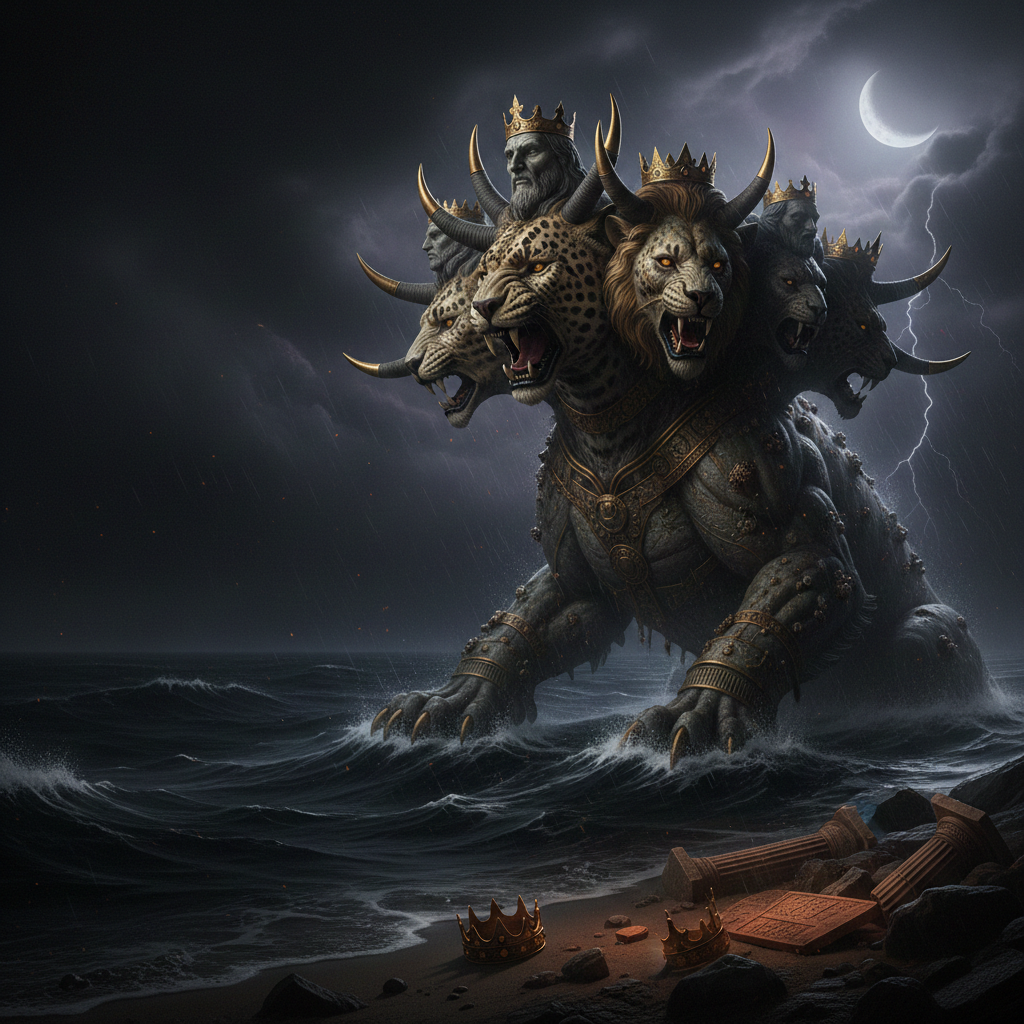
Profile of the Scarlet Beast — UNV 17:3-8
kai eidon gynaika kathemenen epi therion kokkinon, gemonta onomata blasphemias, echon kephalas hepta kai kerata deka.
“And I saw a woman sitting upon a scarlet beast (therion kokkinon), full of names of blasphemy, having seven heads and ten horns.”
Scarlet Beast file
| Attribute | Greek text | Reference |
|---|---|---|
| Color | kokkinon — scarlet | UNV 17:3 |
| Names | gemonta onomata blasphemias — full of names of blasphemy | UNV 17:3 |
| Heads | kephalas hepta — 7 heads | UNV 17:3 |
| Horns | kerata deka — 10 horns | UNV 17:3 |
| Temporal formula | en kai ouk estin kai mellei anabainein ek tes abyssou — “was and is not and is about to ascend from the abyss” | UNV 17:8 |
| Rider | The Harlot (he porne) sitting upon it | UNV 17:1-3 |
| Destiny | eis apoleian hypagei — “goes to perdition” | UNV 17:8 |
The Harlot who rides — UNV 17:4
kai he gyne en peribeblemene porphyroun kai kokkinon, kai kechrysomene chrysio kai litho timio kai margaritais, echousa poterion chrysoun en te cheiri autes gemon bdelygmaton
“And the woman was clothed in purple (porphyroun) and scarlet (kokkinon), and gilded with gold and precious stone and pearls, holding a golden cup in her hand full of abominations (bdelygmaton).”
Critical connection: porphyroun — the same priestly purple that appears in the robe of mockery placed on Jesus (Jn 19:2,5). See Easter Egg: Purple.
QUESTION 1 — Why is the color different from the Sea Beast?
The problem
The Sea Beast (UNV 13:1) has no specified color. The Scarlet Beast (UNV 17:3) is kokkinon — scarlet, blood-red. If both are Yahweh (יהוה — yhwh; trad. “Jehovah”1), why the chromatic change?
FOR the thesis (yhwh = Scarlet Beast)
Acquired color thesis: kokkinon is not the beast’s natural color — it is an acquired color. Scarlet is the color of blood. Yahweh (yhwh) as a patriarchal system accumulated blood throughout the entire Old Testament narrative.
AXIOM E-DR-051 documents ~2.8 million deaths attributed to or ordered by Yahweh (yhwh) in the Hebrew corpus. The beast that in UNV 13 had no color, in UNV 17 is drenched in accumulated blood.
Direct parallel: UNV 17:6 confirms:
kai eidon ten gynaika methyousan ek tou haimatos ton hagion kai ek tou haimatos ton martyron Iesou
“And I saw the woman drunk from the blood of the saints and from the blood of the witnesses of Jesus.”
Blood is everywhere in the scene: on the beast, on the woman, in the cup.
AGAINST the thesis
The Scarlet Beast may be a different entity from the Sea Beast. Previous School articles identified the Scarlet Beast with the Dragon being ridden (The Scarlet Beast — The Dragon Ridden by the Harlot). The color kokkinon also connects to the Dragon’s pyrrhos (UNV 12:3 — drakon megas pyrros, “great fiery-red dragon”).
Score
| Criterion | Assessment |
|---|---|
| Greek text supports acquired color? | Plausible — text does not explain the color |
| Parallel with accumulated blood? | Strong — UNV 17:6 confirms blood-drunkenness |
| Alternative (Dragon) is simpler? | Yes — pyrrhos to kokkinon is a direct chromatic transition |
| Score Q1 | 6/10 — sustainable, but the Dragon alternative is more economical |
QUESTION 2 — The 7 heads = 7 mountains AND 7 kings. How do mountains = kings?
The text
UNV 17:9-10 — hai hepta kephalai hepta ore eisin, hopou he gyne kathetai ep’ auton. kai basileis hepta eisin; hoi pente epesan, ho heis estin, ho allos oupo elthen
“The seven heads are seven mountains (ore) where the woman sits upon them. And they are seven kings (basileis): five have fallen, the one exists, the other has not yet come.”
FOR the thesis
Patriarchal thesis: If Yahweh (yhwh) = Sea Beast, the 7 heads = 7 patriarchs (documented in Seven Patriarchs — Heads of the Beast). “Mountains” is an Old Testament metaphor for permanent power/authority (cf. Ps 125:1, Is 2:2, Jer 51:25). Each patriarch is a “mountain” — an era of foundational dominion.
The chronology “5 have fallen, 1 exists, 1 has not yet come” corresponds to:
| Position | Patriarch | Status |
|---|---|---|
| 1 (fallen) | Abraham | Died |
| 2 (fallen) | Isaac | Died |
| 3 (fallen) | Jacob | Died |
| 4 (fallen) | Joseph | Died |
| 5 (fallen) | Moses | Died |
| 6 (exists) | Aaron | Present in the priestly system |
| 7 (not yet come) | The corrupted messianic system | Future |
AGAINST the thesis
The traditional interpretation identifies the 7 mountains as Rome (city of seven hills). The 7 kings as Roman emperors. This reading does not require Yahweh (yhwh) — it requires only the Roman Empire.
Additional problem: the patriarchal sequence is a reconstruction by the School. The text does not name the kings. Any scheme of 7 names is a hypothesis — including the patriarchal one.
Score
| Criterion | Assessment |
|---|---|
| Metaphor mountain = authority in the OT? | Strong — multiple occurrences |
| Patriarchal chronology fits “5+1+1”? | Fits, but depends on the choice of names |
| Alternative (Rome) is viable? | Yes — historically established |
| Score Q2 | 5/10 — both readings are possible; neither is conclusive |
QUESTION 3 — “Was, is not, and is about to ascend” — why the interruption?
The text
UNV 17:8 — to therion ho eides en kai ouk estin, kai mellei anabainein ek tes abyssou
“The beast that you saw was (en) and is not (ouk estin) and is about to ascend (mellei anabainein) from the abyss (abyssou).”
This is the inversion of the divine formula of UNV 1:4 — “The one who IS (ho on) and who WAS (ho en) and who COMES (ho erchomenos).” See Easter Egg: The Inverted Formula (Score 85/100).
FOR the thesis
Christological interruption thesis: If Yahweh (yhwh) = Scarlet Beast:
- “Was” (en) — Yahweh (yhwh) as a system operated throughout the entire OT.
- “Is not” (ouk estin) — the ministry of Jesus interrupted the system. The cross delegitimized the priesthood, the temple, the sacrificial system. The veil was torn (Mt 27:51). Yahweh (yhwh) as a system “ceased to be” — not destroyed, but deauthorized.
- “Is about to ascend from the abyss” (mellei anabainein ek tes abyssou) — the system resurges. Institutional religion rebuilds what Jesus destroyed.
The triple formula describes the lifecycle of a system: operated, was interrupted, will return.
AGAINST the thesis
If the Scarlet Beast = Dragon (as argued in a previous School article), the formula “was and is not” may describe the fall and resurgence of hasatan/the accuser. The interruption would be the defeat in heaven (UNV 12:9), not the ministry of Jesus.
Another objection: Yahweh (yhwh) never “ceased to exist” — even after the cross, the Jewish priestly system continued operating until 70 AD. The interruption is not absolute.
Score
| Criterion | Assessment |
|---|---|
| Inverted formula connects the beasts? | Strong — Easter Egg score 85/100 |
| Christological interruption is textually sustainable? | Partial — “is not” implies cessation, not deauthorization |
| Alternative (Dragon) explains better? | Equally plausible |
| Score Q3 | 6/10 — the thesis holds, but the Dragon alternative is not eliminated |
QUESTION 4 — The 10 horns = 10 kings who “have not yet received a kingdom.” Who are they?
The text
UNV 17:12 — kai ta deka kerata ha eides deka basileis eisin, hoitines basileian oupo elabon, all’ exousian hos basileis mian horan lambanousin meta tou theriou
“And the ten horns that you saw are ten kings (basileis), who have not yet received a kingdom (oupo elabon), but receive authority as kings for one hour with the beast.”
FOR the thesis
Tribal hypothesis: If Yahweh (yhwh) = Sea Beast and the heads = patriarchs, the 10 horns = 10 tribes of Israel (excluding Levi and Joseph, replaced by Ephraim and Manasseh — documented in Ten Horns — Tribes of Israel).
The “have not yet received a kingdom” is explained: the tribes received territory (Joshua), not kingdom in the full sense (basileia). They operated as a tribal federation, not as a monarchy. The “one hour with the beast” indicates temporary and derived authority.
Commandments hypothesis: Open alternative — the 10 horns as the 10 commandments functioning as an authority system. Not as moral law, but as an instrument of Yahweh (yhwh)’s institutional power.
Institutional hypothesis: 10 future powers that instrumentalize the religious system.
AGAINST the thesis
The text says “have not yet received” (oupo elabon) — this implies future for the observer. If the tribes already existed in the OT, how can they “not yet have received”?
The futurist reading is more natural: 10 future political/religious entities that ally with the beast for a brief period.
Score
| Criterion | Assessment |
|---|---|
| Tribal hypothesis coherent? | Partial — tension with “have not yet received” |
| Text allows multiple readings? | Yes — three open hypotheses |
| Does the Yahweh (yhwh) thesis depend on this question? | No — beast identification does not require solving the horns |
| Score Q4 | 4/10 — open question; no hypothesis dominates |
QUESTION 5 — The 10 horns will hate the Harlot and destroy her. Internal rebellion?
The text
UNV 17:16 — kai ta deka kerata ha eides kai to therion, houtoi misesousin ten pornen, kai eremomenen poiesousin auten kai gymnen, kai tas sarkas autes phagontai, kai auten katakausousin en pyri
“And the ten horns that you saw AND THE BEAST, these will hate (misesousin) the harlot, and will make her desolate and naked, and will devour her flesh, and will burn her with fire.”
FOR the thesis
Secular rebellion thesis: If the Harlot = the institutional religious system that rides upon Yahweh (yhwh) (the beast), then UNV 17:16 describes the moment when secular powers revolt against organized religion.
The historical pattern exists: secularization, reforms, revolutions that overthrew institutional religious power. The “horns” (derived powers) eventually destroy the “rider” (the religious system that mounted them).
Forensic detail: the text says that the beast also participates in the destruction. The horns AND the beast hate the harlot. The mount revolts against the rider.
AGAINST the thesis
If the Scarlet Beast = Dragon, the reading changes: the Dragon + allied powers destroy false religion as part of a larger plan. It is not internal rebellion — it is the Dragon discarding a used instrument.
Furthermore: if Yahweh (yhwh) = beast, why would Yahweh (yhwh) destroy the very religious system that operates in his name? Self-destruction raises a logical problem.
Score
| Criterion | Assessment |
|---|---|
| Text confirms beast + horns vs. harlot? | Yes — explicit in UNV 17:16 |
| Internal rebellion coherent with Yahweh (yhwh) thesis? | Partial — self-destruction is paradoxical |
| Alternative (Dragon discards instrument) is cleaner? | Yes — avoids the paradox |
| Score Q5 | 5/10 — sustainable with caveats; alternative is more elegant |
theos-put-in-their-hearts--which-theos">QUESTION 6 — “Theos put in their hearts” — WHICH Theos?
The text
UNV 17:17 — ho gar theos edoken eis tas kardias auton poiesai ten gnomen autou
“For Theos (ho theos) gave into their hearts to execute his purpose (gnomen).”
FOR the thesis
Theos ambiguity thesis: The text says Theos (theos), not yhwh. In the Unveiling School, Theos is a generic designation — it may refer to the Father (El Elyon), to Jesus, or even to the god of the system (yhwh).
If Theos here = the Father (El Elyon / true God), then UNV 17:17 reveals: the Father orchestrates the destruction of the false religious system. He places in the hearts of the secular powers (10 horns) the desire to destroy the Harlot. The dismantling is not accident — it is divine purpose.
This radically separates Theos (who orchestrates) from Yahweh (yhwh) (who is the beast being dismantled). The question “which Theos?” is the most critical question of UNV 17.
See Theos — Who Is He Really? for the complete ambiguity mapping.
AGAINST the thesis
In the traditional reading, Theos = Yahweh (yhwh) = God. There is no ambiguity: God sovereignly uses political powers to destroy Babylon. The separation Theos vs. Yahweh (yhwh) depends on the School’s axiom — without it, the question does not exist.
Furthermore: if Theos = Father and Yahweh (yhwh) = beast, the text would need to distinguish explicitly. It does not. The separation is inferred, not declared.
Score
| Criterion | Assessment |
|---|---|
| Text uses Theos, not Yahweh (yhwh)? | Yes — verifiable textual fact |
| Does the School document Theos ambiguity? | Yes — dedicated dossier |
| Is the Theos/yhwh separation explicit in the text? | No — it is inferred by the axiom |
| Score Q6 | 7/10 — the question is legitimate and the textual datum is solid, but the conclusion depends on the framework |
Consolidated scorecard
| # | Question | Score | Verdict |
|---|---|---|---|
| Q1 | Why scarlet? | 6/10 | Acquired color is plausible, but Dragon alternative is more economical |
| Q2 | Mountains = kings? | 5/10 | Both readings (patriarchal and imperial) are possible |
| Q3 | Was, is not, about to ascend? | 6/10 | Christological interruption works, Dragon alternative also |
| Q4 | 10 kings without kingdom? | 4/10 | Open question — three hypotheses, none conclusive |
| Q5 | Internal rebellion? | 5/10 | Self-destruction paradox weakens the thesis |
| Q6 | Which Theos? | 7/10 | Strong textual datum, but depends on the axiom |
| AVERAGE | 5.5/10 | THESIS SUSTAINABLE, NOT CONCLUSIVE |
Comparative table — three identity hypotheses
| UNV 17 Attribute | Hypothesis 1: Yahweh (yhwh) | Hypothesis 2: Dragon | Hypothesis 3: Babylon/Rome |
|---|---|---|---|
| Kokkinon color | Accumulated blood (~2.8M) | Transition from pyrrhos (UNV 12:3) | Imperial luxury |
| 7 heads = 7 kings | 7 patriarchs | 7 forms of manifestation | 7 Roman emperors |
| “Was and is not” | OT/interruption/resurgence | Celestial fall/defeat/return | Empire fell/will fall |
| Harlot rides | Religion upon Yahweh (yhwh) | Religion upon the Dragon | Rome upon political power |
| 10 horns destroy harlot | Secular vs. religious | Dragon discards instrument | Provinces vs. Rome |
| Theos orchestrates | Father dismantles Yahweh (yhwh) | Father dismantles Dragon | God dismantles Rome |
What this stress test reveals
The thesis Yahweh (yhwh) = Scarlet Beast is NOT refuted — but neither is it confirmed in a dominant way. Score 5.5/10 means: survives interrogation, but does not eliminate the alternatives.
The strongest question is Q6 (Which Theos?) — the textual separation between Theos and Yahweh (yhwh) is a verifiable datum that no traditional reading addresses.
The weakest question is Q4 (10 kings without kingdom) — no hypothesis satisfactorily explains the “have not yet received.”
The Dragon thesis competes directly on nearly every question, especially Q1 (chromatic transition) and Q5 (instrument disposal vs. self-destruction).
The Harlot is the critical link. Regardless of who the beast is, the woman clothed in porphyroun (priestly purple) and kokkinon (blood-scarlet), holding a cup of bdelygmaton (abominations), points to the institutional religious system — and this is consistent with all three hypotheses.
Questions that remain open
| Question | Status |
|---|---|
| Is the Scarlet Beast the SAME Sea Beast seen from another perspective? | Open |
| Or is it the Dragon with a different title in the context of UNV 17? | Open |
| Does the formula “was and is not” describe Yahweh (yhwh) or hasatan? | Open |
| Are the 10 horns tribes, commandments, or future powers? | Open |
| Is the Theos of UNV 17:17 the Father distinct from Yahweh (yhwh)? | Open — strong textual datum |
Conclusion — the stress test as method
The Forensic Unveiling School does not force conclusions. It submits theses to rigor and records the results. The thesis “Scarlet Beast = Yahweh (yhwh)” survives interrogation — but does not dominate. The thesis “Scarlet Beast = Dragon” remains competitive. The thesis “Scarlet Beast = Babylon/Rome” is the weakest of the three within the School’s framework, but the most accepted by tradition.
The investigator presents. The text speaks. The reader decides.
What UNV 17 shows with clarity: there is a woman clothed in purple and scarlet, drunk with blood, sitting upon an entity with 7 heads and 10 horns that will be destroyed — and the Theos of verse 17 is the one who orchestrates that destruction. The question “which Theos?” remains the most dangerous question in the entire chapter.
“You read. And the interpretation is yours.”
Artificial form: vowels from Adonai (אֲדֹנָי → a, o, a) placed over consonants YHWH — Masoretic qere perpetuum. Medieval Latin readers merged both, producing “YeHoVaH” — a hybrid that never existed as a Hebrew word. The most accepted academic reconstruction is Yahweh /jah.ˈweh/, based on Greek transcriptions (Ιαβε — Clement of Alexandria, ~200 AD; Ιαουε — Theodoret of Cyrus, ~450 AD), abbreviated biblical forms (Yah — הַלְלוּ יָהּ), theophoric names (Yahu/Yeho — Eliyahu, Yehoshua) and Samaritan oral tradition (Yabe/Yawe). ↩︎