The fourth occurrence
Public source text: WLC (Westminster Leningrad Codex) + Nestle 1904. Translation: Belem-2025 Bible translation – literal, rigid, straight from public códices.
Of the four canonical occurrences of 666, three are widely discussed: DES 13:18 (the enigma), 1 Kings 10:14 (Solomon) and 2 Chronicles 9:13 (parallel). The fourth is treated as a minor curiosity, an insignificant number in a census list.
Ezra 2:13:
בְּנֵי אֲדֹנִיקָם שֵׁשׁ מֵאוֹת שִׁשִּׁים וְשִׁשָּׁה benei Adoniqam shesh meot shishim veshishah “Sons of Adonikam: six hundred and sixty-six.”
A forensic investigator does not discard evidence for appearing trivial. A list of names and numbers is exactly the type of document that contains factual data. The investigation begins where tradition stops.
The name: Adonikam (אֲדֹנִיקָם)
The etymology is direct:
| Component | Hebrew | Meaning |
|---|---|---|
| אֲדֹנִי | Adoni | “My Lord” |
| קָם | Qam | “Has risen / Resurrected” |
| Complete | אֲדֹנִיקָם | “My Lord Has Risen” |
The root קום (qum) means “to rise, to stand up, to resurrect.” It is the same root used in contexts of resurrection and restoration throughout the OT.
The name is not decorative. Hebrew names are theological declarations. “My Lord Has Risen” is a confession: the system fell and was restored. The lord (adon) of the system resurrected.
Easter Egg: 666 people whose name means “My Lord Has Risen” return to rebuild the Temple. The name and the number and the context – everything points to the same thing: the system was wounded and healed.
The context: return from the Babylonian exile
Ezra 2 is the census list of those who returned from Babylon to Jerusalem under the decree of Cyrus (538 B.C.). It is not narrative – it is an administrative document. Families, clans, exact numbers.
The purpose of the return was singular: to rebuild the Temple of Yahweh (יהוה — yhwh; trad. “Jehovah”1).
Ezra 1:2-3:
“Thus says Cyrus, king of Persia: Yahweh (yhwh), the Elohim of the heavens, gave me all the kingdoms of the earth and he charged me to build him a house in Jerusalem.”
The 666 sons of Adonikam did not return for a stroll. They returned to rebuild the institutional infrastructure of the Yahweh (yhwh) system: the Temple, the priesthood, the sacrifices, the complete cultic system.
The mortal wound and the healing
The First Temple: construction and destruction
| Event | Date | Text |
|---|---|---|
| Solomon builds the Temple | ~960 B.C. | 1 Kgs 6:14 |
| 666 talents of gold annually | Reign of Solomon | 1 Kgs 10:14 |
| Nebuchadnezzar destroys the Temple | 586 B.C. | 2 Kgs 25:8-9 |
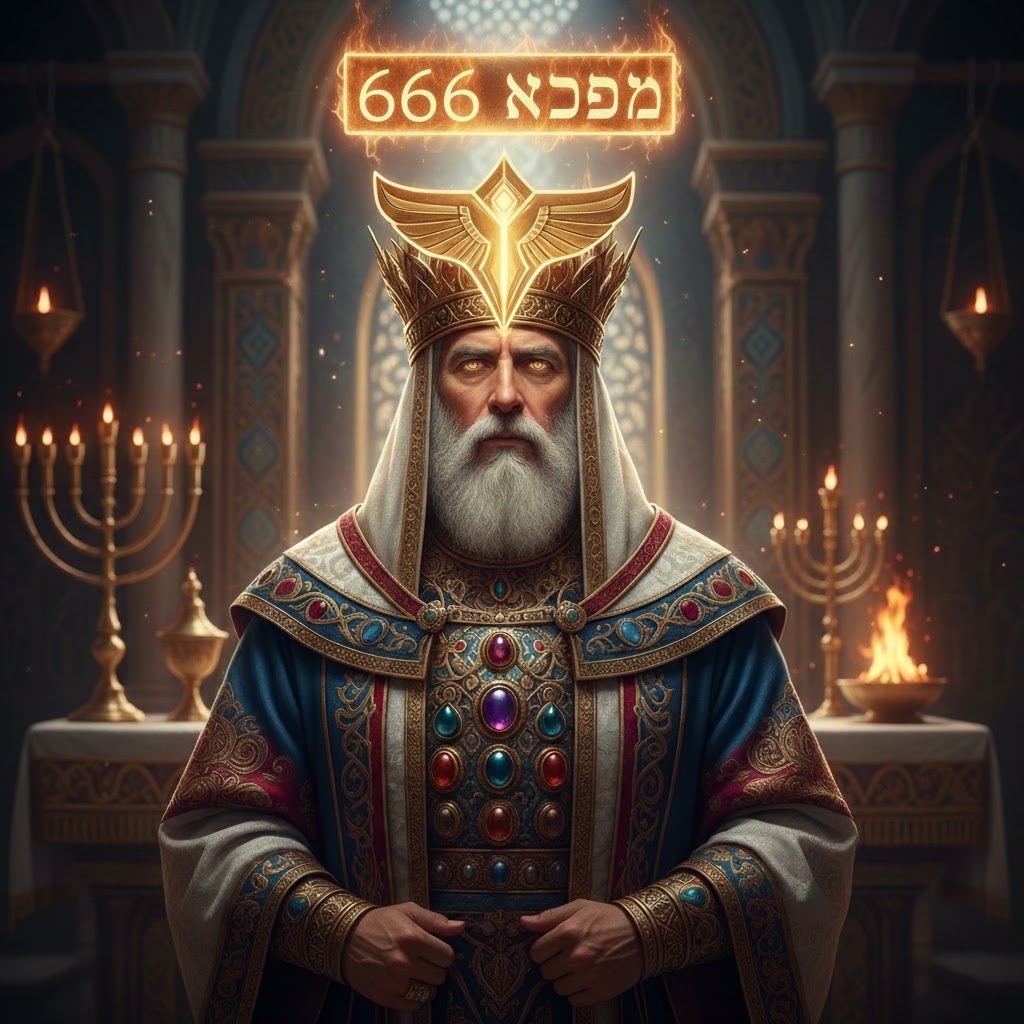
The destruction of the Temple is the mortal wound of the system. The cultic center was razed. The priests were killed or exiled. The sacrificial system ceased. The nezer hakodesh (priestly crown that sums to 666) lost its function.
The Second Temple: restoration
| Event | Date | Text |
|---|---|---|
| Decree of Cyrus | 538 B.C. | Ezra 1:1-4 |
| Return of the exiles (incl. 666 of Adonikam) | ~537 B.C. | Ezra 2 |
| Temple foundations laid | ~536 B.C. | Ezra 3:10-11 |
| Second Temple completed | 516 B.C. | Ezra 6:15 |
The mortal wound was healed. The system resurrected. And 666 sons of “My Lord Has Risen” participated in the reconstruction.
DES 13:3 – the head wounded to death
καὶ μίαν ἐκ τῶν κεφαλῶν αὐτοῦ ὡς ἐσφαγμένην εἰς θάνατον, καὶ ἡ πληγὴ τοῦ θανάτου αὐτοῦ ἐθεραπεύθη kai mian ek ton kephalon autou hos esphagmenen eis thanaton, kai he plege tou thanatou autou etherapeuthe “And one of his heads as if slaughtered to death, and the wound of his death was healed.”
The verb ἐθεραπεύθη (etherapeuthe) – “was healed” – indicates complete restoration. The system that was dead returned to function.
The historical correspondence is exact:
| DES 13:3 | History |
|---|---|
| “One of the heads” | The institutional system (Temple) |
| “As if slaughtered to death” | Destruction of 586 B.C. |
| “The wound was healed” | Reconstruction of 516 B.C. |
| “All the earth marveled” | The restored Temple returned to function |
And the number of people who participated in this healing? 666. From a family whose name means: “My Lord Has Risen.”
The variant in Nehemiah 7:18
The parallel of Ezra 2 in Nehemiah 7 brings a variant:
בְּנֵי אֲדֹנִיקָם שֵׁשׁ מֵאוֹת שִׁשִּׁים וְשִׁבְעָה benei Adoniqam shesh meot shishim veshivah “Sons of Adonikam: six hundred and sixty-seven.”
Nehemiah records 667. Ezra records 666. The difference of 1 does not invalidate the evidence – it is common in ancient census lists to have small counting variations. The relevant datum is that both sources record approximately 666 sons of Adonikam.
The textual variant, in fact, reinforces the importance: later scribes did not “correct” the 666 in Ezra to avoid the association. The number was preserved as it stood in the original document.
Adonikam in Ezra 8:13
Adonikam appears again in Ezra 8:13, in the second wave of returnees:
וּמִבְּנֵי אֲדֹנִיקָם אַחֲרֹנִים umibenei Adoniqam acharonim “And of the sons of Adonikam, the last ones.”
The word אַחֲרֹנִים (acharonim) means “the last, the final.” The sons of Adonikam are the last to return. The family name that means “My Lord Has Risen” closes the list of returnees. The narrative construction is not casual.
The complete chain of 666
When we place the four occurrences in chronological narrative order, the chain reveals itself:
| # | Text | Period | Event | 666 Connection |
|---|---|---|---|---|
| 1 | 1 Kgs 10:14 | Solomon (~960 B.C.) | Apex of the system | 666 talents of gold annually |
| 2 | 2 Chr 9:13 | Solomon (~960 B.C.) | Documentary confirmation | 666 talents (parallel) |
| 3 | Ezra 2:13 | Post-exile (~537 B.C.) | Restoration of the system | 666 sons of Adonikam |
| 4 | DES 13:18 | 1st century A.D. | Identification of the system | The number is 666 |
The trajectory is: apex (Solomon) -> fall (Temple destruction) -> restoration (Adonikam) -> identification (Unveiling).
The 666 is not prophecy about the future. It is tracking of the past. The Unveiling identifies the system that was built by Solomon, destroyed by Babylon and rebuilt by the sons of Adonikam.
Easter Egg: the name Adonikam is the thesis summarized in two words: “My Lord Has Risen.” The system fell and resurrected. The mortal wound was healed. And 666 people participated.
Conclusion
Ezra 2:13 is not a trivial number in a census list. It is the fourth canonical occurrence of 666 – and the one that completes the circuit. The 666 sons of Adonikam are, literally, the builders of the restored system. Their name declares the thesis: “My Lord Has Risen.”
The mortal wound (Temple destruction) was healed (reconstruction). The Yahweh (yhwh) system that operated with 666 talents of gold at the Solomonic apex was restored by 666 people in the post-exile. And the Unveiling, centuries later, identifies this system by the same number: 666.
Text interprets text. Number confirms number. Name carries thesis.
“You read. And the interpretation is yours.”
Artificial form: vowels from Adonai (אֲדֹנָי → a, o, a) placed over consonants YHWH — Masoretic qere perpetuum. Medieval Latin readers merged both, producing “YeHoVaH” — a hybrid that never existed as a Hebrew word. The most accepted academic reconstruction is Yahweh /jah.ˈweh/, based on Greek transcriptions (Ιαβε — Clement of Alexandria, ~200 AD; Ιαουε — Theodoret of Cyrus, ~450 AD), abbreviated biblical forms (Yah — הַלְלוּ יָהּ), theophoric names (Yahu/Yeho — Eliyahu, Yehoshua) and Samaritan oral tradition (Yabe/Yawe). ↩︎