Two methods, two results
Public source text: WLC (Westminster Leningrad Codex) + Nestle 1904. Translation: Belem-2025 Bible translation – literal, rigid, straight from public códices.
The word “gematria-o-codigo-numerico-escondido-na-biblia/" class="autolink" title="gematria">gematria” provokes two reactions: mystical fascination or academic rejection. Both miss the point. The problem was never gematria itself – it was the method of application.
The Forensic Unveiling School Belem an.C-2039 rigorously distinguishes between two uses:
| Type | Method | Direction | Result |
|---|---|---|---|
| Forensic Gematria | Verify values already present in the códices | Text -> Number | Evidence |
| Mystical Gematria | Search for names that sum to a desired value | Number -> Name | Speculation |
The difference is fundamental. It is the difference between investigation and divination.
Mystical gematria: the prohibited method
How it works
- Take a number (e.g.: 666)
- Search for names, titles or phrases that sum to 666
- Find a “candidate” (e.g.: Nero Caesar)
- Declare that the candidate is “the answer”
The problem
The method works for any name. Given a numerical target, it is always possible to find some combination of letters that sums to that value – especially when one is allowed to:
- Switch languages (Hebrew -> Greek -> Latin)
- Use orthographic variants (Neron vs. Nero)
- Include or exclude titles (“Caesar,” “Imperator”)
- Use alternative counting systems
Easter Egg: using mystical gematria, it has been “proven” that 666 = Nero, Domitian, the Pope, Napoleon, Hitler, Henry Kissinger and Bill Gates. When the method works for any answer, it answers nothing.
Historical examples of mystical gematria applied to 666
| Candidate | Method | Problem |
|---|---|---|
| Nero Caesar (נרון קסר) | Hebrew, variant with final nun | Requires transliteration from Latin to Hebrew |
| LATEINOS (Λατεινος) | Greek, isopsephy | Generic name, not personal |
| Vicarius Filii Dei | Latin, Roman values | Unofficial title, forged |
| Muhammad (מחמד) | Hebrew | Anachronism + forced transliteration |
| www (ווו) | Hebrew, vav = 6 | Absolute anachronism |
All begin with the number and search for the name. All require linguistic manipulation. None begins with the text.
Forensic gematria: the permitted method
How it works
- Begin with a text that already contains the number (DES 13:18 contains 666)
- Identify what the text describes (a mark on the forehead)
- Search in the canon for the biblical object that corresponds (priestly plate on the forehead, Ex 28:36)
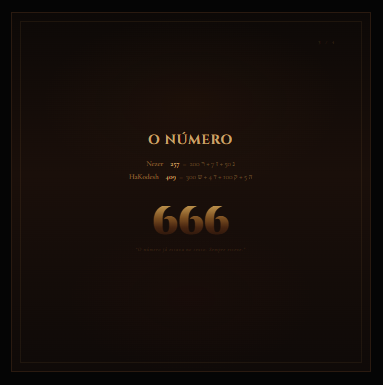
- Calculate the value of the object using standard Hebrew gematria (נזר הקדש = 666)
- Verify through internal parallels (all 4 occurrences of 666 connect to the Yahweh (יהוה — yhwh; trad. “Jehovah”1) system)
The principle
The direction is inverted. One does not search for a name for the number. One verifies whether the object described by the text has the indicated numerical value.
The forensic question is not: “what name sums to 666?” The forensic question is: “does the object that the text describes on the forehead have the value 666?”
The nezer hakodesh case: step-by-step demonstration
Step 1 – Source text
DES 13:18: “Here is the wisdom. The one who has understanding, let him calculate the number of the beast, because it is a number of man, and his number is 666.”
DES 13:16: the mark is placed on the forehead (μέτωπον, metopon).
Step 2 – Described object
The text describes: mark on the forehead, associated with a name (v.17) and a number (v.18).
Step 3 – Corresponding biblical object
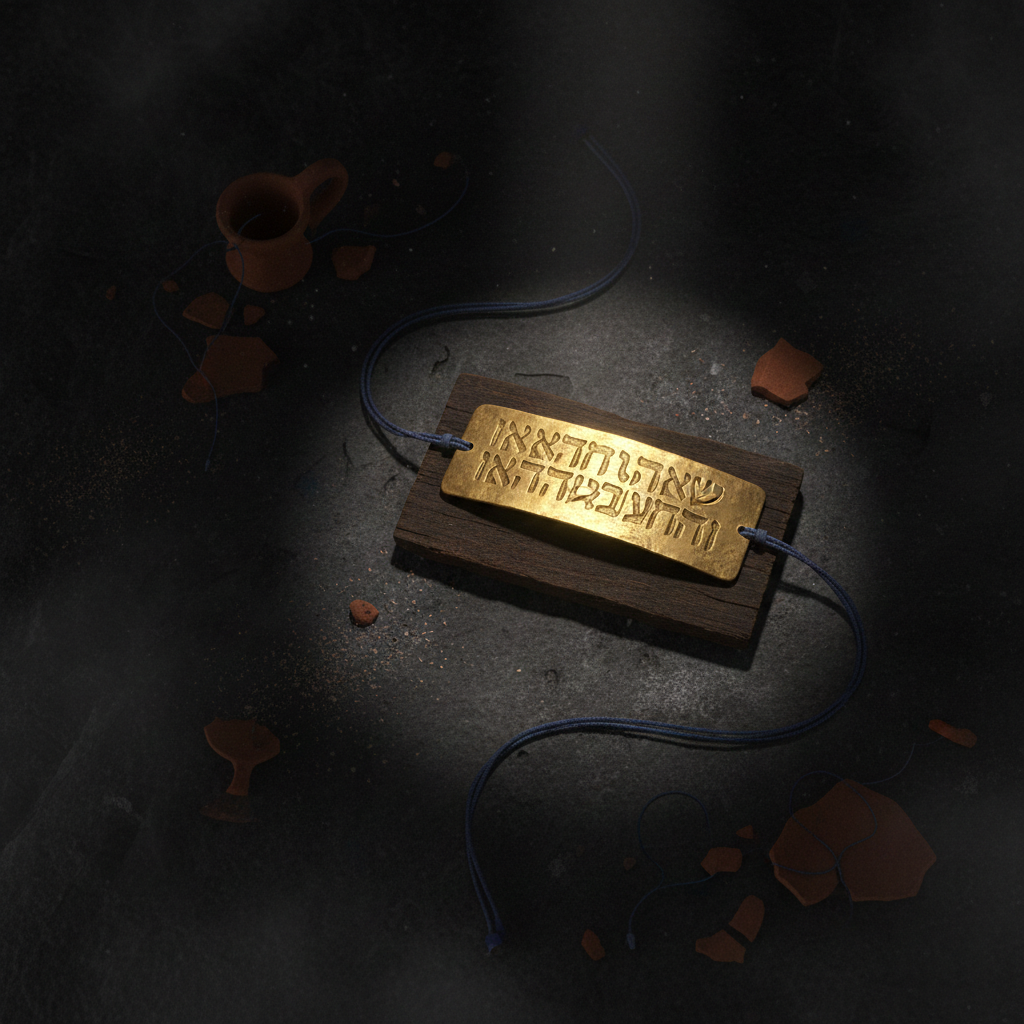
Exodus 28:36-38: plate of pure gold engraved with “HOLINESS TO Yahweh (yhwh),” placed on the forehead of the high priest. The engraving is described as חֹתָם (chotam) – a permanent seal.
The object on the forehead is called נזר הקדש (nezer hakodesh) – “crown/diadem of holiness.”
Step 4 – Standard calculation
| Letter | Value |
|---|---|
| נ (Nun) | 50 |
| ז (Zayin) | 7 |
| ר (Resh) | 200 |
| ה (He) | 5 |
| ק (Qof) | 100 |
| ד (Dalet) | 4 |
| ש (Shin) | 300 |
| Total | 666 |
Standard Hebrew gematria. No alternative systems. No hidden ciphers.
The two key expressions in the Hebrew text (WLC) —
Exodus 28:36 (the inscription on the plate):
וּפִתַּחְתָּ֣ עָלָ֔יו פִּתּוּחֵ֖י חוֹתָ֑ם קֹ֖דֶשׁ לַיהוָֽה
“And you shall engrave on it engravings of a seal: HOLINESS TO Yahweh (yhwh) (קֹדֶשׁ לַיהוָה).” — Exodus 28:36
Leviticus 8:9 (the crown of holiness):
וַיָּ֣שֶׂם עַל־הַמִּצְנֶ֗פֶת […] אֵ֣ת צִ֤יץ הַזָּהָב֙ נֵ֣זֶר הַקֹּ֔דֶשׁ
“And he placed on the turban […] the flower of gold, the crown of holiness (נֵזֶר הַקֹּדֶשׁ).” — Leviticus 8:9
Step 5 – Cross-verification
| Verification | Result |
|---|---|
| Location (forehead) | DES 13:16 = Ex 28:38 |
| Number (666) | DES 13:18 = נזר הקדש |
| Name (yhwh) | DES 13:17 “name of the beast” = קדש ליהוה |
| Function (authorization) | DES 13:17 “buy/sell” = priest authorized to officiate |
| Historical (4 occurrences) | All connect to the Yahweh (yhwh) system |
Five layers of verification. No external sources. No manipulation.
The distinction as a methodological rule
The Forensic Unveiling School explicitly prohibits:
| Prohibited | Reason |
|---|---|
| Mystical gematria (kabbalah) | Inverted direction (number -> name) |
| Numerology | Subjective attribution of meanings |
| Alternative gematric systems | Allow any desired result |
| Conversion between languages | Introduces manipulation variable |
| Atbash, albam gematria, etc. | Ciphers not present in the códices |
The School permits exclusively:
| Permitted | Reason |
|---|---|
| Forensic isopsephy | Directional verification (text -> number) |
| Standard Hebrew gematria | Universally accepted values |
| Standard Greek gematria (isopsephy) | Universally accepted values |
| Verifiable calculation | Anyone can redo it |
| Internal cross-verification | Text confirms text |
Tradition looked outward
For two millennia, tradition searched for 666 outside the códices:
- Irenaeus of Lyon (180 A.D.) -> LATEINOS, TEITAN, EUANTHAS
- Medieval commentators -> popes, kings, heretics
- Reformers -> Roman Catholic Church
- Moderns -> political leaders, technologies
Each generation found its own “666” because the method allows any answer. Mystical gematria is a mirror – it reflects who is looking, not what is written.
The forensic method looks inward
The forensic method begins and ends in the códices:
- DES 13:18 says: “calculate”
- DES 13:16 says: “on the forehead”
- Ex 28:36-38 says: “plate on the forehead, KODESH LAyhwh”
- נזר הקדש = 666
- 1 Kgs 10:14, 2 Chr 9:13, Ezra 2:13: confirm the pattern
No external table. No language conversion. No historical candidate. Text verifies text.
Easter Egg: tradition needed Nero, three writing systems and a textual variant to arrive at 666. The priestly crown needs only standard Hebrew gematria – the same method that any scribe of the Second Temple period knew.
Conclusion
The distinction between forensic gematria and mystical gematria is the distinction between evidence and speculation. Forensic gematria starts from the text, identifies the object, calculates the value and verifies by cross-referencing with other texts. Mystical gematria starts from the number, searches for names and declares victory.
The Forensic Unveiling School does not use gematria to “discover secrets.” It uses gematria to verify what the text already says. The text says “calculate.” The text says “forehead.” The object on the forehead sums to 666. End.
“You read. And the interpretation is yours.”
Artificial form: vowels from Adonai (אֲדֹנָי → a, o, a) placed over consonants YHWH — Masoretic qere perpetuum. Medieval Latin readers merged both, producing “YeHoVaH” — a hybrid that never existed as a Hebrew word. The most accepted academic reconstruction is Yahweh /jah.ˈweh/, based on Greek transcriptions (Ιαβε — Clement of Alexandria, ~200 AD; Ιαουε — Theodoret of Cyrus, ~450 AD), abbreviated biblical forms (Yah — הַלְלוּ יָהּ), theophoric names (Yahu/Yeho — Eliyahu, Yehoshua) and Samaritan oral tradition (Yabe/Yawe). ↩︎