The army that rises from below
Public source text: WLC (Westminster Leningrad Codex) + Nestle 1904. Translation: Belem-2025 Bible translation – literal, rigid, straight from public códices.
The fifth trumpet of DES 9 opens the abyss. Smoke rises as from a great furnace. And from the smoke emerge creatures that the text calls “locusts” — but that resemble no locust known to entomology. The description is detailed, the rules are specific, and the commander has a name in two languages. None of this is accidental.
The opening of the abyss
DES 9:1-2 — “And the fifth angel sounded the trumpet, and I saw a star from heaven fallen (πεπτωκότα, peptokota) to the earth, and to him was given the key of the pit of the abyss (ἡ κλεὶς τοῦ φρέατος τῆς ἀβύσσου). And he opened the pit of the abyss, and smoke ascended from the pit like smoke of a great furnace, and the sun and the air were darkened by the smoke of the pit.”
| Term | Greek | Transliteration | Meaning |
|---|---|---|---|
| Fallen star | ἀστέρα πεπτωκότα | astera peptokota | Perfect participle: “having fallen” — fall already accomplished |
| Key | κλείς | kleis | Instrument of authority (access) |
| Pit | φρέαρ | phrear | Shaft, vertical access point |
| Abyss | ἄβυσσος | abyssos | Bottomless depth |
The star is not falling — it has already fallen (perfect). It is an entity that received (ἐδόθη — divine passive: “was given”) the key. The authority to open the abyss is delegated, not autonomous.
The smoke that rises darkens the sun and the air. The abyss is not merely a place — it is a source of obscurity that contaminates the atmosphere.
The description of the locusts
DES 9:3 — “And from the smoke came locusts (ἀκρίδες, akrides) upon the earth, and to them was given power as the scorpions (σκορπίοι) of the earth have power.”
The text calls the creatures ἀκρίδες — locusts. But the description that follows does not correspond to any insect:
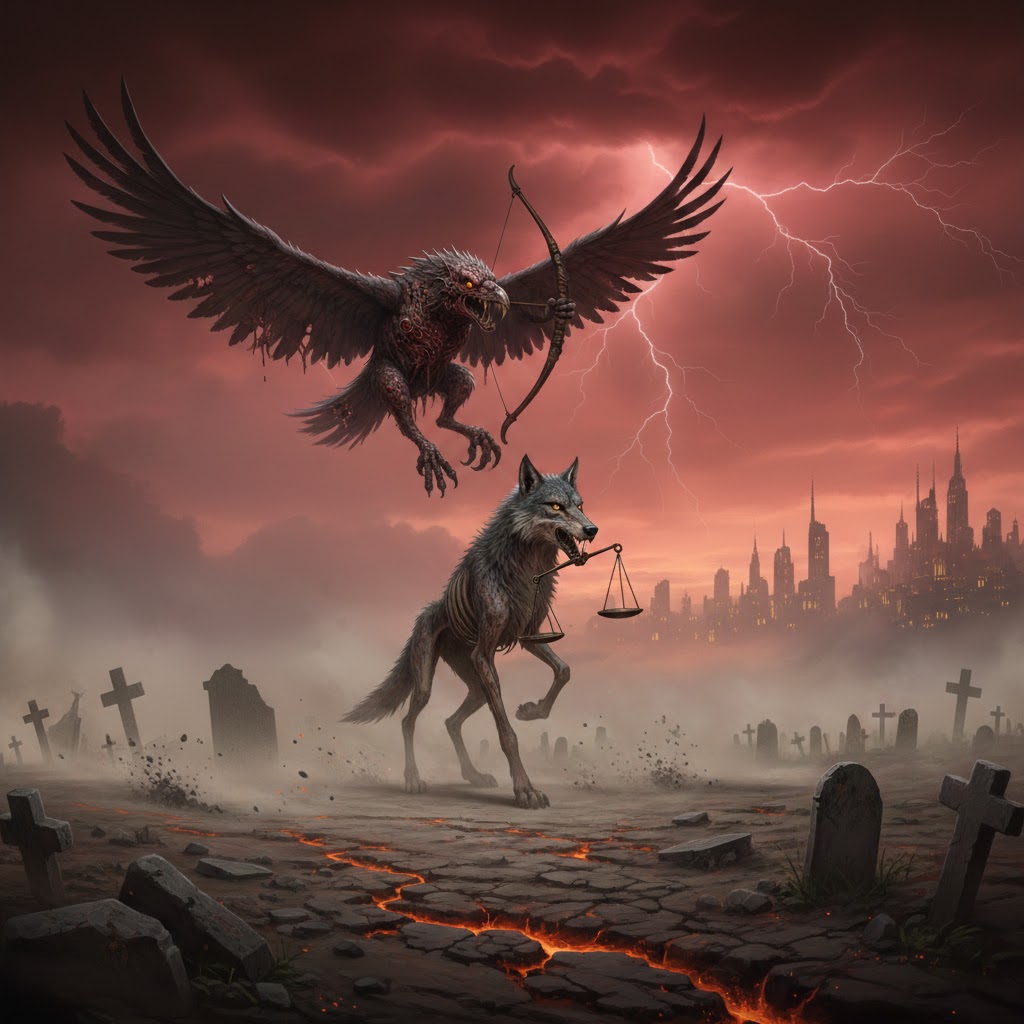
DES 9:7-10 — “And the likenesses of the locusts were like horses prepared for war; and upon their heads something like crowns resembling gold; and their faces were like faces of men; and they had hair like hair of women; and their teeth were like those of lions; and they had breastplates like breastplates of iron; and the sound of their wings like the sound of chariots of many horses running to war; and they had tails like scorpions, and stings; and in their tails the power to harm men five months.”
The forensic profile:
| Attribute | Description | Parallel |
|---|---|---|
| General form | Like war horses | Military |
| Head | Crowns resembling gold | Authority |
| Face | Like faces of men | Rationality |
| Hair | Like hair of women | Deceptive appearance |
| Teeth | Like teeth of lions | Destructive power |
| Breastplates | Of iron | Impenetrable protection |
| Wings | Sound of chariots of many horses | Auditory terror |
| Tails | Like scorpions with stings | Attack mechanism |
Seven attributes. None corresponds to a real locust. These are composite creatures — hybrids combining military, human, animal and supernatural elements.
The rules of engagement
The most extraordinary aspect of the locusts is that they operate under defined rules of engagement:
DES 9:4 — “And it was said to them that they should not harm the grass of the earth, nor any green thing, nor any tree, but only the men who do not have the seal of Θεός upon their foreheads.”
DES 9:5 — “And it was given to them not that they should kill them, but that they should torment (βασανισθήσονται, basanisthesontai) them five months; and their torment was like the torment of a scorpion when it strikes a man.”
Three explicit restrictions:
| Restriction | What they CANNOT do | What they CAN do |
|---|---|---|
| Target | Not harm vegetation | Attack ONLY humans without the seal |
| Lethality | Not kill | Torment |
| Duration | Not exceed the timeframe | Five months |
Real locusts destroy vegetation — that is what they do. These are forbidden to touch plants. Real locusts do not attack humans. These attack exclusively humans. The inversion is complete: everything natural locusts do, these do not. Everything natural locusts do not do, these do.
Easter Egg: The seal of Θεός functions as a safe-conduct. The sealed ones (DES 7:3-4 — the 144,000) are immune to the torment. The seal is not decorative — it is jurisdictional. It marks ownership and confers protection.
The five months
The period of five months (μῆνας πέντε, menas pente) appears twice: DES 9:5 and DES 9:10. The repetition emphasizes temporal precision.
Why five months? The text does not explain. But the investigator notes: five months is the natural life cycle of a locust — from egg to death. The duration of the torment corresponds to the biological cycle of the creature these entities mimic.
| Cycle | Duration | Source |
|---|---|---|
| Natural locust | ~5 months (spring to autumn) | Entomology |
| Locusts of the abyss | 5 months | DES 9:5,10 |
The coincidence is not accidental — it is narrative design. The creatures of the abyss operate within the biological timetable of the insect they imitate.
Torment without death
DES 9:6 — “And in those days men will seek death and will not find it; they will desire to die, and death will flee from them.”
The torment is so severe that death becomes desirable — but unattainable. Death flees (φεύξεται, pheuxetai) from the men. The verb is active: death does not simply fail to come — it actively avoids the victims.
This suggests that the torment is not physical in the conventional sense. It is a suffering that death cannot resolve. A torment that operates in the sphere where death has no jurisdiction — the spiritual, psychological, existential sphere.
The king: Abaddon / Apollyon
DES 9:11 — “They had over them as king the angel of the abyss; his name in Hebrew Ἀβαδδών (Abaddon), and in Greek he has the name Ἀπολλύων (Apollyon).”
| Name | Language | Meaning | Root |
|---|---|---|---|
| Ἀβαδδών | Hebrew (אֲבַדּוֹן) | Destruction, place of ruin | אבד (avad) = to perish |
| Ἀπολλύων | Greek | Destroyer | ἀπόλλυμι (apollymi) = to destroy |
The bilingual naming is unique in the Unveiling. No other entity receives a name in two languages. The double naming indicates that this entity operates in both systems — the Hebrew (OT) and the Greek (NT). It is not confined to one testament. It transits between the two.
In the OT, Abaddon appears as a place, not a person:
| Passage | Usage of אֲבַדּוֹן |
|---|---|
| Job 26:6 | “Sheol is naked before him, and Abaddon has no covering” |
| Job 28:22 | “Abaddon and Death say: With our ears we have heard the report of it” |
| Job 31:12 | “A fire that would consume to Abaddon” |
| Ps 88:11 | “Shall your lovingkindness be declared in the grave? Your faithfulness in Abaddon?” |
| Prov 15:11 | “Sheol and Abaddon are before יהוה” |
The Hebrew text of Proverbs 15:11 (WLC) —
שְׁא֣וֹל וַ֭אֲבַדּוֹן נֶ֣גֶד יְהוָ֑ה אַ֝֗ף כִּֽי־לִבּ֥וֹת בְּנֵי־אָדָֽם
“Sheol and Abaddon (אֲבַדּוֹן) [are] before Yahweh (יהוה — yhwh; trad. “Jehovah”1) — how much more the hearts of the sons of man.” — Proverbs 15:11
In the OT, Abaddon is a place — the abyss of destruction, parallel to Sheol. In the Unveiling, Abaddon becomes a person — the angel who governs that place. The transition from location to entity is significant: the abyss has an administrator.
Easter Egg: The Greek name Ἀπολλύων (Apollyon) sounds phonetically close to Ἀπόλλων (Apollon) — Apollo, the Greek god. Linguistic coincidence or deliberate provocation? The text does not make it explicit, but the first-century reader, familiar with the cult of Apollo, would certainly have heard the resonance.
Locusts as army
The most direct Old Testament parallel is Joel 1-2, where an army of locusts devastates the land:
Joel 2:4-5 — “Their appearance is like the appearance of horses, and like horsemen so they run. Like the noise of chariots, on the tops of mountains they leap; like the crackling of a flame of fire consuming stubble; like a mighty people set in battle array.”
Joel describes locusts with military metaphors. The Unveiling inverts: it describes military creatures with the name of locusts. The movement is from natural to supernatural — from agricultural phenomenon to the army of the abyss.
Conclusion
The locusts of DES 9 are not insects. They are a supernatural army from the abyss with a hybrid description, defined rules of engagement, temporal jurisdiction of five months and a king named in two languages. They do not kill — they torment. They do not touch vegetation — they attack exclusively humans without the seal. Death flees from their victims.
The investigation reveals a precise system of judgment: defined target, limited duration, prohibited lethality, clear hierarchy. It is not chaos — it is a military operation with rules. And the rules come from the throne.
“You read. And the interpretation is yours.”
Artificial form: vowels from Adonai (אֲדֹנָי → a, o, a) placed over consonants YHWH — Masoretic qere perpetuum. Medieval Latin readers merged both, producing “YeHoVaH” — a hybrid that never existed as a Hebrew word. The most accepted academic reconstruction is Yahweh /jah.ˈweh/, based on Greek transcriptions (Ιαβε — Clement of Alexandria, ~200 AD; Ιαουε — Theodoret of Cyrus, ~450 AD), abbreviated biblical forms (Yah — הַלְלוּ יָהּ), theophoric names (Yahu/Yeho — Eliyahu, Yehoshua) and Samaritan oral tradition (Yabe/Yawe). ↩︎