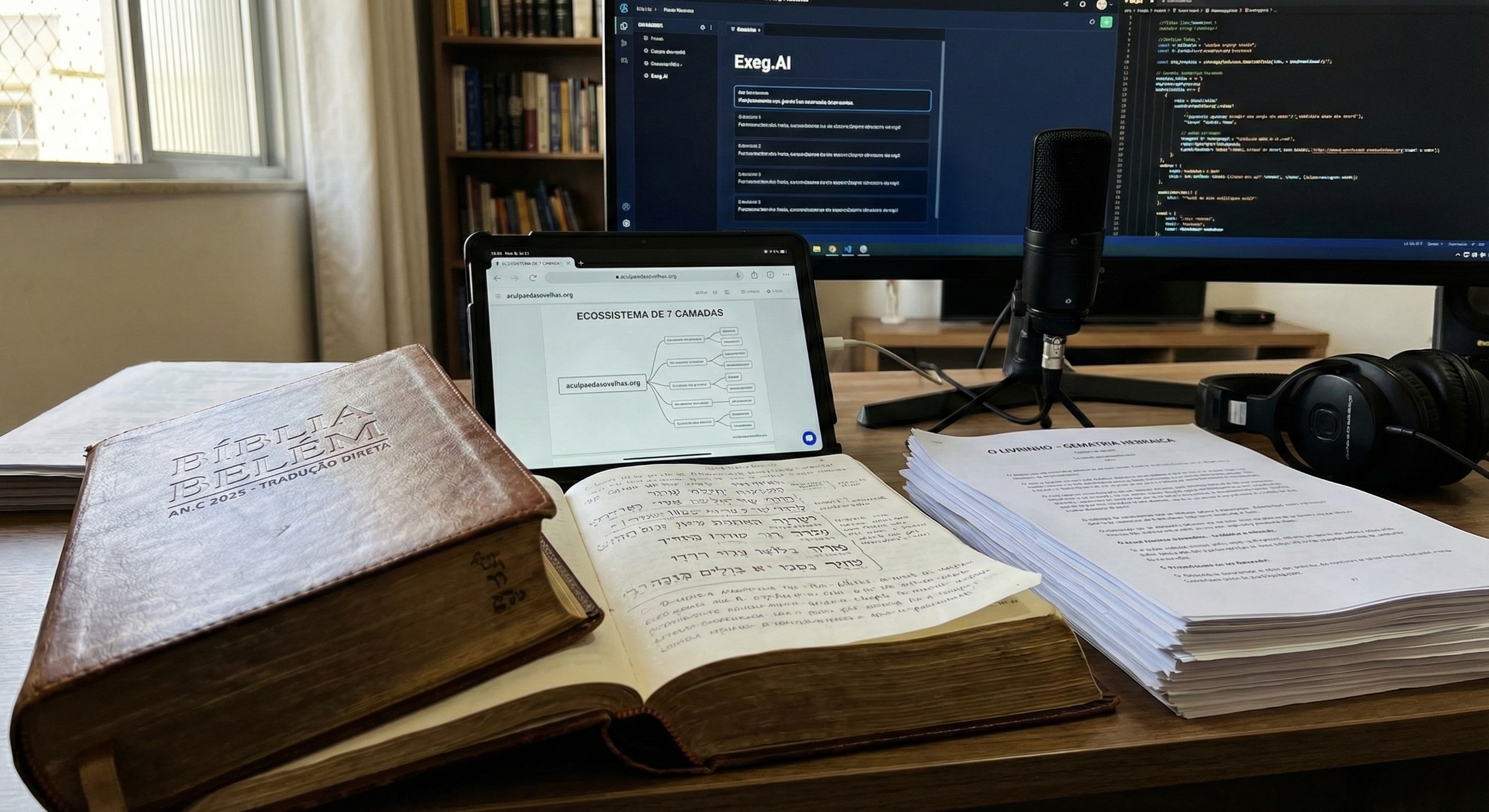
Public source text: WLC (Westminster Leningrad Codex) + Nestle 1904. Translation: Belem-2025 Bible translation — literal, rigid, straight from public códices.
The translator’s dilemma
Every translation faces a choice: fidelity to the original text or fluency in the target language. The more faithful to the original, the less fluent. The more fluent, the more interpretive.
Most biblical translations in Portuguese chose fluency. The Belem-2025 Bible translation chose fidelity. Total. Non-negotiable.
This produces a text that sounds strange in Portuguese. Sentences that do not flow naturally. Constructions that demand effort from the reader. And this is intentional. Because the goal is not linguistic comfort — it is access to the original text.
What rigid literality is
Rigid literality means translating morpheme by morpheme, not meaning by meaning. Each minimal unit of meaning in the Greek or Hebrew text receives a direct correspondence in Portuguese.
| Approach | What it does | Result |
|---|---|---|
| Dynamic equivalence | Translates the general meaning of the sentence | Fluid, interpretive text |
| Formal equivalence | Translates word by word | Reasonably literal text |
| Rigid literality | Translates morpheme by morpheme | Raw text, without editorial treatment |
Rigid literality is the most extreme degree of fidelity to the original. The translator does not soften. Does not harmonize. Does not “improve” the text for the modern reader. He delivers the text as it is — raw, rough, unpolished.
Concrete examples
The differences are visible and measurable:
θηρίον (therion)
| Translation | Choice | Problem |
|---|---|---|
| Almeida Corrigida | “besta” (beast) | Adds pejorative charge that the Greek does not possess |
| NVI | “besta” (beast) | Same problem |
| Belem-2025 Bible translation | “fera” (wild animal) | Literal translation of θηρίον — wild animal, without value judgment |
The Greek θηρίον simply means “wild animal, beast.” The Portuguese translation “besta” carries a semantic charge of stupidity, moral brutality, repugnance — none of these connotations exist in the Greek. The translator who chooses “besta” has already interpreted before translating.
ἄγγελος (angelos)
| Translation | Choice | Problem |
|---|---|---|
| Most translations | “anjo” (angel) | Implies winged celestial being — concept not present in Greek |
| Belem-2025 Bible translation | “mensageiro” (messenger) | Literal translation — someone who carries a message |
The word ἄγγελος means “messenger.” It can be human, it can be celestial — the Greek does not specify. When the translator writes “angel,” he has already decided that the messenger is a celestial being. That decision is interpretation, not translation.
ἐκκλησία (ekklesia)
| Translation | Choice | Problem |
|---|---|---|
| Most translations | “igreja” (church) | Implies organized religious institution |
| Belem-2025 Bible translation | “assembleia” (assembly) | Literal translation — group summoned for gathering |
In classical and koine Greek, ἐκκλησία is simply an assembly of summoned citizens. There is no temple. There is no hierarchy. There is no denomination. The translation “church” projects 2000 years of institutionalization onto a text that describes gatherings of people.
σταυρός (stauros)
| Translation | Choice | Problem |
|---|---|---|
| Most translations | “cruz” (cross) | Assumes specific shape without textual basis |
| Belem-2025 Bible translation | “estaca” or “madeiro” (stake/timber) | Literal translation — σταυρός = vertical post |
The Greek σταυρός designates a vertical post, a stake. The cross shape (with horizontal crossbar) is a later artistic tradition. The Greek text does not specify the shape. The literal translation preserves this ambiguity that the original possesses.
The principle of non-softening
Conventional translations apply three editorial processes that the Belem-2025 Bible translation rejects:
1. Softening
Making the text more pleasant for the reader. Example: transforming rough Hebrew constructions into fluid sentences in Portuguese.
Rejected. If the Hebrew is rough, the Portuguese of the translation will be rough.
2. Harmonization
Making apparently contradictory passages seem consistent. Example: adjusting divergent genealogies.
Rejected. If the códices diverge, the translation reflects the divergence. The reader decides what to do with it.
3. Implicit interpretation
Choosing a translation that already implies an interpretation. Example: translating πνεῦμα (pneuma) as “Spirit” with a capital letter in certain contexts and “spirit” with a lowercase letter in others — a decision that the Greek does not make (Greek does not have upper/lowercase in the same way).
Rejected. The translation does not make interpretive decisions for the reader.
The sovereignty of the reader
This is the central principle: the reader has absolute sovereignty over interpretation.
The translation delivers the raw text. Any processing — softening, harmonization, interpretation — is done by the reader, not the translator.
This inverts the power dynamic. In conventional translations, the translator makes hundreds of micro-interpretive decisions that the reader never sees. The reader receives an already-processed product and believes they are reading “what the text says.” In reality, they are reading what the translator decided the text says.
Easter Egg #5: The expression λίθον λευκὸν (lithon leukon — “white stone”) in DES 2:17 receives in the literal translation exactly those two words: “white stone.” Conventional translations sometimes add explanatory notes about Roman voting customs. The literal translation does not add them. The reader finds “white stone” and researches on their own. The explanation does not come embedded — because explanation is interpretation.
The text as an untouched crime scene
In criminal forensics, the crime scene must be preserved intact. Each piece of evidence must remain where it was found. No one reorganizes the scene so it “makes more sense” for the photographer.
Rigid literal translation operates by the same principle. The original text is the crime scene. The translation is the photograph of the scene. If the photograph is “improved” — objects reorganized, stains cleaned, artificial lighting — it loses probative value.
| Conventional translation | Rigid literal translation |
|---|---|
| Reorganizes the scene for the reader | Photographs the scene as it is |
| Cleans the textual “stains” | Preserves every stain |
| Adds interpretive lighting | Shows with natural light |
| Produces a beautiful image | Produces a faithful image |
A beautiful translation can be a lying translation. An ugly translation can be the true translation.
The exeg.ai platform and literality
The artificial intelligence platform exeg.ai follows the same principle as the translation: it does not apply normalization automatically.
When the user asks a question about a passage, the AI searches the data of the Belem-2025 Bible translation and returns the literal text. It does not soften. Does not harmonize. Does not interpret. It offers tools — semantic search, lexical analysis, intertextual mapping — and the user decides what to do with the results.
The AI is a microscope. It is not a pathologist. The report belongs to the investigator.
Practical comparison: DES 13:1
Let us see how different translations handle the same verse:
Greek (Nestle 1904):
Καὶ εἶδον ἐκ τῆς θαλάσσης θηρίον ἀναβαῖνον, ἔχον κέρατα δέκα καὶ κεφαλὰς ἑπτά
Almeida Corrigida:
“And I saw rising from the sea a beast that had ten horns and seven heads”
NVI:
“I saw a beast that came out of the sea. It had ten horns and seven heads”
Belem-2025 Bible translation:
“And I saw out of the sea wild-animal ascending, having horns ten and heads seven”
The Belem AnC translation preserves:
- θηρίον = “fera” / “wild-animal” (not “beast”)
- The Greek word order: “horns ten and heads seven” (not inverted for fluency)
- The preposition: “out of the sea” (ἐκ τῆς θαλάσσης — the exit is emphasized)
Is the text less fluid? Yes. Is it more faithful to the original? Also yes. And that is the choice rigid literality makes — in every verse, in every word, without exception.
The first of its kind in Portuguese
The Belem-2025 Bible translation is the first rigid literal translation in the Portuguese language. Literal translations exist in English (such as Young’s Literal Translation of 1862), but in Portuguese this approach had not been attempted with this degree of rigor.
The project is open source, licensed under CC BY 4.0, and the API is publicly available at Bíblia.aculpaedasovelhas.org. Anyone can verify the translation choices. Anyone can contest. Anyone can propose corrections.
Because rigid literality is not a dogma — it is a method. And methods are refined by public scrutiny.
“You read. And the interpretation is yours.”