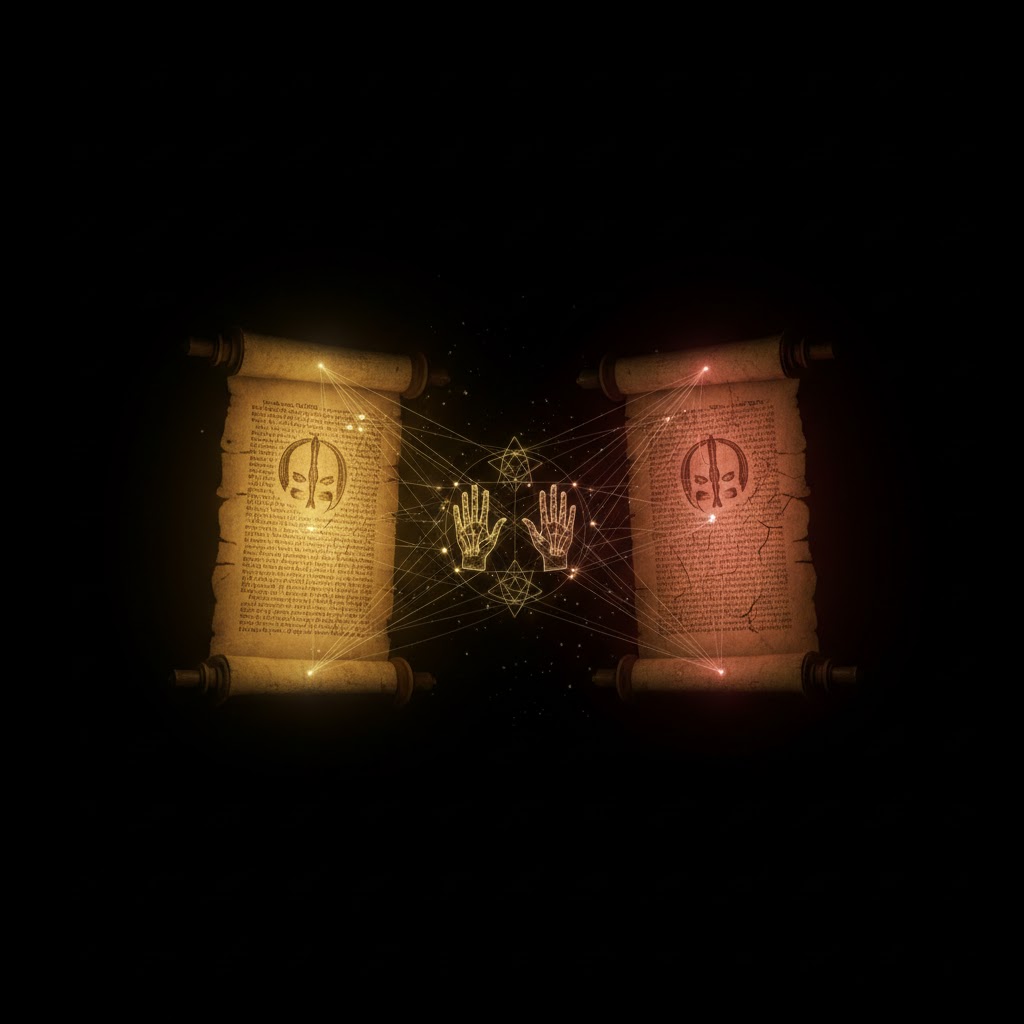
A sealed book. An open little book. Five chapters apart.
Public source text: WLC (Westminster Leningrad Codex) + Nestle 1904. Translation: Belem-2025 Bible translation – literal, rigid, straight from the public códices.
The Unveiling of John contains two of the most dramatic moments in prophetic literature: the book sealed with seven seals that no one can open (DES 5) and the little book already open in the hand of a strong angel descending from heaven (DES 10). Eschatological tradition treats these two episodes as isolated scenes. The forensic unveiling method places them in direct dialogue – because the text itself connects them through vocabulary, structure, and narrative logic.
The forensic question: is the biblaridion of DES 10 the same as the biblion of DES 5, now opened? Or is it a completely different document?
Scene 1 – The sealed book: DES 5:1-2
kai eidon epi ten dexian tou kathemenou epi tou thronou biblion gegrammenon esothen kai opisthen katesphragismenon sphragisin hepta. “And I saw in the right hand of the One sitting on the throne a book written inside and on the back, sealed with seven seals.” – DES 5:1
kai eidon angelon ischyron keryssonta en phone megale; tis axios anoixai to biblion kai lysai tas sphragidas autou? “And I saw a strong angel proclaiming in a great voice: Who is worthy to open the book and to loose its seals?” – DES 5:2
Forensic elements of the scene:
| Element | Greek | Analysis |
|---|---|---|
| Book | biblion | Scroll/codex – generic term for written document |
| Right hand | dexian | Hand of authority, executive power |
| Written inside and on the back | gegrammenon esothen kai opisthen | Perfect passive participle – completely filled document |
| Sealed | katesphragismenon | Perfect passive participle of katasphragizo – complete sealing (prefix kata- = intensive) |
| Seven seals | sphragisin hepta | Sevenfold sealing – maximum security |
| Strong angel | angelon ischyron | First appearance of this designation |
The perfect participle katesphragismenon is crucial. The prefix kata- intensifies the sealing: not a simple seal, but total, complete, top to bottom. Seven seals reinforces the idea of inviolability.
The drama of worthiness – DES 5:3-5
kai oudeis edynato en to ourano oude epi tes ges oude hypokato tes ges anoixai to biblion oude blepein auto. “And no one in heaven, nor on the earth, nor under the earth was able to open the book or to look at it.” – DES 5:3
Three domains searched. Zero candidates. The verb edynato – imperfect of dynamai – indicates continuous inability. It is not that no one tried and failed. It is that no one could.
The Lamb (to arnion) is presented in DES 5:5-7 as the only worthy one. He takes (eilephen, perfect of lambano) the book from the right hand of the One sitting on the throne. The perfect indicates: he took and maintains possession.
Scene 2 – The open little book: DES 10:1-2
Kai eidon allon angelon ischyron katabainonta ek tou ouranou peribeblemenon nephelen, kai he iris epi ten kephalen autou, kai to prosopon autou hos ho helios, kai hoi podes autou hos styloi pyros, kai echon en te cheiri autou biblaridion eneogmenon. “And I saw another strong angel descending from heaven, clothed with a cloud, and the rainbow upon his head, and his face as the sun, and his feet as pillars of fire, and having in his hand a little book opened.” – DES 10:1-2a
Forensic elements of the scene:
| Element | Greek | Analysis |
|---|---|---|
| Another | allon | “Another of the same kind” – presupposes the first |
| Strong angel | angelon ischyron | Same designation as DES 5:2 |
| Little book | biblaridion | Diminutive of biblion – reduced form |
| Opened | eneogmenon | Perfect passive participle of anoigo – already opened, resultant state |
| In his hand | en te cheiri | Does not specify right or left |
Easter Egg: the word “another” (allon)
The word allon in DES 10:1 is one of the most underestimated forensic clues in the Unveiling.
In Greek, allos means “another of the same kind” (distinct from heteros, “another of a different kind”). When John writes “I saw another strong angel,” he grammatically presupposes that the reader already knows the first strong angel. And where does the first appear? In DES 5:2.
| Reference | Greek | Function |
|---|---|---|
| DES 5:2 | angelon ischyron | First strong angel – asks “who is worthy?” |
| DES 10:1 | allon angelon ischyron | Another strong angel – brings the book already opened |
The allon creates a narrative arc. DES 5 and DES 10 are not standalone episodes. They are two acts of the same dramatic scene. The first strong angel raises the question (who can open?). The second strong angel brings the answer (the book is open).
The lexical evidence: biblion vs. biblaridion
Here lies the core of the investigation. The two terms are:
| Term | Reference | Form | Meaning |
|---|---|---|---|
| biblion | DES 5:1-9 | Standard form | Book, scroll, document |
| biblaridion | DES 10:2, 9, 10 | Double diminutive | Little book, small book |
The diminutive biblaridion is formed by double suffixation: bibl- (root) + -ar- + -idion. It is a rare form in the New Testament – it appears exclusively in DES 10. Tradition uses this diminutive to argue that these are two different documents: a large book (DES 5) and a little book (DES 10).
But the textual evidence complicates that reading. In DES 10:8, the text alternates:
kai he phone hen ekousa ek tou ouranou palin lalousan met emou kai legousan; hypage labe to biblion to eneogmenon en te cheiri tou angelou “And the voice which I heard from heaven again speaking with me and saying: Go, take the book opened in the hand of the angel.” – DES 10:8
Notice? In DES 10:2, John calls it biblaridion (little book). In DES 10:8, the voice from heaven calls the same object biblion (book) – exactly the same term as DES 5:1.
| Verse | Term used | Who speaks |
|---|---|---|
| DES 10:2 | biblaridion | John describes |
| DES 10:8 | biblion | The voice from heaven names |
| DES 10:9 | biblaridion | John asks the angel |
| DES 10:10 | biblaridion | John narrates |
The celestial voice uses biblion – the same term as DES 5. John uses the diminutive biblaridion. Are these different perspectives on the same object? The lexical alternation within the same scene suggests yes.
The decisive participle: eneogmenon
The word eneogmenon is the perfect passive participle of anoigo (“to open”). The Greek perfect passive indicates:
- An action completed in the past
- Whose result remains in the present
- Performed by an external agent (passive)
The little book is not “being opened.” It was opened and remains open. The act of opening is prior to the scene of DES 10. Someone already opened it.
Who opened it? The only being declared worthy to open the sealed book is the Lamb (DES 5:5-7). If the biblaridion of DES 10 is the biblion of DES 5, then the perfect passive eneogmenon is the grammatical marker that the Lamb already completed the opening.
The structural arc: DES 5 → DES 6-9 → DES 10
The narrative sequence reinforces the continuity thesis:
| Chapter | Event | State of the book |
|---|---|---|
| DES 5 | Lamb takes the sealed book | Sealed – seven seals intact |
| DES 6:1-17 | Opening of seals 1 through 6 | Partially opened |
| DES 7 | Interlude – sealing of the 144,000 | Narrative pause |
| DES 8:1-5 | Opening of seal 7 | Seals completed |
| DES 8:6 - 9:21 | Seven trumpets (content of the 7th seal) | Content being revealed |
| DES 10 | Another strong angel with little book already open | Open – eneogmenon |
The progression is logical: sealed → seals opened one by one → completely open. DES 10 is the arrival point of the process initiated in DES 5.
Intertextual parallel: Ezekiel 2:8 - 3:3
The act of eating the book in DES 10:9-10 is not original to John. It is a direct citation from Ezekiel:
| Element | Ezekiel 2-3 | DES 10 |
|---|---|---|
| Command | “Eat this scroll” | “Take and devour it” |
| Taste | Sweet as honey | Sweet as honey in the mouth |
| Bitterness | Not explicitly mentioned | Bitterness in the belly |
| Result | Prophesy to Israel | “You must prophesy again” (DES 10:11) |
The added bitterness in DES 10 is significant. In Ezekiel, the scroll contained “lamentations, mourning and woes” (Ezek 2:10) but was sweet when eaten. In DES 10, the sweet reception of the word transforms into visceral bitterness – the content of the prophecy is pleasant to receive but painful to proclaim.
daniel-124--the-temporal-seal">Daniel 12:4 – the temporal seal
“But you, Daniel, shut up the words and seal the book until the time of the end.” – Daniel 12:4
Daniel receives the order to seal. The Unveiling presents the process of unsealing. The arc spans all of prophetic literature:
| Text | Action | Time |
|---|---|---|
| Daniel 12:4 | Seal the book | “Until the time of the end” |
| DES 5:1 | Book sealed with seven seals | The time of the end approaches |
| DES 5:5-7 | Lamb worthy to open | The time has come |
| DES 6-8 | Seals opened progressively | The content is revealed |
| DES 10:2 | Little book already open | The process is complete |
| DES 22:10 | “Do not seal the words” | Total reversal of Daniel |
DES 22:10 closes the cycle: “Do not seal the words of the prophecy of this book, for the time is near.” What Daniel sealed, the Unveiling opens. What was hidden is now exposed.
The seven thunders – DES 10:3-4: the seal within the opening
kai hote elalesen hai hepta brontai, emellon graphein; kai ekousa phonen ek tou ouranou legousan; sphragison ha elalesen hai hepta brontai kai me auta grapses. “And when the seven thunders spoke, I was about to write; and I heard a voice from heaven saying: Seal the things which the seven thunders spoke and do not write them.” – DES 10:3-4
Forensic paradox: in the very chapter where the book appears open, John receives the order to seal something. The verb sphragison – aorist imperative of sphragizo – is a direct command: seal. Do not record.
| Action | Reference | Direction |
|---|---|---|
| Seven seals opened | DES 5-8 | Revelation → exposure |
| Seven thunders sealed | DES 10:4 | Revelation → concealment |
Even in the act of unveiling, layers remain veiled. The Unveiling is not total revelation. It is selective revelation. The book was opened, but not all its content was transcribed. The seven thunders speak – and John hears – but the reader is not granted access.
Final comparative table: DES 5 vs. DES 10
| Criterion | DES 5 | DES 10 |
|---|---|---|
| Object | biblion | biblaridion / biblion (v.8) |
| State | katesphragismenon (sealed) | eneogmenon (opened) |
| Location | Right hand of the Throne | Hand of the strong angel |
| Strong angel | angelon ischyron (first) | allon angelon ischyron (another) |
| Angel’s function | Asks: “Who is worthy?” | Brings the book already opened |
| Required action | Open and unseal | Take and devour |
| Agent of opening | The Lamb | Not named (perfect passive) |
| Content | Seals → trumpets → bowls | Prophecy that must be proclaimed |
| OT parallel | Daniel 12:4 (seal) | Ezekiel 2-3 (eat the scroll) |
| Emotional result | John weeps (DES 5:4) | Sweet and bitter (DES 10:10) |
Conclusion
The evidence converges toward a continuity thesis: the biblaridion of DES 10 is the biblion of DES 5 in its post-opening state. The lexical alternation between biblaridion and biblion within chapter 10 itself demonstrates that John uses the diminutive as a visual description (the scroll, now unrolled, appears smaller) while the celestial voice maintains the original name.
The narrative arc is structurally coherent: sealed book (DES 5) → seals progressively opened (DES 6-8) → completely open book (DES 10). The word allon (“another”) in DES 10:1 connects the two strong angels in explicit dialogue. The perfect passive eneogmenon confirms that the opening was already accomplished – by the only being declared worthy to do so.
But even at the moment of total opening, the seven thunders are sealed. The Unveiling reveals and conceals simultaneously. The book is open. Not all its content is accessible.
“You read. And the interpretation is yours.”