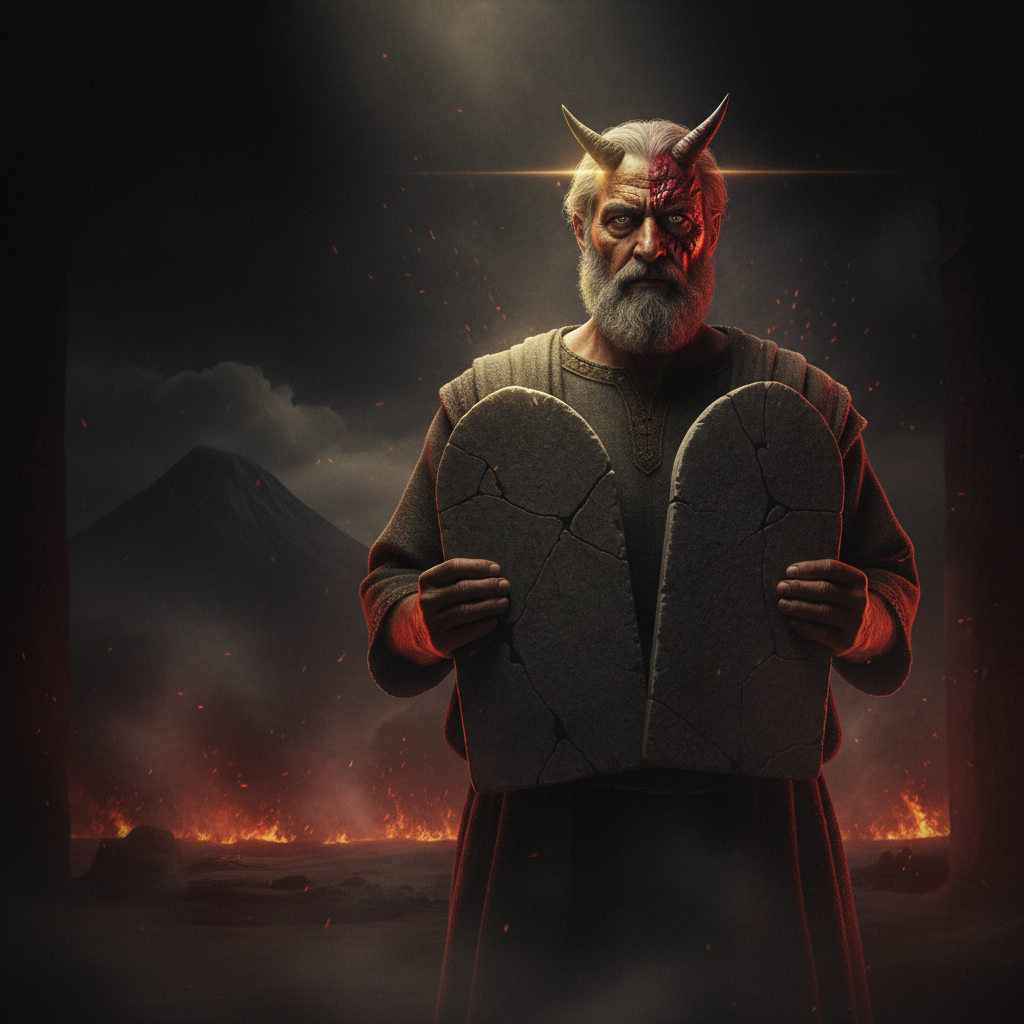
Public source text: WLC (Westminster Leningrad Codex) + Nestle 1904 + Westcott-Hort 1881. Translation: Belem-2025 Bible translation — literal, rigid, straight from the public códices.
The first act of Moses: homicide
The first documented act of Moses as a narrative subject in Scripture is not a prayer. It is not a miracle. It is not a divine calling. It is a murder.
Exodus 2:11-12 records:
וַיִּ֤פֶן כֹּה֙ וָכֹ֔ה וַיַּ֖רְא כִּ֣י אֵ֣ין אִ֑ישׁ וַיַּךְ֙ אֶת־הַמִּצְרִ֔י וַֽיִּטְמְנֵ֖הוּ בַּחֽוֹל
“And he turned this way and that way, and saw that there was no man, and struck (וַיַּךְ) the Egyptian and hid him (וַיִּטְמְנֵהוּ) in the sand.” — Exodus 2:12
The Hebrew verb vayak (וַיַּךְ, from the root nakah) does not describe an accident or an impulsive gesture. It designates a lethal blow — a deliberate action with a fatal result. And the subsequent verb vayitmenehu (and he hid him) reveals full awareness of the act: prior verification for witnesses, execution, and concealment of the body. Homicide with intent and subsequent dissimulation. Before being a prophet, legislator, liberator, or covenant mediator, Moses is a murderer.
This textual datum is not interpretation. It is a survey. No translation hides it. But tradition harmonises it — dissolving this inaugural murder into the ocean of his later biography, as if it were an irrelevant detail. It is not. It is the beginning.
In John 8:44, Jesus confronts the Pharisees:
“Ekeinos anthropoktonos en ap’ arches” — “That one was a man-killer from the beginning.”
The expression ap’ arches (from the beginning) does not require regression to Gênesis 1. It can refer to the operational beginning of the agent in question. And indeed: the documented beginning of Moses’ story is a homicide. From his beginning, Moses is anthropoktonos — a killer of men.
The forensic catalogue: 10 documented episodes in the Torah
That initial murder does not remain isolated. It inaugurates a pattern that intensifies when Moses assumes the role of mediator between Yahweh (יהוה — yhwh; trad. “Jehovah”1) and the people. The forensic survey tracked all episodes in the Torah where Moses killed personally, ordered executions, or commanded campaigns of extermination.
| # | Episode | Reference | Dead | Role of Moses |
|---|---|---|---|---|
| 1 | The Egyptian | Exodus 2:11-12 | 1 | Personal killer |
| 2 | Golden Calf Massacre | Exodus 32:25-29 | ~3,000 | Ordered executions via Levites |
| 3 | The Blasphemer | Leviticus 24:10-23 | 1 | Transmitted death verdict |
| 4 | The Sabbath Violator | Numbers 15:32-36 | 1 | Transmitted death sentence |
| 5 | Korah’s Rebellion | Numbers 16:1-35 | 250 + families | Invoked judgement |
| 6 | Post-Korah Plague | Numbers 17:6-15 | 14,700 | Indirect cause (accused by the people) |
| 7 | Baal-Peor | Numbers 25:1-9 | 24,000 + executions | Ordered executions + plague |
| 8 | War against Midian | Numbers 31:1-54 | ~182,000 | Military commander + genocidal |
| 9 | Destruction of Sihon | Numbers 21; Dt 2 | ~50,000 | Commander of total herem |
| 10 | Destruction of Og | Numbers 21; Dt 3 | ~175,000 | Commander of total herem |
Explicit subtotal (episodes 1-7): 41,953 dead — numbers that the Hebrew text itself records in letters.
But the last three episodes — Midian, Sihon, Og — do not provide a total count. They only record: herem. Total destruction. Men, women, children. Everyone. The text omits the number, but the mathematics does not.
The demographic presumption: 32,000 virgins as forensic anchor
The Midian episode (Numbers 31) is the only one that provides a demographic datum precise enough to reconstruct the total population.
The anchor datum
The Hebrew text of Numbers 31:35 (WLC) delivers the raw number —
וְנֶ֣פֶשׁ אָדָ֔ם מִן־הַ֨נָּשִׁ֔ים אֲשֶׁ֥ר לֹא־יָדְע֖וּ מִשְׁכַּ֣ב זָכָ֑ר כָּל־נֶ֕פֶשׁ שְׁנַ֥יִם וּשְׁלֹשִׁ֖ים אָֽלֶף
“And the human souls, of the women who had not known the bed of a male — all souls: thirty-two thousand.” — Numbers 31:35
32,000 persons — specifically, virgin girls who had not known man by lying with a male.
These 32,000 are the only survivors of the massacre. All others were executed:
- Numbers 31:7 — all men killed in battle
- Numbers 31:17a — Moses orders: “Kill every male among the children” (hirgu kol-zakhar bataf)
- Numbers 31:17b — Moses orders: “And every woman who has known man… kill” (vekhol ishah yoda’at ish harogu)
- Numbers 31:18 — “But all the girls who have not known… keep for yourselves”
Easter Egg: Moses did not give this order before the battle. Numbers 31:14-15 records that Moses was enraged (vayiqtsof Mosheh) at the officers because they spared the women and children. The order for genocide did not come from Yahweh (yhwh) — it came directly from Moses, in a fit of rage, AFTER seeing that the officers had shown mercy. The officers’ mercy provoked the prophet’s fury.
The calculation
If 32,000 virgins = only female survivors, they are a fraction of the total female population. In ancient pastoral Near Eastern society, pre-nuptial girls (virgins in the textual sense: lo-yad’u mishkav zakhar) represent approximately 25% to 35% of the female population. Moderate premise: 30%.
| Category | Calculation | Result |
|---|---|---|
| Total women | 32,000 / 0.30 | ~107,000 |
| Non-virgin women executed | 107,000 - 32,000 | ~75,000 |
| Total men (ratio ~1:1) | ~107,000 | ~107,000 |
| Total dead in Midian | ~182,000 | |
| Virgins abducted | 32,000 | |
| Estimated Midianite population | ~214,000 |
Cross-validation by animal spoils
The same chapter records the spoils:
| Category | Quantity |
|---|---|
| Sheep | 675,000 |
| Cattle | 72,000 |
| Donkeys | 61,000 |
| Total animals | 808,000 |
In pastoral society, the animal-to-person ratio varies between 3:1 and 5:1. Applying: 808,000 / 3 = ~269,000 | 808,000 / 5 = ~162,000. The resulting range (162,000 to 269,000) is consistent with the demographic estimate of ~214,000. The numbers validate each other.
The herem kingdoms: Sihon and Og
Before Midian, Moses had already carried out two campaigns of herem (חרם) — total destruction, no survivors — against the Amorite kingdoms.
Sihon (Numbers 21:21-31; Deuteronomy 2:26-37)
Deuteronomy 2:34 records:
“We took all his cities at that time, and utterly destroyed every city: men, women, and children. We left no survivor.”
The Amorite kingdom of Sihon, with its capital at Heshbon, extended from Aroer to the Jabbok. The text says “all his cities” — not some, not most. All. Moderate estimate for a kingdom with 15 to 25 urban centres: ~50,000 dead.
Og (Numbers 21:33-35; Deuteronomy 3:1-7)
Deuteronomy 3:4-5 records:
“We took all his cities at that time; there was not a city which we did not take from them: sixty cities, all the region of Argob, the kingdom of Og in Bashan. All these cities were fortified with high walls, gates, and bars — besides very many unwalled towns.”
Sixty fortified cities. The Hebrew text allows no ambiguity: shishim ir, kol-chevel Argob, mamlekhet Og baBashan. Sixty. Plus unwalled towns. And Deuteronomy 3:6 confirms the procedure:
“We utterly destroyed them, as we did to Sihon — men, women, and children of every city.”
Easter Egg: The formula “as we did to Sihon” (ka’asher asinu le-Sichon) in Deuteronomy 3:6 reveals industrial standardisation of extermination. It is not situational improvisation. It is a replicable protocol. The herem of Sihon becomes a template for Og. And both become a template for Joshua’s wars (Joshua 6-12). Moses does not merely execute genocide — he institutionalises the method.
Moderate estimate for 60 fortified cities (average 2,000-3,000 inhabitants) plus dozens of unwalled villages: ~175,000 dead.
The total count: half a million lives
| Level | Episode(s) | Basis | Dead |
|---|---|---|---|
| Explicit | 7 episodes with numbers in the text | Hebrew text | 41,953 |
| Implicit | Korah’s families + Baal-Peor executions | Textual inference | ~3,250 |
| Presumption | War against Midian | 32,000 virgins (Nm 31:35) | ~182,000 |
| Presumption | Kingdom of Sihon | Total herem, all cities | ~50,000 |
| Presumption | Kingdom of Og | Total herem, 60 cities + villages | ~175,000 |
| TOTAL DEAD | ~452,000 | ||
| + Virgins abducted | 32,000 | ||
| TOTAL LIVES | ~484,000 |
Half a million lives. Under the command of a single man. Documented across five books. None of these numbers is invented — all derive from explicit textual data, moderate demographic presumptions, and cross-validation.
And the classification by role reveals that Moses is not merely a passive executor of divine orders:
| Role | Episodes | % of dead |
|---|---|---|
| Personal killer | 1 (Egyptian) | < 0.01% |
| Ordered direct executions | 5 (Calf, Blasphemer, Sabbath, Baal-Peor, Midian) | ~57% |
| Military commander of herem | 2 (Sihon, Og) | ~49% |
| Invoked judgement | 1 (Korah) | < 0.1% |
| Indirect cause | 1 (Post-Korah plague) | ~3% |
In 7 of the 10 episodes, Moses is a direct agent — he orders or commands. He is not a reluctant intermediary. He is the operator.
“By their works you shall know them”: the criterion of Jesus
The central forensic question is not whether Moses killed. The text says he killed. The question is: what does Jesus do with this datum?
In John 8:39-44, Jesus says to the Pharisees:
“If you were children of Abraham, you would do the works of Abraham. But now you seek to kill me — a man who told you the truth that he heard from Theos. Abraham did not do this. You do the works of your father.”
They respond: “We were not born of fornication; we have one father: the Theos.”
And Jesus concludes: “If the Theos were your father, you would love me […] You are of your father, the diabolos, and you want to do the desires of your father. That one was a man-killer from the beginning (ekeinos anthropoktonos en ap’ arches) and did not stand in the truth, because there is no truth in him.”
The criterion of Jesus is practical: by their works. Abraham does not found a system based on death. He does not order religious executions. He does not legitimise genocides. He does not enslave virgins. But Moses — precisely the figure to whom the Pharisees bind themselves (“We are disciples of Moses”, John 9:28) — inaugurates, institutionalises, and perpetuates death as a pedagogical, punitive, and theological mechanism. Four hundred and fifty thousand times.
The chain of filiation that the Johannine text constructs:
Dragon → yhwh (Beast of the Sea) → Moses (Beast of the Earth) → Pharisees → "you seek to kill me"
The Pharisees seek to kill Jesus. They are disciples of Moses. Moses is a murderer from the beginning. The diabolos is a murderer from the beginning. Who, then, is the operational father?
The silence of tradition
Why does tradition not make this count? Because it never places the 10 episodes side by side. Each is treated in isolation, diluted in apologetic context: “Moses was obedient,” “it was a divine order,” “the people deserved it.” But forensic investigation does not ask why. It asks how many.
And how many: over 450,000 documented dead. Plus 32,000 virgin girls abducted as property, distributed as spoils — 16,000 for the warriors, 16,000 for the congregation, and 32 handed to the Levites as “Yahweh (yhwh)’s portion” (Numbers 31:40).
The Torah does not hide these numbers. They are in Numbers, in Exodus, in Leviticus, in Deuteronomy. Books that tradition itself reveres. But revering the text is one thing. Reading it is another.
Conclusion
Moses is a murderer from the beginning — not by interpretation, but by textual survey. The first recorded act of his adult life is a homicide. The final chapter of his military leadership includes the order to massacre tens of thousands of women and children after an already-won battle. Between the first murder and the last genocide, the catalogue totals ten episodes and over 450,000 dead.
Jesus knew. That is why he asked the Pharisees whose children they were. They answered: “We are disciples of Moses.” And Jesus concluded: “You are of your father, the diabolos.”
The connection is not accidental. It is textual.
“You read. And the interpretation is yours.”
Artificial form: vowels from Adonai (אֲדֹנָי → a, o, a) placed over consonants YHWH — Masoretic qere perpetuum. Medieval Latin readers merged both, producing “YeHoVaH” — a hybrid that never existed as a Hebrew word. The most accepted academic reconstruction is Yahweh /jah.ˈweh/, based on Greek transcriptions (Ιαβε — Clement of Alexandria, ~200 AD; Ιαουε — Theodoret of Cyrus, ~450 AD), abbreviated biblical forms (Yah — הַלְלוּ יָהּ), theophoric names (Yahu/Yeho — Eliyahu, Yehoshua) and Samaritan oral tradition (Yabe/Yawe). ↩︎