The calculation nobody made
Public source text: WLC (Westminster Leningrad Codex) + Nestle 1904. Translation: Belem-2025 Bible translation – literal, rigid, straight from the public códices.
For two millennia, tradition searched for 666 in the names of emperors, economic systems and future conspiracies. The simplest calculation – and the most devastating – was in the Hebrew text itself, in the description of the high priest in Exodus 28.
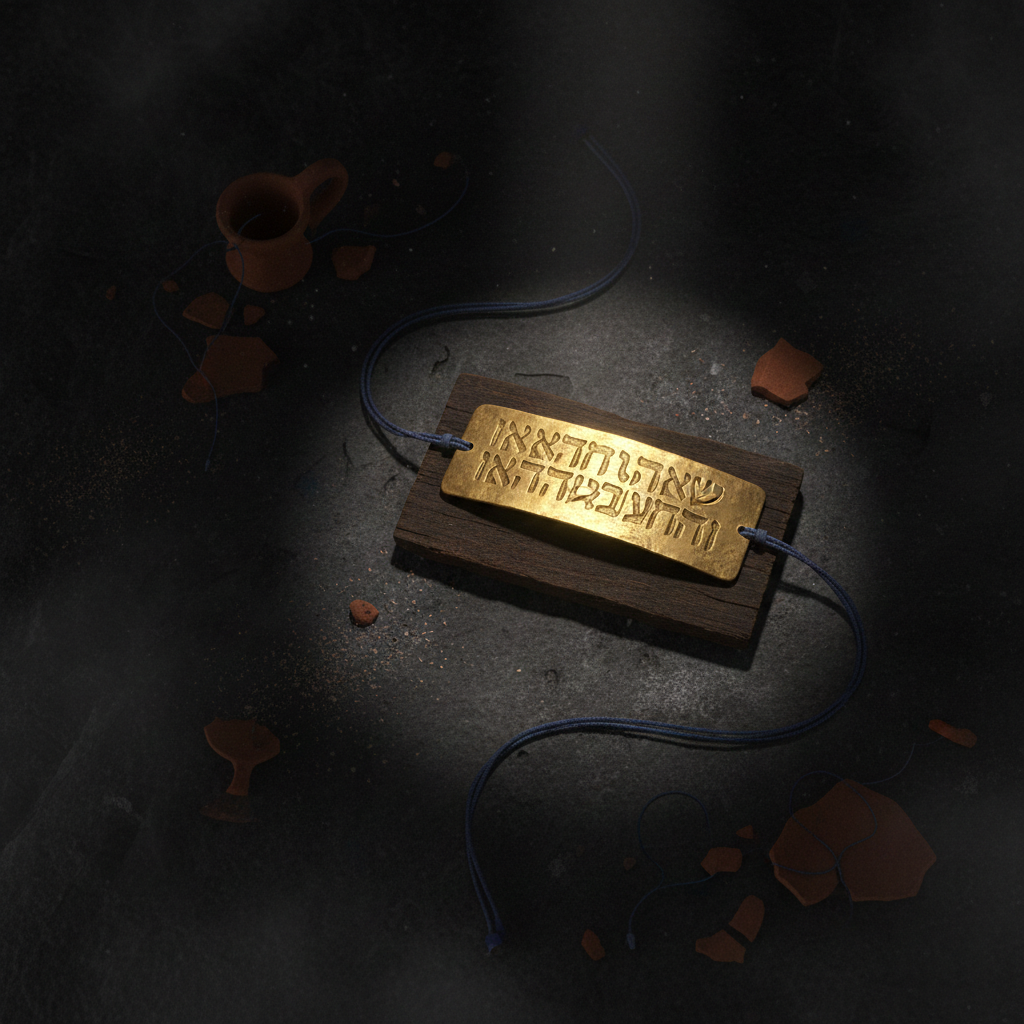
Nezer HaKodesh (נזר הקדש). The crown of holiness. The plate of pure gold that was on the forehead of the high priest.
The object: Exodus 28:36-38
וְעָשִׂיתָ צִּיץ זָהָב טָהוֹר וּפִתַּחְתָּ עָלָיו פִּתּוּחֵי חֹתָם קֹדֶשׁ לַיהוה veasita tsits zahav tahor upitachta alav pituchei chotam KODESH LAyhwh “And you shall make a plate of pure gold, and engrave upon it engravings of a seal: HOLINESS TO yhwh.”
Three forensic data points in this single verse:
- Material: pure gold (zahav tahor) – wealth
- Method: seal engraving (pituchei chotam) – permanent, indelible
- Inscription: קדש ליהוה (KODESH LAyhwh) – “Holiness to Yahweh (יהוה — yhwh; trad. “Jehovah”1)”
Verse 38 completes:
וְהָיָה עַל מֵצַח אַהֲרֹן vehayah al metsach Aharon “And it shall be upon the forehead of Aaron.”
Location: forehead. Function: identification of belonging. Method: permanent engraving like a seal. Inscription: name of yhwh.
gematria-o-codigo-numerico-escondido-na-biblia/" class="autolink" title="gematria">gematria">The calculation: standard Hebrew gematria
No manipulation. No kabbalistic system. Standard Hebrew values that any Hebrew student knows:
First word: נזר (NEZER = crown/diadem)
| Letter | Name | Value |
|---|---|---|
| נ | Nun | 50 |
| ז | Zayin | 7 |
| ר | Resh | 200 |
| Total | 257 |
Second word: הקדש (HAKODESH = the holiness)
| Letter | Name | Value |
|---|---|---|
| ה | He | 5 |
| ק | Qof | 100 |
| ד | Dalet | 4 |
| ש | Shin | 300 |
| Total | 409 |
Textual source: Leviticus 8:9
The textual source of the expression appears in Leviticus 8:9 (WLC) —
וַיָּ֣שֶׂם עַל־הַמִּצְנֶ֗פֶת אֶל־מ֤וּל פָּנָיו֙ אֵ֣ת צִ֤יץ הַזָּהָב֙ נֵ֣זֶר הַקֹּ֔דֶשׁ כַּאֲשֶׁ֛ר צִוָּ֥ה יְהוָ֖ה אֶת־מֹשֶֽׁה
“And he placed on the turban, facing his face, the flower of gold, the crown of holiness (נֵזֶר הַקֹּדֶשׁ), as Yahweh (yhwh) commanded Moses.” — Leviticus 8:9
Final sum
| Component | Value |
|---|---|
| נזר (Nezer) | 257 |
| הקדש (HaKodesh) | 409 |
| TOTAL | 666 |
No hidden ciphers. No alternative systems. Standard gematria. The result is 666.
Easter Egg: two millennia of gematria applied to names of Roman emperors (Nero, Domitian, Caligula) require alphabet conversion, textual variants and linguistic acrobatics. The sacerdotal crown requires only summing the Hebrew letters. Standard. Direct.
The 5-layer verification chain
The discovery does not stand alone. It must withstand cross-verification. Five layers of evidence:
Layer 1 – Textual (location)
| Text | Location | Object |
|---|---|---|
| Ex 28:38 | Forehead of the high priest | Gold plate |
| DES 13:16 | Forehead (μέτωπον, metopon) | Mark of the beast |
| DES 14:1 | Forehead of the 144,000 | Name of the Father |
| DES 22:4 | Forehead of the servants | His name |
Same anatomical location. Four texts. No contradiction.
Layer 2 – Gematric (numerical value)
נזר הקדש = 257 + 409 = 666
The number of DES 13:18 is the gematric value of the object on the priest’s forehead in Exodus 28. The connection is mathematical.
Layer 3 – Inferential (holy insignia = name of yhwh)
The inscription on the plate is קדש ליהוה – “Holiness to yhwh.” The plate carries the name of Yahweh (yhwh). DES 13:17 says the mark is “the name of the beast or the number of its name.” The sacerdotal plate is literally the name of Yahweh (yhwh) engraved as a seal.
Layer 4 – Functional (authority -> name -> mark -> commerce -> number)
The functional chain of DES 13 finds correspondence in the sacerdotal system:
| DES 13 | Sacerdotal System |
|---|---|
| Authority received (v.2) | Priesthood instituted by Yahweh (yhwh) (Ex 28:1) |
| Name on the mark (v.17) | KODESH LAyhwh on the plate (Ex 28:36) |
| Mark on the forehead (v.16) | Plate on Aaron’s forehead (Ex 28:38) |
| Commercial control (v.17) | Priests controlled offerings, tithes, Temple commerce |
| Number 666 (v.18) | נזר הקדש = 666 |
Layer 5 – Historical (Adonikam = restoration of the system)
Ezra 2:13 – 666 sons of Adonikam (“My Lord Has Risen”) return to rebuild the Temple. The sacerdotal system, including the nezer hakodesh crown, is restored. The mortal wound is healed (DES 13:3).
The seal as engraving method
The text of Exodus 28:36 uses the expression פִּתּוּחֵי חֹתָם (pituchei chotam) – “engravings of a seal.” The word חֹתָם (chotam) is the same root used for royal seals, property seals, authentication seals.
The sacerdotal plate was not an ornament. It was an identity seal – engraved permanently, indelibly, like a royal signet. The mark of DES 13:16 uses χάραγμα (charagma), which means “engraving, impression, permanent mark.”
Both terms – chotam and charagma – describe the same type of object: a permanent mark of identification and belonging.
What tradition did with this
Tradition ignored the Hebrew calculation for two millennia. Instead of summing the letters of the sacerdotal crown, it preferred to:
- Convert “Nero Caesar” to Hebrew (נרון קסר = 666) – requiring a specific textual variant
- Search for political leaders whose names sum to 666 in some system
- Project 666 into the future as a microchip, barcode or digital currency
None of these approaches begins with the text. All begin with an external thesis and force the text to fit.
The forensic approach begins with the text: DES 13:18 says “calculate the number.” The text describes a mark on the forehead. The OT has an object on the priest’s forehead. That object sums to 666. Done.
Easter Egg: the priest’s crown was on the forehead. The mark of the beast is on the forehead. The crown sums to 666. The mark is 666. The text did not need Nero.
Conclusion
NEZER HAKODESH – the crown of holiness, the plate of pure gold engraved with the name of Yahweh (yhwh), placed on the forehead of the high priest of Israel – sums to 666 in standard Hebrew gematria.
The 5-layer cross-verification confirms: textual (forehead), gematric (666), inferential (name of yhwh), functional (chain of authority) and historical (restoration by Adonikam).
The 666 of DES 13:18 does not point outside the códices. It points inside – to the most sacred sacerdotal insignia of the system of yhwh.
“You read. And the interpretation is yours.”
Artificial form: vowels from Adonai (אֲדֹנָי → a, o, a) placed over consonants YHWH — Masoretic qere perpetuum. Medieval Latin readers merged both, producing “YeHoVaH” — a hybrid that never existed as a Hebrew word. The most accepted academic reconstruction is Yahweh /jah.ˈweh/, based on Greek transcriptions (Ιαβε — Clement of Alexandria, ~200 AD; Ιαουε — Theodoret of Cyrus, ~450 AD), abbreviated biblical forms (Yah — הַלְלוּ יָהּ), theophoric names (Yahu/Yeho — Eliyahu, Yehoshua) and Samaritan oral tradition (Yabe/Yawe). ↩︎