Public source text: WLC (Westminster Leningrad Codex) + Nestle 1904. Translation: Belem-2025 Bible translation — literal, rigid, directly from the public códices.
Exclusive source: ENIGMA 666 Dossier (consolidated ROCHA) + Beast of the Earth Dossier + Enigmatic Elements Catalog (Forensic Unveiling School Belem an.C-2039).
The crown no one saw
The previous article (Nezer HaKodesh — The Priestly Crown That Sums to 666) demonstrated the gematria-o-codigo-numerico-escondido-na-biblia/" class="autolink" title="gematria">gematria calculation. This article investigates what that calculation reveals when cross-referenced with the installation mechanics described in the códices — and why the invisibility of the nezer is the most important forensic datum of the entire enigma.
Tradition imagines the high priest with a gleaming gold plate on his forehead, visible to all. The text describes something else. The plate sat beneath the turban. The nezer was a hidden crown. A mark of authority that only the bearer knew he carried.
And who implemented this marking system? Moses. The Beast of the Earth (UNV 13:11). Axiom 8/8 of the Forensic Unveiling School.
The text: Exodus 28:36-38 and Leviticus 8:9
Exodus 28:36 — The fabrication
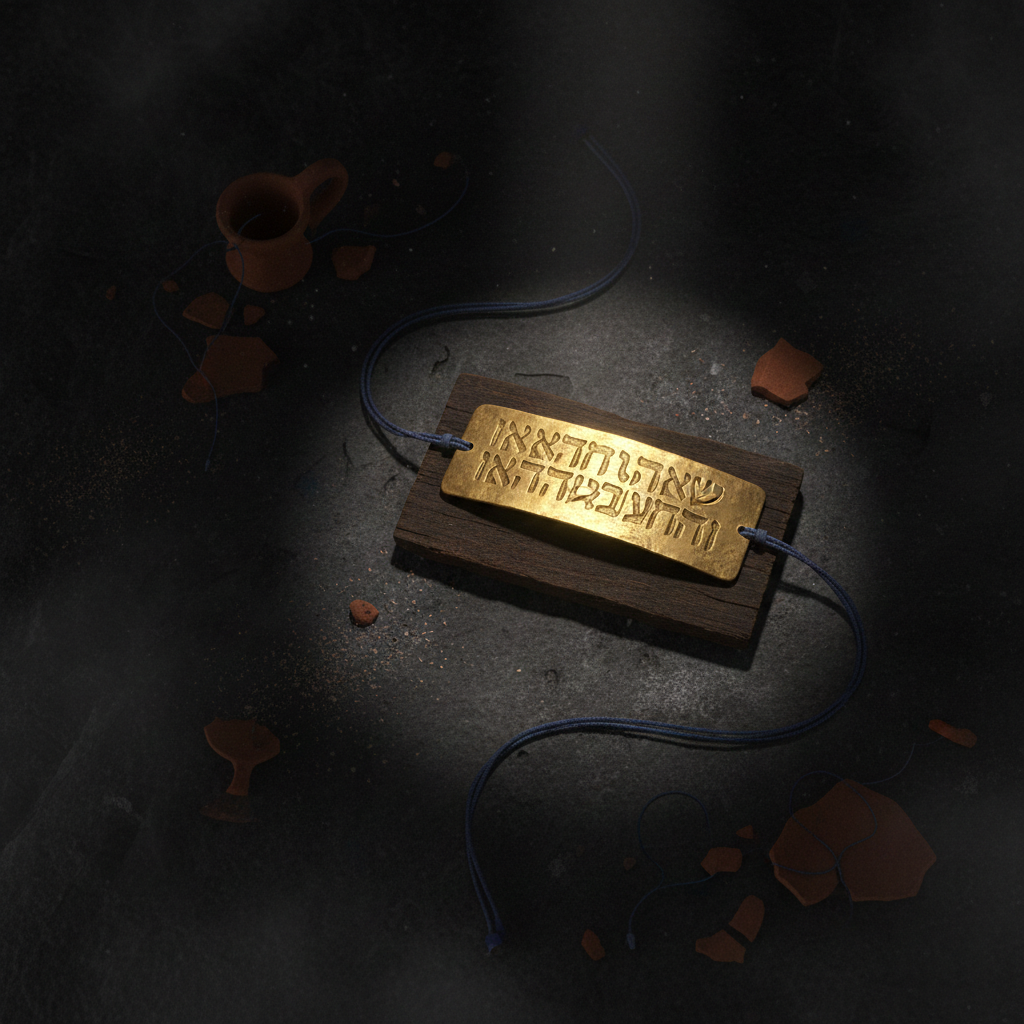
וְעָשִׂיתָ צִּיץ זָהָב טָהוֹר וּפִתַּחְתָּ עָלָיו פִּתּוּחֵי חֹתָם קֹדֶשׁ לַיהוה veasita tsits zahav tahor upitachta alav pituchei chotam QODESH LAyhwh “And you shall make a plate of pure gold, and engrave upon it engravings of a seal: HOLINESS TO yhwh.”
Three critical data points:
| Element | Hebrew | Forensic meaning |
|---|---|---|
| Material | זָהָב טָהוֹר (zahav tahor) | Pure gold — concentrated wealth |
| Method | פִּתּוּחֵי חֹתָם (pituchei chotam) | Engravings of a seal — permanent, indelible mark |
| Inscription | קֹדֶשׁ לַיהוה (QODESH LAyhwh) | “Holiness to Yahweh (יהוה — yhwh; trad. “Jehovah”1)” — the name of Yahweh (yhwh) engraved |
Exodus 28:37 — The attachment
וְשַׂמְתָּ אֹתוֹ עַל פְּתִיל תְּכֵלֶת וְהָיָה עַל הַמִּצְנָפֶת vesamta oto al petil tekhelet vehayah al hamitsnefet “And you shall put it on a blue cord, and it shall be upon the turban.”
The plate is fastened upon the turban (מִצְנֶפֶת, mitsnefet). Not directly on the skin. On the covering.
Exodus 28:38 — The location
וְהָיָה עַל מֵצַח אַהֲרֹן vehayah al metsach Aharon “And it shall be upon the forehead of Aaron.”
Leviticus 8:9 — The actual installation
וַיָּשֶׂם עָלָיו אֶת הַמִּצְנֶפֶת וַיָּשֶׂם עַל הַמִּצְנֶפֶת אֶל מוּל פָּנָיו אֵת צִיץ הַזָּהָב נֵזֶר הַקֹּדֶשׁ vayasem alav et hamitsnefet vayasem al hamitsnefet el mul panav et tsits hazahav nezer hakodesh “And he placed upon him the turban, and he placed upon the turban, in front of his face, the gold plate — the nezer hakodesh.”
Here is the installation sequence that Leviticus 8:9 documents:
| Step | Action | Result |
|---|---|---|
| 1 | Places the turban (mitsnefet) on the head | Head covered |
| 2 | Places the gold plate (tsits hazahav) upon the turban | Plate on fabric, not on skin |
| 3 | Designation: nezer hakodesh | The plate is named “crown of holiness” |
The plate was not exposed on bare skin. It sat upon the turban — covered by layers of fabric, only partially visible or completely hidden beneath the folds of linen.
The operator: Moses installs the system
And who performed this ceremony? The verse is explicit. Leviticus 8:9 falls within the narrative of Leviticus 8:1-36 — the priestly consecration. The subject of every action is Moses.
וַיִּקַּח מֹשֶׁה אֶת שֶׁמֶן הַמִּשְׁחָה vayiqqach Mosheh et shemen hammishchah “And Moses took the anointing oil.” — Lv 8:10
Moses is the one who:
- Dresses Aaron in the priestly garments (Lv 8:7)
- Places the turban (Lv 8:9a)
- Fixes the nezer hakodesh upon the turban (Lv 8:9b)
- Anoints the tabernacle and everything in it (Lv 8:10)
- Anoints Aaron (Lv 8:12)
The Beast of the Earth (UNV 13:11) implements the marking system of the first beast. Moses did not create the system — Yahweh (yhwh) commanded it (Ex 28:1-43). But Moses is the executor. The operational agent who places the mark on the forehead of the first priest.
This is exactly what UNV 13:12 describes:
kai ten exousian tou protou theriou pasan poiei enopion autou “And all the authority of the first beast it exercises before it.”
Moses exercises Yahweh (yhwh)’s authority. Installs the priestly system. Places the mark.
The calculation: why 666
The calculation was already demonstrated in the previous article, but the full decomposition is necessary here for cross-referencing with UNV 13:18.
נֵזֶר (NEZER) — crown, diadem, consecration
| Letter | Name | Value |
|---|---|---|
| נ | Nun | 50 |
| ז | Zayin | 7 |
| ר | Resh | 200 |
| Total | 257 |
הַקֹּדֶשׁ (HAKODESH) — the holiness
| Letter | Name | Value |
|---|---|---|
| ה | He | 5 |
| ק | Qof | 100 |
| ד | Dalet | 4 |
| ש | Shin | 300 |
| Total | 409 |
Sum
| Component | Value |
|---|---|
| נזר (Nezer) | 257 |
| הקדש (HaKodesh) | 409 |
| TOTAL | 666 |
Standard Hebrew gematria. Canonical values. No manipulation.
The connection to UNV 13:18
hode he sophia estin; ho echon noun psephisato ton arithmon tou theriou; arithmos gar anthropou estin; kai ho arithmos autou hexakosioi hexekonta hex. “Here is wisdom. Let the one who has understanding calculate the number of the beast, for it is a number of man, and its number: six hundred sixty-six.”
Three Greek terms require attention:
| Greek term | Transliteration | Meaning |
|---|---|---|
| ψηφισάτω | psephisato | “calculate” — aorist imperative, punctual action |
| ἀριθμὸν τοῦ θηρίου | arithmon tou theriou | “number of the beast” — possessive genitive |
| ἀριθμὸς ἀνθρώπου | arithmos anthropou | “number of man” — qualitative genitive |
The text says: calculate. The number belongs to the beast. And it is a human number — not angelic, not mystical, not encrypted. A number that a human being can calculate with standard gematria.
נזר הקדש = 666. The most direct calculation possible.
Invisibility as forensic datum
Here is the point that no previous investigation identified: the nezer was invisible.
Textual evidence
The turban (mitsnefet) was a voluminous piece of linen wrapped around the head. The gold plate was fastened upon the turban, not upon the skin. In Leviticus 8:9, the sequence is explicit: first the turban, then the plate upon the turban.
The term אֶל מוּל פָּנָיו (el mul panav) — “in front of his face” — indicates that the plate was positioned on the front of the turban. But the turban was not an open cap. It was an enveloping covering. The layers of linen covered and wrapped around the plate.
Forensic implication
| Aspect | Nezer hakodesh (Ex 28 / Lv 8) | Mark of the beast (UNV 13:16) |
|---|---|---|
| Location | Forehead (metsach) | Forehead (metopon) |
| Visibility | Hidden beneath the turban | Implicit — does not describe visibility |
| Method | Seal engraving (chotam) | Engraving/mark (charagma) |
| Content | Name of Yahweh (yhwh) | Name of the beast or number of its name |
| Value | 666 | 666 |
The crown is invisible to everyone — except the one who bears it and the one who installed it. The high priest knows he carries the mark. Moses knows he placed it. The people see the turban. They do not see the plate.
Easter Egg: UNV 13:16 says the mark is placed on the forehead or on the right hand. The nezer hakodesh goes on the forehead — hidden. The tefillin (Ex 13:9, 16; Dt 6:8) go on the hand and between the eyes — visible. Two forms of the same mark. One hidden (priestly). One visible (popular). The complete system.
The Nazirite vow: nezer as separation — Numbers 6:1-21
The root נזר (nzr) does not appear only in the priestly crown. It is the root of the Nazirite vow (נָזִיר, nazir) described in Numbers 6.
כׇּל יְמֵי נֵזֶר נָזְרוֹ… קָדֹשׁ הוּא לַיהוה kol yemei nezer nazro… qadosh hu LAyhwh “All the days of the nezer of his separation… holy he is to yhwh.” — Nm 6:8
| Term | Text | Meaning |
|---|---|---|
| נֵזֶר | nezer | Separation, consecration, crown |
| נָזִיר | nazir | The separated one, the consecrated one |
| קָדֹשׁ לַיהוה | qadosh LAyhwh | “Holy to Yahweh (yhwh)” — same formula as the plate |
The same root. The same formula. The nazir is “holy to Yahweh (yhwh)” (qadosh LAyhwh) — the same inscription engraved on the high priest’s plate (QODESH LAyhwh). The nezer of the nazir is invisible — it is not a plate, not a visible mark. It is a state. A separation that only the bearer and Yahweh (yhwh) know.
The system of Yahweh (yhwh) operates through invisible marking. The mark does not need to be seen. It needs to be carried.
The crown of thorns: the contrast — John 19:2
kai hoi stratiotai plexantes stephanon ex akanthon epethekan autou te kephale “And the soldiers, having woven a crown of thorns, placed it upon his head.”
| Attribute | Nezer hakodesh (yhwh) | Stephanos ex akanthon (Jesus) |
|---|---|---|
| Material | Pure gold (zahav tahor) | Thorns (akanthon) |
| Function | Priestly authority | Public humiliation |
| Visibility | Invisible — beneath the turban | Visible — exposed to all |
| Inscription | “Holiness to Yahweh (yhwh)” | “King of the Jews” (Jn 19:19 — plate on the cross) |
| Purpose | To hide power | To display suffering |
| Gematria value | 666 | — |
The system of Yahweh (yhwh) places a gold crown hidden. The system of Jesus places a crown of thorns exposed. The authority of Yahweh (yhwh) operates in concealment. The authority of Jesus operates in the visible, in public suffering, in total vulnerability.
The nezer hakodesh is power disguised as holiness. The crown of thorns is holiness disguised as weakness.
Easter Egg: The Greek word for the crown of Jesus is stephanos — crown of victory, not of royalty. The priestly crown is nezer — crown of separation/consecration. Two types of crown. Two systems. Two opposite purposes.
The convergence map
           NEZER HAKODESH (נזר הקדש = 666)
                     |
        ┌────────────┼────────────┐
        |            |            |
   FABRICATOR     INSTALLER     BEARER
   yhwh           Moses         Aaron
   (Sea Beast)    (Earth Beast) (high priest)
   Ex 28:36       Lv 8:9        Ex 28:38
        |            |            |
   COMMANDS the   EXECUTES the  CARRIES the
   system         installation  mark on forehead
        |            |            |
        └────────────┼────────────┘
                     |
              UNV 13:11-18
        Earth Beast implements
        mark of the Sea Beast
        number = 666
        location = forehead
                     |
              CONTRAST:
        Jesus = crown of thorns
        VISIBLE, public suffering
        Stephanos ≠ Nezer
Stress test
| Criterion | Result |
|---|---|
| Verifiable original Hebrew text (WLC)? | Yes — Ex 28:36-38, Lv 8:9, Nm 6:1-21 |
| Standard gematria without manipulation? | Yes — nun(50)+zayin(7)+resh(200)+he(5)+qof(100)+dalet(4)+shin(300) = 666 |
| Nezer fastened upon the turban (invisible)? | Yes — Lv 8:9 explicit sequence |
| Moses as installer? | Yes — Lv 8:1-36 entire chapter, subject of the action |
| Connection to UNV 13:18 (arithmos tou theriou)? | Yes — number of the beast = 666 = nezer hakodesh |
| Connection to UNV 13:16 (mark on forehead)? | Yes — same anatomical location (metsach/metopon) |
| Root nzr in Nm 6 (nazir = holy to yhwh)? | Yes — same formula qodesh/qadosh LAyhwh |
| Contrast with crown of thorns? | Yes — Jn 19:2, visible vs. invisible |
| Compatible with axiom Moses = Beast of the Earth? | Yes — implements Yahweh (yhwh)’s system |
| Self-sufficient (66 Books + códices)? | Yes — zero external sources |
Conclusion — the mark no one searched for
The nezer hakodesh is the mark that tradition never investigated — because it was always hidden. Beneath the turban. Beneath layers of linen. Beneath two millennia of religious reverence that transformed Yahweh (yhwh)’s priestly insignia into a decorative ornament and projected the 666 into a future that never needed to exist.
The data:
- Nezer hakodesh (נזר הקדש) = 666 in standard gematria
- Engraved with pituchei chotam — seal engravings (permanent mark)
- Inscription: QODESH LAyhwh — the name of Yahweh (yhwh)
- Location: forehead (metsach) — same location as UNV 13:16 (metopon)
- Fastened beneath the turban — invisible
- Installed by Moses — the Beast of the Earth
- Commanded by Yahweh (yhwh) — the Sea Beast
UNV 13:18 says: “calculate the number of the beast.” The number is calculated. The mark is located. The installer is identified. The fabricator is documented.
The crown was invisible. The investigation is not.
“You read. And the interpretation is yours.”
Artificial form: vowels from Adonai (אֲדֹנָי → a, o, a) placed over consonants YHWH — Masoretic qere perpetuum. Medieval Latin readers merged both, producing “YeHoVaH” — a hybrid that never existed as a Hebrew word. The most accepted academic reconstruction is Yahweh /jah.ˈweh/, based on Greek transcriptions (Ιαβε — Clement of Alexandria, ~200 AD; Ιαουε — Theodoret of Cyrus, ~450 AD), abbreviated biblical forms (Yah — הַלְלוּ יָהּ), theophoric names (Yahu/Yeho — Eliyahu, Yehoshua) and Samaritan oral tradition (Yabe/Yawe). ↩︎