Three things disappear, not two
Public source text: WLC (Westminster Leningrad Codex) + Nestle 1904. Translation: Belem-2025 Bible translation – literal, rigid, straight from the public códices.
When the eschatological tradition speaks of the “new heaven and new earth,” it usually summarizes: the old world passes and the new begins. Simple. Clean. But the Greek text of DES 21:1 does not merely say that. It says something more — and that “something more” is the part that most people ignore.
The Greek text — DES 21:1
Καὶ εἶδον οὐρανὸν καινὸν καὶ γῆν καινήν· ὁ γὰρ πρῶτος οὐρανὸς καὶ ἡ πρώτη γῆ ἀπῆλθαν, καὶ ἡ θάλασσα οὐκ ἔστιν ἔτι Kai eidon ouranon kainon kai gen kainen; ho gar protos ouranos kai he prote ge apelthan, kai he thalassa ouk estin eti “And I saw a new heaven and a new earth; for the first heaven and the first earth passed away, and the sea no longer exists.”
The verse presents three disappearances, not two:
| # | What disappears | Greek | Observation |
|---|---|---|---|
| 1 | First heaven | ὁ πρῶτος οὐρανός | Adjective “first” (πρῶτος) present |
| 2 | First earth | ἡ πρώτη γῆ | Adjective “first” (πρώτη) present |
| 3 | The sea | ἡ θάλασσα | WITHOUT the adjective “first” |
The heaven is called “first” (πρῶτος). The earth is called “first” (πρώτη). But the sea is not called “first sea.” It is called simply “the sea” (ἡ θάλασσα) — with the definite article. It is not “the first sea that passes to give way to a new sea.” It is “the sea that ceases to exist.” Full stop.
Easter Egg: The text distinguishes the sea from the other cosmic structures. Heaven and earth are replaced (first → new). The sea is eliminated — without substitute. In the new creation, there is no sea.
οὐκ ἔστιν ἔτι — The formula of nonexistence
The expression οὐκ ἔστιν ἔτι (ouk estin eti) — “no longer exists” — is a formula of ontological annihilation. It is not “was transformed.” It is not “was renewed.” It is “does not exist.”
This same formula appears in DES 18:21-22 about Babylon:
| Reference | Subject | Formula |
|---|---|---|
| DES 18:21 | Babylon | οὐ μὴ εὑρεθῇ ἔτι (“shall never be found”) |
| DES 18:22 | Music, craftsmanship, mill | οὐ μὴ ἀκουσθῇ ἔτι (“shall never be heard”) |
| DES 18:23 | Lamplight | οὐ μὴ φάνῃ ἔτι (“shall never shine”) |
| DES 21:1 | The sea | οὐκ ἔστιν ἔτι (“no longer exists”) |
The sea receives the same treatment as Babylon: absolute cessation of existence. There is no “new sea” just as there is no “new Babylon.”
The sea in the Unveiling: where the beast comes from
The term θάλασσα (thalassa) appears at critical points in the Unveiling:
| Reference | Context |
|---|---|
| DES 4:6 | Before the throne, sea of glass (θάλασσα ὑαλίνη) |
| DES 5:13 | Creatures in the sea praising |
| DES 7:1-3 | Four angels holding winds so as not to damage the sea |
| DES 8:8-9 | Second trumpet: mountain of fire cast into the sea; third of the sea turns to blood |
| DES 10:2 | Strong Angel with right foot on the sea |
| DES 13:1 | “And I saw rising from the sea a beast” (ἐκ τῆς θαλάσσης θηρίον) |
| DES 15:2 | Sea of glass mixed with fire |
| DES 16:3 | Third bowl: sea turns to blood |
| DES 18:17-19 | Sailors lament the fall of Babylon |
| DES 21:1 | “The sea no longer exists” |
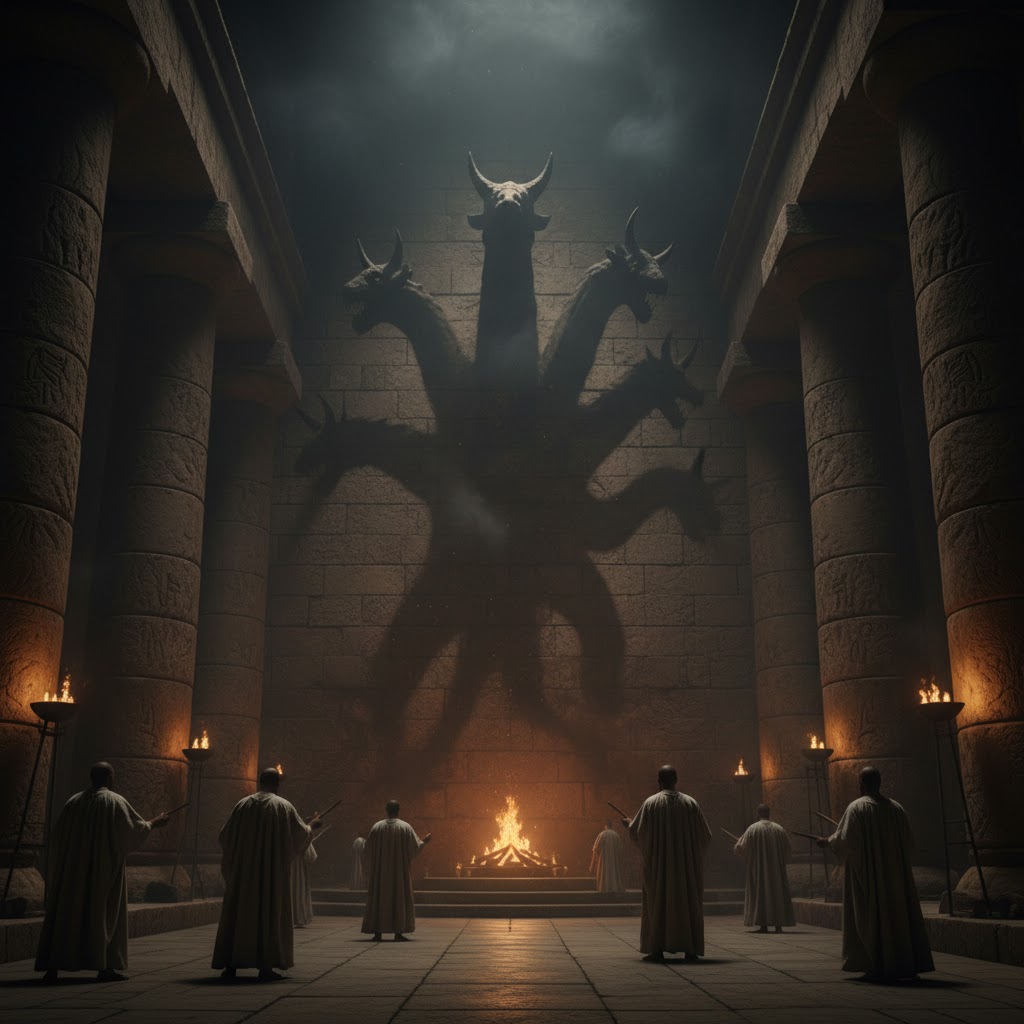
The most relevant forensic data point: the Beast of the Sea emerges from θάλασσα (DES 13:1). The sea is the origin of the bestial system. And in DES 21:1, that origin is eliminated.
The sea as structural source
If the sea were merely saltwater, its elimination would be a geographic detail. But in the symbolic system of the Unveiling, the sea is something more:
| Function of the sea | Reference | Description |
|---|---|---|
| Origin of the beast | DES 13:1 | The beast rises from the sea |
| Target of judgment | DES 8:8-9 | Third of the sea turns to blood |
| Repository of the dead | DES 20:13 | Sea delivers up its dead |
| Object of dominion | DES 10:2 | Angel steps on the sea |
| Transport system | DES 18:17 | Sailors profit from Babylon |
The sea is simultaneously: source of bestial power, economic system (maritime routes), repository of the dead and target of judgment. When DES 21:1 declares that “the sea no longer exists,” it is not talking about oceanography. It is declaring that the structural source of the old system has been eliminated.
καινός vs νέος — New in what way?
The adjective used for “new” is καινός (kainos), not νέος (neos).
| Adjective | Transliteration | Meaning |
|---|---|---|
| καινός | kainos | New in quality, unprecedented, different |
| νέος | neos | New in time, recent, young |
The heaven is not “young” — it is qualitatively different. The earth is not “recent” — it is unprecedented. The new creation is not a reform of the old. It is a qualitative replacement.
What the first heaven and the first earth were
To understand what disappears, one must trace what “first heaven” and “first earth” mean in the Unveiling:
The first heaven:
- Where the celestial war occurred (DES 12:7-9)
- From which the dragon was cast to the earth (DES 12:9)
- Where the silence of half an hour happened (DES 8:1)
- Where trumpets sounded and bowls were poured out
The first earth:
- Where the dragon fell (DES 12:12)
- Where the Beast of the Earth emerged (DES 13:11)
- Where Babylon reigned (DES 17-18)
- Where the saints were martyred
Both — first heaven and first earth — are stages of conflict. The new creation eliminates the stages of conflict, not merely the actors.
The declaration of the one seated on the throne — DES 21:5
DES 21:5 — “And the one seated upon the throne said: Behold, I make new (καινά, kaina) all things (πάντα, panta).”
“All things” (πάντα) — without exception. What is excluded from this renewal? The sea. Babylon. Death. Hades. The beast. The dragon. The false prophet. These are not renewed — they are eliminated. “Making all things new” does not include renewing evil. It includes replacing the structure where evil operated.
Easter Egg: “I make all things new” is not restoration. It is replacement. The verb ποιέω (poieo) — “I make” — is creative, not reparative. It is not repair. It is original production.
The heaven and the earth flee — and do not return
In DES 20:11, heaven and earth flee from the white throne. In DES 21:1, new heaven and earth appear. The sequence:
- Heaven and earth flee (DES 20:11) — unable to remain
- Final judgment happens (DES 20:12-15) — in the cosmic void
- New heaven and new earth arise (DES 21:1) — qualitative creation
- The sea does not exist (DES 21:1) — elimination of the bestial source
The interval between 20:11 and 21:1 is the moment when there is no cosmos. The judgment happens in a space beyond creation. And the new creation starts from zero — without carrying the vices of the previous one.
Conclusion
DES 21:1 does not merely describe cosmic renewal. It describes the selective elimination of three structures: the first heaven (stage of the celestial war), the first earth (stage of the terrestrial conflict) and the sea (source of the beast and the bestial system).
The heaven and the earth are replaced by qualitatively new versions (καινός). The sea is not replaced — it is eliminated. In the new creation, the source from which the beast emerged simply no longer exists.
What disappears is not merely the old world. It is the very possibility of the bestial system regenerating itself.
“You read. And the interpretation is yours.”