Public source text: WLC (Westminster Leningrad Codex) + Nestle 1904. Translation: Belem-2025 Bible translation — literal, rigid, straight from the public códices.
1. The Viral Story — and What It Left Out
A news story went viral. The headline said something like: “Codes left by Jesus 2,000 years ago are being explained by neuroscience.” Millions of clicks. Thousands of shares. Comments split between those who celebrated (“science confirming the Bible!”) and those who ridiculed (“more mystical nonsense”). And neither side stopped to ask the question an investigator asks first: what exactly was said — and what was left out?
What the story got right: the human brain is a pattern-detecting machine. Neuroscience confirms this. The neural networks of the temporal lobe — particularly the fusiform gyrus and the association areas — evolved to identify regularities in the environment. See a face. Recognize a voice. Anticipate a threat. The brain that did not detect patterns died before reproducing. What survived was the pattern machine you carry inside your skull right now, at this very moment, as you read these words and your visual cortex is already organizing these letters into familiar sequences, even before you finish reading this sentence.
Up to this point, the story was correct. Patterns exist. The brain detects them. That is biology. That is verifiable. That is data.
What the story got wrong — and got wrong fatally — was the next leap. From the verifiable fact (“the brain detects patterns”) to the unverified conclusion (“therefore, the codes of Jesus are being revealed by science”). That leap is exactly what the Forensic Unveiling School Belem an.C-2039 identifies, catalogues and rejects as method. Detecting a pattern is not the same as interpreting it. Measuring a textual coincidence is not the same as declaring its meaning. And the difference between these two operations — measuring and interpreting — is the difference between investigation and guessing.
The viral story committed the oldest methodological sin of religious tradition: it confused detection with revelation. It saw that the brain finds patterns and concluded that the patterns found are necessarily true, divine and incontestable. But the brain that finds patterns is the same brain that sees faces in clouds. And that detail — that brutal detail — is where the investigation begins.
I am a police officer. When I arrive at a crime scene, my brain also sees patterns — that is what I was trained for. But forensic training adds a layer that the viral story ignored: the verification protocol. The investigator does not celebrate the first connection his brain offers. He catalogues it, tests it, measures it and — frequently — discards it. Because the brain’s first impression is almost always contaminated by bias.
Let me give a police example. I arrive at a homicide scene. There is blood on the floor. There is a knife in the sink. The brain immediately connects: “the knife is the weapon.” Investigative pareidolia. The first hypothesis, the most obvious, the one the brain constructs in milliseconds. But the protocol demands: isolate the knife, send it to forensics, compare the blood on the knife with the victim’s blood, check fingerprints, cross-reference with the database. In half the cases, the knife in the sink was a kitchen knife — used to cut onions three hours earlier. The blood on the floor did not match any mark on the knife. The brain saw a pattern. The forensic protocol dismantled the pattern. And the investigator who trusted the brain without protocol would arrest the innocent person who cut onions.
The viral story delivered the first impression to the reader and called it science. That is not science. It is propaganda with a neurological veneer.
2. The Brain Is a Pattern Machine
You need to understand what is inside your head before opening a codex.
The human nervous system processes approximately 11 million bits of sensory information per second. The conscious cortex — the part that “you” call thought — processes about 50. Fifty bits per second. The rest is processed underneath, in layers of neurological automation that you never perceive. And the main task of these automatic layers is a single one: find patterns. Regularities. Repetitions. Predictable structures. Because predictability, in the evolutionary vocabulary, means survival.
This is not metaphor. It is biological engineering.
The temporal lobe — specifically the fusiform gyrus and the superior temporal sulcus — is specialized in recognizing visual and auditory patterns. It is what allows you to recognize a human face in milliseconds, even before the frontal cortex processes whose face it is. It is what makes you distinguish your mother’s voice among a hundred simultaneous voices. It is what transforms blots of ink into letters and letters into words and words into meaning — all in less than 300 milliseconds.
This system is spectacular. And it is dangerous. Spectacular because without it you would not read this sentence. Dangerous because it has no brakes. No internal filter. No built-in validation criterion.
Dangerous because it does not distinguish between real pattern and invented pattern. The fusiform gyrus that recognizes real faces also “recognizes” faces in electrical outlets, clouds, wall stains and burnt toast. Neuroscience calls this pareidolia — the brain’s tendency to perceive meaningful patterns (especially faces) in random stimuli. You see the Virgin Mary in a moisture stain not because the Virgin Mary is there, but because your fusiform gyrus is doing the job it was selected for: detecting faces. It detects so well that it detects even where there are none.
And there is an even more insidious phenomenon: apophenia. If pareidolia is seeing faces where there are no faces, apophenia is seeing connections where there are no connections. It is the brain connecting disconnected dots and forming a coherent narrative from random data. The gambler who sees a “lucky streak” in the dice. The conspiracist who links unrelated events. The theologian who finds “prophecies” in vocabulary coincidences without measuring the lexeme’s frequency.
Apophenia operates with refinement: it does not merely invent connections — it makes them plausible. The human brain is a compulsive storyteller. When it receives two disconnected points, it constructs a line between them and calls it “destiny,” “providence” or “fulfilled prophecy.” When it receives three disconnected points, it constructs a triangle and calls it “pattern.” And the more the reader invests emotionally in a narrative, the more the brain recruits cognitive resources to defend it — even against contrary evidence. This is neurology, not moral weakness. It is cerebral architecture. The limbic system hijacks the prefrontal cortex when the emotional threat is great enough. And few things are emotionally greater than questioning one’s own religious beliefs.
Apophenia is fed by confirmation bias — the neurological tendency to privilege information that confirms what we already believe and to ignore information that contradicts it. The prefrontal cortex, which should function as an impartial judge, is in practice a defense attorney: it seeks evidence for the thesis the brain has already decided to accept.
These three mechanisms — pareidolia, apophenia and confirmation bias — are survival tools. They were selected because the cost of seeing a false pattern (a scare without danger) is infinitely less than the cost of not seeing a real pattern (death by predator). Statisticians call this the asymmetry between Type I error (false positive: seeing a lion where there is only grass) and Type II error (false negative: not seeing the lion in the grass). On the savanna, the Type I error causes anxiety. The Type II error causes death. Evolution preferred the anxious animal to the dead one. Preferred the fearful animal to the skeptical one.
And now this fearful, paranoid, pattern-addicted animal is sitting reading the Bible — and seeing connections in everything. Seeing “prophecies” in lexical coincidences. Seeing “signs of the times” in everyday events. Seeing the “hand of God” in unmeasured textual echoes. The same brain that sees a face on the Moon sees a prophecy in every verse — because for it, a pattern is a pattern. There is no dedicated circuit to distinguish forensic lexical pattern from theological pareidolia. That distinction requires an external method. Requires an instrument. Requires discipline that the brain does not possess from the factory.
This has direct implications for anyone who opens a biblical codex. If you sit down to read the Unveiling of John already believing the book speaks of the future, your prefrontal cortex will seek — and find — evidence that the book speaks of the future. If you sit down believing that 666 is a Roman emperor, your brain will seek — and find — connections with Nero. If you sit down believing that “holy” means “morally pure,” your brain will read קֹדֶשׁ (qodesh) and project moral purity onto a term that describes a seal of ownership. The brain does not read the text. The brain reads itself through the text.
The question, then, is not “what do I see in the text?” The question is: how many of those connections are real — and how many are theological pareidolia?
3. The Problem: If the Brain Sees Patterns in Everything, How to Separate the Real from the Illusory?
This is the question that religious tradition never asked. Never. In two millennia. And the reason is simple: tradition did not need to ask this question because it had a ready answer for all patterns — “it is a mystery of God.”
When the medieval reader saw a connection between two biblical passages, the ecclesiastical system did not say “measure that connection.” It said “believe.” When the copyist monk noticed a lexical repetition between Exodus and the Unveiling, the system did not say “catalogue the frequency of the lexeme and calculate the probability of random coincidence.” It said “it is the hand of God writing between the lines.” And when someone dared to ask “how do we know this pattern is real and not an illusion?”, the system had the perfect answer: “faith does not need proof.”
See what happened. The brain, biologically programmed to detect patterns in excess, found a system — ecclesiastical tradition — that validated all patterns without exception. The neurological mechanism that generates false positives found a cultural ecosystem that transformed false positives into dogma. Pareidolia became theology. Apophenia became hermeneutics. Confirmation bias became apostolic tradition.
And the result was predictable: two millennia of interpretations built upon unmeasured patterns. Connections no one calculated. Coincidences no one verified. “Prophecies” no one tested against probability. The brain saw what it wanted to see, and tradition blessed everything the brain saw.
What the Protestant Reformation did with papal authority — question — Protestant tradition never did with its own interpretive methods. Luther removed the Pope’s authority and handed it to the text; but never questioned whether the reader’s brain was reliable for reading the text without a measuring instrument. Sola Scriptura — the text as the sole source — is a correct principle that was executed with the wrong tool: the human brain without a forensic protocol. It is like handing a microscope to someone who never learned to calibrate the lens and saying “now, look.”
The Forensic Unveiling School refuses this heritage. Entirely.
The forensic method does not say “believe.” It says “measure.” It does not say “it is a mystery.” It says “it is data — and the data has a score.” When the investigator finds a fiber at the crime scene, he does not say “it is destiny.” He catalogues the fiber, compares it with the database, calculates the probability of random coincidence and records the result. If the result is statistically significant, the fiber becomes a clue. If not, the fiber is discarded.
The patterns in the biblical text demand the same treatment. Measure first. Decide later.
Imagine the scenario: a preacher steps to the pulpit and declares that the word “mystery” in Unveiling 17:5 proves that Babylon is the Catholic Church. The congregation assents. The brain of each listener seeks confirmation — and finds it, because confirmation bias is that efficient. No one raises a hand and asks: “Pastor, how many times does μυστήριον appear in the New Testament? In which contexts? What is the probability of random lexical coincidence between DES 17:5 and 2 Thessalonians 2:7? Is the echo statistically significant or are we facing apophenia?” No one asks because the system does not allow measurement questions. The system only allows confirmation questions: “Amen?”
And here is the part that hurts — the part that disturbs those who built their life upon unmeasured patterns: the forensic protocol does not protect convictions. It tests them. And many do not survive the test. If the pattern you believed was “divine revelation” is, in reality, lexical pareidolia — an echo so common that random coincidence explains 100% of the occurrence — the protocol discards it. Without mercy. Without negotiation. Without pastoral care. Because the investigator who protects the thesis instead of protecting the evidence is not an investigator — he is a defense attorney. And the Forensic Unveiling School does not advocate. It investigates.
4. The Forensic Response: The Easter Egg Engine
The Easter Egg Engine is the tool that the Forensic Unveiling School developed to solve the problem that tradition never faced: how to separate measurable patterns from cerebral illusions in the biblical text.
The Engine operates on the original códices — Westminster Leningrad Codex (Hebrew) and Nestle 1904 (Greek) — and classifies detected patterns into six types. Each type has measurable criteria, a scoring scale from 0 to 100 and an inviolable rule:
THE ENGINE MEASURES — THE ENGINE DOES NOT INTERPRET.
Measurement is objective. Interpretation is the reader’s. Always. Without exception. Without concession.
Think of the Engine as an X-ray machine. The X-ray shows a fracture in the femur. It does not say whether the fracture was caused by a fall, car accident or assault. It shows the fracture. The diagnosis is the doctor’s. The report is the expert’s. The sentence is the judge’s. The X-ray — measures.
The Engine is the X-ray of the biblical text. And the six types of pattern it detects are the six categories of possible fracture.
Before describing them, a note about what makes each type different from the others. The distinction matters because tradition treated all patterns as an undifferentiated mass of “inspiration.” It did not distinguish between a word repetition and a mirrored narrative structure. It did not distinguish between a recurring number and an authorial chiasm. Everything was “the Bible speaks to itself” — a beautiful statement that measures nothing. The Engine separates the types because each type requires a different measurement criterion. The rarity of a lexeme is measured by frequency; the convergence of a structure is measured by the quantity of parallels; the significance of a number is measured by distribution. Different methods for different data. This is the minimum that a serious investigation demands.
Type 1: Lexical Echo
Measurable repetition of a lexeme (word in dictionary form) between two or more textual locations. The rarity of the lexeme functions as a multiplier: the rarer the word, the more significant the echo.
A word that appears 2,000 times in the corpus and repeats in two contexts is not news. The Greek article ὁ (ho, “the”) appears thousands of times — its repetition between two verses means nothing. But a word that appears 4 times in 7,959 verses and connects two opposing contexts is a lexical event with a high score. The formula is simple: low frequency + asymmetric distribution = high relevance. The Engine calculates both factors and generates the score.
Type 2: Numerical Paradox
An identical number or one belonging to the same series that appears in distinct textual locations with apparently different meanings. The Engine registers the numerical coincidence, calculates the distribution and scores it.
Numbers in the códices are not decorative. When the same number appears in distinct contexts, the Engine does not say what it means — it says it exists and measures how improbable the repetition is. The number 7 appears hundreds of times in the Bible — its recurrence, in isolation, has a low score due to high frequency. The number 666 appears in only 4 passages in the entire collection of 66 books — its recurrence has a high score due to extreme rarity. The Engine treats numbers as it treats words: by frequency.
Type 3: Structural Mirror
A narrative macrostructure of one passage that replicates in another passage with verifiable parallels. It is not about individual words — it is about the architecture of the narrative. Corresponding characters, recurring numbers, parallel sequences, inverted outcomes.
The Structural Mirror is the most difficult type to measure — because the temptation of apophenia is maximal here. The brain loves constructing narrative parallels. Two female characters? “It is a mirror!” Two events by the sea? “It is a parallel!” The Engine imposes rigor: it only scores when the converging elements are multiple (at minimum three), verifiable in the códices and independent of each other. Two parallels may be coincidence. Five parallels with lexical anchors are data.
Type 4: Twin Theme
A thematic motif that appears in two or more contexts with verifiable lexical anchors. Different from the Lexical Echo (which measures one lexeme), the Twin Theme measures the co-occurrence of multiple lexemes forming a shared semantic field. When two distinct passages share not just one word, but a cluster of terms from the same field, the lexical intersection is measured and scored.
Type 5: Rare Link
Low-frequency terms — especially lilit-o-nome-que-todas-as-traduções-apagaram/" class="autolink" title="hapax legomenon">hapax legomenon (single occurrence in the corpus) — that by their very rarity create significant connections. The rarer the word, the more significant its presence in a given context. The Engine weighs frequency as a multiplicative factor of relevance.
The rarity scale is straightforward:
| Classification | Frequency | Relevance |
|---|---|---|
| Hapax legomenon | 1 occurrence | Very high |
| Dis legomenon | 2 occurrences | High |
| Tris legomenon | 3 occurrences | Moderate to high |
| Common | 50+ occurrences | Low (in isolation) |
A hapax legomenon at the center of a theologically dense passage is like a rare fingerprint at the crime scene — its mere existence is a notable event that deserves isolation and analysis.
Type 6: Chiasmic Signature
A literary structure in A-B-C-B’-A’ pattern with a defined center, where peripheral elements mirror each other and the center carries the semantic weight. The chiasm is a documented Hebrew literary structure in the códices. The Engine verifies whether the pairs possess lexical or thematic correspondence and whether the center possesses semantic prominence.
| |
The chiasm is an authorial signature. When the pairs A↔A’ and B↔B’ exhibit verifiable lexical correspondence and the center C possesses highlighted semantic charge, the Engine scores the structure as a strong pattern. When the pairs are vague or the correspondence is forced, the score drops. The Engine does not impose chiasms on the text — it verifies whether the text contains them.
Classification by score
Each detected pattern receives a score from 0 to 100:
| Range | Classification | Meaning |
|---|---|---|
| 0-29 | Weak | Coincidence possible, no investigative weight |
| 30-59 | Probable | Significant pattern — merits investigation |
| 60-100 | Strong | High forensic relevance — candidate for clue |
A “Strong” pattern is not automatically true. It is relevant. It deserves to be isolated, investigated and submitted to the complete pipeline of the Unveiling Canvas: CLUE → PROOF → THESIS → AXIOM. The score is not a verdict — it is a calibrated alarm signal.
Six types. Six measurement categories. No interpretation category.
Why is this separation inviolable? Because the moment the Engine interpreted, it would cease being an instrument and become a denomination. It would be one more voice saying “this means that.” And the world already has too many voices saying “this means that” — twenty centuries of voices, each contradicting the previous one, each appealing to the same divine authority that the previous one invoked. The Engine does not join that queue. It leaves the queue. It is not a voice — it is a scale. It weighs the data and delivers the weight. What you do with the weight is your business.
The Engine is a detection instrument. It says: “there is smoke here.” It does not say: “there is a fire here.” The decision about the nature of the smoke — whether it is a barbecue or a catastrophe — is the reader’s. Always the reader’s.
5. Concrete Examples: The Easter Eggs That Exist in the Códices
Theory without data is a sermon. And the Forensic Unveiling School does not give sermons. It does forensic analysis. Therefore: data.
The four examples that follow were extracted from articles already published by the School. Each uses one or more Engine detection types. Each is verifiable in the public códices. And each demonstrates something the viral story did not show: it is not enough to say that “there are codes in the Bible.” One must measure which patterns are statistically significant and which are lexical pareidolia.
Example 1 — πορφυροῦν (porphyroun): The Purple That Connects Jesus to the Prostitute
The lexeme πορφυροῦν (porphyroun — “purple”) appears in the New Testament in only 4 occurrences, distributed among 7,959 verses:
| Passage | Context |
|---|---|
| John 19:2 | Soldiers dress Ἰησοῦς with a purple robe — humiliation |
| John 19:5 | Ἰησοῦς is displayed with the purple robe — public mockery |
| DES 17:4 | The woman wears purple and scarlet — ostentation |
| DES 18:16 | The great city wore purple — lament over the fall |
Frequency: 4 in 7,959 = 0.05% of verses. In John, the purple clothes the victim. In the Unveiling, the purple clothes the oppressor. The same fiber. Two opposite destinies.
The Engine registers: Lexical Echo + Rare Link. Score: high. Because the rarity of the lexeme (0.05%) makes the coincidence statistically significant. If πορφυροῦν appeared 200 times in the NT, the connection would be irrelevant. With 4 occurrences, each one of them weighs.
Now observe the narrative sequence that emerges when we organize the four occurrences chronologically: Jesus receives purple as mockery (Jn 19:2); Jesus is displayed in public wearing purple (Jn 19:5); the Prostitute wears purple as an insignia of power (DES 17:4); the city that wore purple crumbles (DES 18:16). Humiliation → Exposure → Ostentation → Fall. The narrative arc is complete. The fiber that humiliated Jesus is the same fiber that adorns whom the system celebrates — and the same that is lamented when the system falls. This is not pareidolia. This is a thread with four verifiable knots at four distinct textual coordinates.
Easter Egg #1: Religious pareidolia — the brain “invents” faces in clouds; the Engine detects πορφυροῦν in 4 of 7,959 NT verses (0.05%). Pareidolia is illusion. Lexical Echo is measurable data.
Example 2 — “Who Is Like the Beast?” = “Who Is Like You Among the Gods?”
Exodus 15:11, after the crossing of the Red Sea, Israel sings:
מִי כָמֹכָה בָּאֵלִם יהוה mi kamokha baelim yhwh “Who is like you among the gods, Yahweh (יהוה — yhwh; trad. “Jehovah”1)?”
Unveiling 13:4, after the Beast rises from the sea, the earth worships:
τίς ὅμοιος τῷ θηρίῳ tis homoios tō theriō “Who is like the beast?”
The liturgical formula is identical. The structure is identical. “Who is like X?” — a rhetorical question of worship. In Exodus, directed to yhwh. In the Unveiling, directed to the Beast. Both emerge from the sea. Both receive the same form of worship.
The Engine registers: Structural Mirror + transversal Lexical Echo (Hebrew → Greek). The pattern is not invented by the reader’s brain. The pattern is in the text. The liturgical formula is traceable. The structural coincidence is measurable. What it means — that is up to you.
But note what tradition did with this pattern: ignored it. Because if the Unveiling is quoting Exodus, if the rhetorical question of worship to the Beast is the same rhetorical question of worship to Yahweh (yhwh), then the Beast of the Sea is not an unknown future entity — it is an entity Israel already knew. And tradition cannot accept this conclusion without dismantling twenty centuries of futurist eschatology. So the measured pattern became invisible. Not because the brain did not see it — but because tradition censored it.
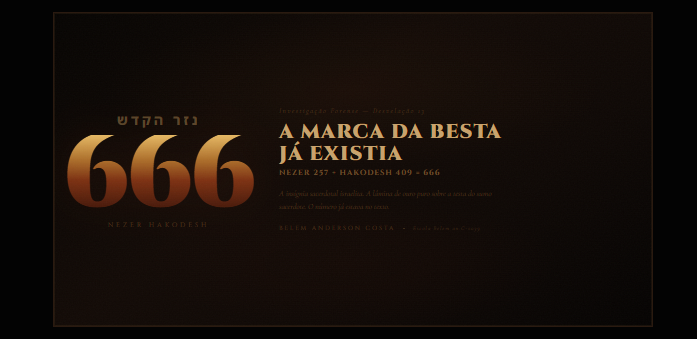
Example 3 — נֵזֶר הַקֹּדֶשׁ (nezer hakodesh) = 666
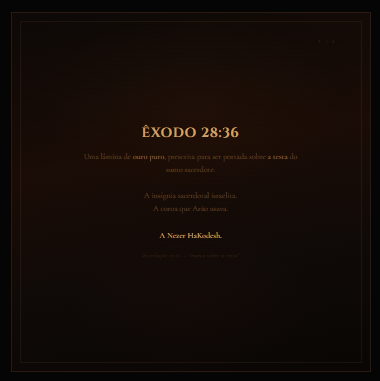
The sacerdotal crown of the high priest — the plate of pure gold engraved with “HOLINESS TO Yahweh (yhwh)” and fixed on the forehead (מֵצַח, metsach) of Aaron — carries the name נֵזֶר הַקֹּדֶשׁ (nezer hakodesh).
The textual source of the expression — Leviticus 8:9 (WLC) —
וַיָּ֣שֶׂם עַל־הַמִּצְנֶ֗פֶת אֶל־מ֤וּל פָּנָיו֙ אֵ֣ת צִ֤יץ הַזָּהָב֙ נֵ֣זֶר הַקֹּ֔דֶשׁ כַּאֲשֶׁ֛ר צִוָּ֥ה יְהוָ֖ה אֶת־מֹשֶֽׁה
“And he placed on the turban, facing his face, the flower of gold, the crown of holiness (נֵזֶר הַקֹּדֶשׁ), as Yahweh (yhwh) commanded Moses.” — Leviticus 8:9
Standard Hebrew gematria-o-codigo-numerico-escondido-na-biblia/" class="autolink" title="gematria">gematria:
| Word | Letters | Values | Total |
|---|---|---|---|
| נזר (nezer) | נ(50) + ז(7) + ר(200) | — | 257 |
| הקדש (hakodesh) | ה(5) + ק(100) + ד(4) + ש(300) | — | 409 |
| TOTAL | 666 |
No manipulation. No kabbalistic system. Standard Hebrew values. The gematria goes from the text to the number (forensic), not from the number to the name (mystical). The object is described in Exodus 28:36-38. It is on the forehead. It is a mark of belonging. It sums to 666. And Unveiling 13:16-18 speaks of a mark on the forehead whose number is 666.
The Engine registers: Numerical Paradox + Lexical Echo (forehead → forehead; mark → mark; 666 → 666). Score: strong. Three vectors converge independently.
And here is the part no denomination wants to hear: mystical gematria spent two millennia searching for 666 in names of Roman emperors, popes and modern dictators. Nero Caesar. Domitian. Napoleon. Hitler. Bill Gates. Each generation found its candidate — because the mystical method works for any name, provided one adjusts language, spelling and counting system. Forensic gematria takes the opposite path: starts from the text (Exodus 28:36), identifies the described object (sacerdotal crown), calculates the value with standard Hebrew gematria (257 + 409 = 666) and discovers that the most feared number of Christian eschatology belongs to the sacerdotal system that the Bible itself describes. The pattern does not point outward. It points inward. And it is measurable. And it is verifiable. And it is devastating.
Example 4 — ἐν τάχει (en takhei): The Text Says “Shortly”
The first verse of the Unveiling declares:
Ἀποκάλυψις Ἰησοῦ Χριστοῦ, ἣν ἔδωκεν αὐτῷ ὁ Θεὸς δεῖξαι τοῖς δούλοις αὐτοῦ ἃ δεῖ γενέσθαι ἐν τάχει — DES 1:1 “Unveiling of Jesus Christos, which Θεός gave to him to show to his servants the things that must happen shortly (ἐν τάχει).”
And the penultimate chapter repeats:
ἃ δεῖ γενέσθαι ἐν τάχει — DES 22:6 “the things that must happen shortly (ἐν τάχει).”
The expression ἐν τάχει (en takhei) — “shortly,” “quickly,” “with swiftness” — appears in the first verse and reappears at the close. It functions as a narrative frame. The text defines itself as urgent, near, imminent.
The Engine registers: Chiasmic Signature (A-A’ frame encompassing the entire book). DES 1:1 opens with ἐν τάχει. DES 22:6 closes with ἐν τάχει. The structure is verifiable. The data is measurable.
And DES 1:3 reinforces: ὁ γὰρ καιρὸς ἐγγύς (ho gar kairos engys) — “for the time is near.” It is not ambiguity. It is not symbolic language. It is an explicit temporal declaration, repeated in the opening frame and the closing frame. The book begins saying “shortly” and ends saying “shortly.” The urgency is architectonic — it is part of the text’s structure, not a rhetorical ornament.
Place the four examples side by side and observe what emerges:
| # | Pattern | Engine Type | What tradition did |
|---|---|---|---|
| 1 | πορφυροῦν in 4 verses | Lexical Echo + Rare Link | Ignored the Jesus↔Prostitute connection |
| 2 | Liturgical formula Ex 15 → DES 13 | Structural Mirror | Read as future prophecy, not as quotation |
| 3 | נזר הקדש = 666 | Numerical Paradox | Searched for 666 outside the sacerdotal system |
| 4 | ἐν τάχει A-A’ frame | Chiasmic Signature | Redefined “shortly” as “in 2,000 years” |
Four patterns. Four measurements. Four data points that tradition suppressed, distorted or ignored — not because the data were weak, but because they pointed in the direction that tradition could not accept: inward.
What tradition did with these data — and with all the others — is the subject of the next section.
Easter Egg #2: Eschatological apophenia — tradition saw “prophecy of the future” in texts that declare ἐν τάχει (shortly, DES 1:1). The brain projected a 2,000-year pattern where the text said “now.”
6. What Tradition Did with the Patterns
Tradition did the worst thing one can do with patterns: it transformed measurements into mysteries. And it did so in a manner so complete, so systematic and so long-lived that the majority of Bible readers do not even realize an alternative exists. Ask any churchgoer: “How do you know the connection you see between two passages is real and not an illusion of your brain?” The most common answer will be silence. The second most common will be: “The Holy Spirit confirms.” An unverifiable answer to a question that demands verification.
When an ancient reader noticed that πορφυροῦν connected Jesus to the Prostitute of the Unveiling, tradition did not say “measure the frequency of the lexeme and determine whether the connection is statistically significant.” Tradition said: “God works in mysterious ways.” And with that sentence — with that sentence of seven words — it killed any possibility of investigation. Because if God works in mysterious ways, there is nothing to measure. If everything is mystery, nothing is data. If the explanation is supernatural, the natural method is dispensable.
When the scribe noticed that ἐν τάχει (“shortly”) was in the first and last chapters of the Unveiling, but the described events had not happened “shortly” according to his temporal perspective, tradition did not say “perhaps our temporal reading is wrong.” It said: “shortly, in God’s time — because for God a thousand years are as a day.” And thus, with an out-of-context quotation from Psalm 90:4, tradition transformed “shortly” into “in 2,000 years” — and no one noticed that the brain had just projected a pattern (future prophecy) upon a datum that said the opposite (present imminence).
When the medieval scholar calculated that נֵזֶר הַקֹּדֶשׁ summed to 666 — if indeed anyone did — tradition did not publish the calculation for public scrutiny. It hid it. Because tradition did not want 666 to point inward to the sacerdotal system of yhwh. Tradition wanted 666 to point outward — to an external enemy, a Roman emperor, a future antichrist. And so mystical gematria flourished: Nero Caesar, Domitian, the Pope, Napoleon, Hitler — always outward, never inward.
The pattern is clear. When the data points outward, tradition celebrates it. When the data points inward, tradition hides it.
And the brain — the brain that evolved to see patterns in everything — cooperated. It cooperated because confirmation bias works in partnership with the cultural system. If culture says “666 is an external enemy,” the brain seeks and finds external enemies. If culture says “shortly means a distant future,” the brain accepts the temporal distortion without protest. If culture says “holy means pure,” the brain reads קֹדֶשׁ and projects purity — even though Hebrew morphology says “separation for an owner.” The brain is not neutral. It never was. It is a machine for confirming what the cultural environment has already decided.
Tradition and the brain formed a two-millennium alliance. Tradition supplied the presuppositions. The brain supplied the false positives that confirmed them. And no one — no one — inserted a measuring instrument between the two.
The Forensic Unveiling School inserts that instrument. For the first time in two millennia, someone places a filter between the brain and the text. A filter that is not denominational — it is forensic. That is not theological — it is mathematical. That protects no tradition — it protects the data.
The School neither celebrates nor hides. It catalogues. Measures. Publishes. And delivers the result to the reader.
Easter Egg #3: The smoke detector — pattern recognition is a tool, not a destiny. The detector warns that there is smoke; it does not decide whether it is a barbecue or a fire. The Engine measures; you interpret.
7. Unveiling vs. Mysticism
The word that gives its name to the last book of the biblical collection is ἀποκάλυψις (apokalypsis). It does not mean destruction. It does not mean catastrophe. It does not mean the end of times. It means unveiling — the removal of a covering:
| Component | Meaning |
|---|---|
| ἀπό (apo) | away, removal |
| καλύπτω (kalyptō) | to cover, to veil, to hide |
| ἀπό + καλύπτω | to remove the covering = to unveil |
The Unveiling School does exactly what the name of the book describes: it removes coverings. Removes the veil of tradition that hid data under dogma. Removes the layer of mysticism that prevented measurement. Removes the implicit prohibition on investigating — a prohibition that tradition imposed by calling “blasphemy” what is, in reality, method.
Mysticism operates in the opposite direction. It does not remove coverings — it adds coverings. Layer upon layer upon layer. Jewish tradition added the Talmud over the Torah. Catholic tradition added the Magisterium over the Gospels. Protestant tradition added confessions of faith over Sola Scriptura. Each generation added a new veil over the text, calling the veil “authorized interpretation.” The result is an original text buried under twenty centuries of commentaries — each written by a brain contaminated by the same biases we described: pareidolia, apophenia, confirmation.
Each layer of mystical interpretation is one more sheet over the crime scene. Each “mystery of God” is an “access prohibited” sign on the laboratory door. Each “do not question the faith” is a handcuff on the investigator’s wrist.
The difference between unveiling and mysticism is not one of degree — it is one of direction. And it is irreversible. Once you measure, you cannot pretend you did not. Once the data exists, you cannot return to the comfort of mystery. This is the reason tradition never measured — not from incompetence, but from institutional survival instinct. Because data, unlike dogma, cannot be controlled.
| Operation | Unveiling | Mysticism |
|---|---|---|
| Direction | Removes coverings | Adds coverings |
| Method | Measures the data | Sacralizes the mystery |
| Result | Verifiable data | Irrefutable dogma |
| Relation to the reader | Delivers data for decision | Demands faith for acceptance |
| Response to doubt | Good — question more | Heresy — do not question |
The Easter Egg Engine is the materialization of that difference. It is an instrument of unveiling — not of mystification. It does what the expert does: examines, catalogues, measures, scores. Then delivers the report. What the reader does with the report is the reader’s decision. The Engine does not preach. The Engine does not catechize. The Engine has no denomination, no creed, no pastor and no altar. The Engine has data.
It is a smoke detector — not an arsonist.
It detects the smoke. Records the position. Measures the concentration. Triggers the alarm. And stops. Because the detector does not exist to say whether the smoke comes from a barbecue in the backyard or a forest fire. It exists to say: there is smoke. The response is yours.
I know what this provokes in those who grew up within the system. It provokes discomfort. It provokes anger, sometimes. Because mysticism is comfortable. It offers ready answers, wrapped in solemnity, protected by the fear of questioning. “Do not touch the ark.” “Do not question the anointed.” “Do not investigate the mystery.” Sentences that function as electric fences around the text — keeping the reader outside the very book they claim to study.
Unveiling tears down the fences. Not with violence, not with mockery — with data. Numbers. Frequencies. Textual coordinates. Verifiable gematria. Traceable lexical echoes. The reader who could never enter the crime scene now receives the key to the laboratory. And what they find inside may confirm everything they believed — or may demolish everything. Both possibilities are legitimate. Both are the result of measurement, not of blind faith.
The School does not say “believe in me.” The School says “here are the data — verify them yourself.”
And if verification proves the School is wrong? Excellent. The method works. A method that cannot be refuted is not a method — it is dogma. The Unveiling School publishes its data precisely so they can be contested. Open source is not vanity — it is protocol. Public scrutiny is the purifier of Truth. Every person who recalculates a gematria, recounts a lexical frequency or redoes a chiasmic mapping is participating in the forensic process. Is auditing the report. And a report that withstands the audit gains weight. A report that does not withstand it is discarded. Without grudges. Without denominational schism. Without heretic bonfires.
This is unveiling. The opposite of mysticism.
Easter Egg #4: The brain saw “holy = moral” for 2,000 years. Hebrew morphology shows: קֹדֶשׁ (qodesh) = seal of ownership. Zero ethical content. The pattern tradition saw does not exist in the text — it exists in the brain’s expectation.
8. Conclusion: Now You Have Data
Let us recapitulate. Without adornment, without detours, without pastoral care. Point by point. Datum by datum.
The brain sees patterns because it was selected to see patterns. That is biology. The temporal lobe, the fusiform gyrus, confirmation bias — they are survival tools. They were forged by millions of years of selective pressure. The animal that did not see patterns was devoured. The animal that saw too many patterns had nightmares — but survived. You are a descendant of the second.
The biblical text contains patterns because authors placed them there. Lexical repetitions. Chiasmic structures. Numerical frames. Intertextual echoes. These patterns are not accidental — they are literary technique. The Hebrew scribes knew the chiasm; it is an authorial signature present in dozens of Old Testament texts. The Greek authors knew inclusion — the technique of opening and closing a narrative with the same element, creating a frame. The final editors knew the previous texts and wrote in dialogue with them; the Unveiling quotes Exodus, Daniel, Ezekiel and Isaiah not by accident, but by deliberate intertextual engineering. The patterns are in the códices because someone wrote them. They are data — not miracles. They are technique — not magic.
Tradition transformed this data into dogma. Where there was a measurable lexical echo, tradition saw “the hand of God.” Where there was a cataloguable numerical paradox, tradition saw “prophecy of the future.” Where there was a verifiable chiasmic frame, tradition saw “unfathomable mystery.” And by transforming data into dogma, tradition prevented anyone from measuring, calculating, verifying and — if necessary — discarding. Tradition did not err from malice. It erred from method — or rather, from the total absence of method. It erred because it trusted the unassisted brain and called the result “illumination of the Spirit.” But the unassisted brain is a pareidolia machine. And pareidolia blessed by tradition does not become truth — it becomes tradition.
The Forensic Unveiling School Belem an.C-2039 restores to the reader what tradition confiscated: measurable data. The Easter Egg Engine scans the original códices and delivers six types of pattern — catalogued, scored, traceable. It does not say what they mean. It says they exist. It does not preach. It measures.
And it measures with radical transparency. Every calculation published. Every source cited. Every frequency verifiable. The códices are public — the Westminster Leningrad Codex and the Nestle 1904 are available to any person on the planet. The translation is the Belem-2025 Bible translation — literal, rigid, morpheme by morpheme, from the codex to Portuguese. No intermediation. No denominational filter. No “authorized interpretation.” The reader receives the raw text, the raw data and the raw freedom to decide for themselves.
The question was never whether patterns exist in the text. They do. Neuroscience confirms that the brain detects them. Philology confirms that authors inserted them. The viral story was right about that.
The question has always been: which patterns are real — and what do they reveal when measured without the interference of tradition?
Now, for the first time, you have a measuring instrument. You have the Engine. You have the data. You have the scores. You have the six types of pattern catalogued with verifiable criteria. You have concrete examples — πορφυροῦν, the liturgical formula from Exodus in the Unveiling, the nezer hakodesh that sums to 666, the ἐν τάχει frame that the book uses to declare imminence.
None of these data points demands faith. All demand verification. And all are published, open, traceable in the public domain códices. If you disagree with a score, recalculate. If you question a frequency, count. If you doubt a gematria, add the letters. The method invites scrutiny — because scrutiny is the purifier of Truth.
The viral story that opened this article was right about one thing: patterns exist. The brain detects them. Neuroscience confirms it. But the story erred in the next step — and tradition erred in the same step for twenty centuries — by confusing detection with truth, by transforming cerebral impression into dogma, by leaping from smoke to conclusion without stopping at the laboratory.
The Forensic Unveiling School Belem an.C-2039 stops at the laboratory. Measures the smoke. Catalogues the smoke. Delivers the report. And returns to you — not to the pastor, not to the council, not to the tradition’s theologian — the decision about what the smoke means.
And it has the most important question of all — the question that tradition prohibited for two thousand years and that the Unveiling School places in your hands:
What do YOU see when the veil is removed?
Do not answer me. Answer yourself. With data in hand.
So, the next time a viral story says that “neuroscience is explaining the codes of Jesus,” remember: neuroscience explains why the brain detects patterns. Neuroscience does not explain what the patterns mean. Whoever measures the patterns is the Engine. Whoever interprets the patterns is you. And whoever for two millennia prevented this separation from existing — whoever fused detection and interpretation into an undifferentiated mass called “faith” — was tradition.
The Forensic Unveiling School exists to undo that fusion. To separate datum from belief. To separate measurement from preaching. To separate the X-ray from the diagnosis. And to return to the reader what was always theirs: the freedom to read, measure and decide.
Not because the reader is infallible. The reader carries the same bias-filled brain we described in section 2 — pareidolia, apophenia, confirmation. But now, for the first time, the reader has a measuring instrument between the brain and the text. Has a protocol. Has criteria. Has an Engine that has no denomination, has no creed, has no institutional agenda and has no fear of measuring what tradition prohibited.
You read. And the interpretation is yours.
This article is part of the Forensic Eschatological Unveiling School Belem an.C-2039. All cited data are verifiable in the public códices: Westminster Leningrad Codex (Hebrew) and Nestle 1904 (Greek). Translation: Belem-2025 Bible translation — literal, rigid, straight from the códices.
Artificial form: vowels from Adonai (אֲדֹנָי → a, o, a) placed over consonants YHWH — Masoretic qere perpetuum. Medieval Latin readers merged both, producing “YeHoVaH” — a hybrid that never existed as a Hebrew word. The most accepted academic reconstruction is Yahweh /jah.ˈweh/, based on Greek transcriptions (Ιαβε — Clement of Alexandria, ~200 AD; Ιαουε — Theodoret of Cyrus, ~450 AD), abbreviated biblical forms (Yah — הַלְלוּ יָהּ), theophoric names (Yahu/Yeho — Eliyahu, Yehoshua) and Samaritan oral tradition (Yabe/Yawe). ↩︎