Four colors, four mechanisms of power
Public source text: WLC (Westminster Leningrad Codex) + Nestle 1904. Translation: Belem-2025 Bible translation – literal, rigid, straight from public códices.
The four horsemen of DES 6 are probably the most well-known image of the Unveiling — and the most misinterpreted. Medieval art turned them into vague allegories. Popular culture reduced them to “famine, plague, war, and death.” The Greek text is more precise and more disturbing than any painting.
The summons
Each horseman is summoned by one of the four living creatures:
DES 6:1 — “And I saw when the Lamb opened one of the seven seals, and I heard one of the four living creatures saying as a voice of thunder: Ἔρχου (Erchou) — Come!”
The verb is imperative: “Come!” It is not a request — it is a command. The living creatures of the throne command the entrance of the horsemen. The judgment is not accidental — it is authorized by the throne.
First horseman: White
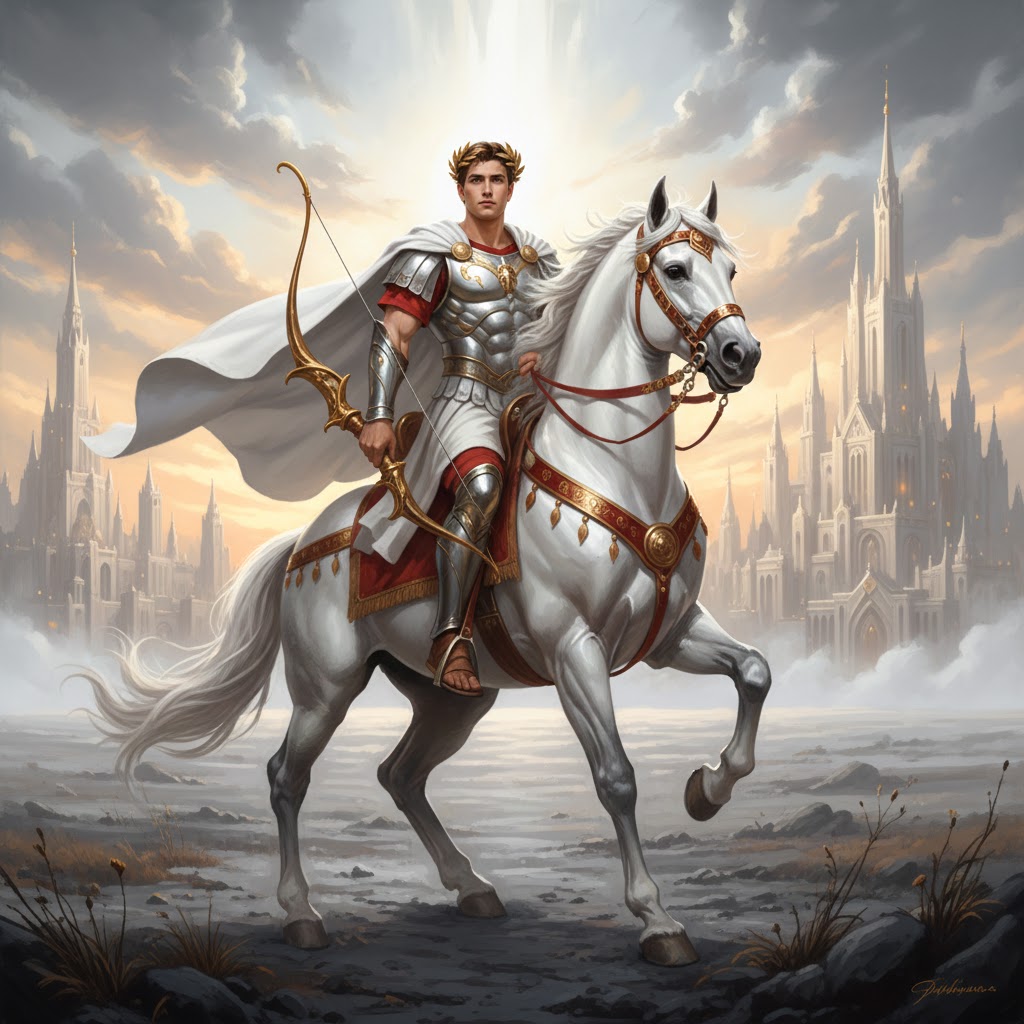
DES 6:2 — “καὶ εἶδον, καὶ ἰδοὺ ἵππος λευκός, καὶ ὁ καθήμενος ἐπ’ αὐτὸν ἔχων τόξον, καὶ ἐδόθη αὐτῷ στέφανος, καὶ ἐξῆλθεν νικῶν καὶ ἵνα νικήσῃ” kai eidon, kai idou hippos leukos, kai ho kathemenos ep’ auton echon toxon, kai edothe auto stephanos, kai exelthen nikon kai hina nikese “And I saw, and behold a white horse, and the one sitting upon it having a bow, and a crown was given to him, and he went out conquering and to conquer.”
| Element | Greek | Meaning |
|---|---|---|
| White horse | ἵππος λευκός | White = conquest/expansion |
| Bow | τόξον (toxon) | Long-range weapon — attack from a distance |
| Crown | στέφανος (stephanos) | Crown of victory (not a royal diadem) |
| Conquering | νικῶν (nikon) | Present participle — ongoing conquest |
Popular tradition identifies the white horseman as Christ. The forensic evidence rejects this identification:
| White horseman (DES 6:2) | Christ (DES 19:11-15) |
|---|---|
| Bow (τόξον) | Sword from the mouth (ῥομφαία) |
| Stephanos (victory crown) | Diadems (διαδήματα) — many |
| No name | “Faithful and True,” “Word of Θεός” |
| Summoned by a living creature | Appears sovereignly |
| Goes out to conquer | Judges and wages war |
The first horseman conquers — but it is imperial conquest, not redemptive. The bow (τόξον) is the weapon of expansionist armies. The crown is given (ἐδόθη — passive: someone gave it) — it is not inherent.
Easter Egg: The identification of the white horseman as Christ is a classic eisegesis. The text places him among the four judgments — alongside war, famine, and death. If the first horseman were Christ, he would be among his own instruments of judgment, which makes no narrative sense.
Second horseman: Red
DES 6:3-4 — “And another horse came out, red (πυρρός, pyrros); and to the one sitting upon it was given to take peace from the earth, and that they should kill one another; and a great sword (μάχαιρα μεγάλη) was given to him.”
| Element | Greek | Meaning |
|---|---|---|
| Red | πυρρός (pyrros) | Fire-colored — blood shed |
| Take peace | λαβεῖν τὴν εἰρήνην | Function: remove stability |
| Great sword | μάχαιρα μεγάλη | Short sword/dagger — interpersonal violence |
The adjective πυρρός comes from πῦρ (pyr) = fire. The color is not any red — it is fire-red, ember-colored. The function is explicit: take peace (εἰρήνη, eirene) from the earth. Not merely war between nations — the text says “that they should kill one another” (ἀλλήλους, allelous). Reciprocal, fratricidal, interpersonal violence.
The sword is μάχαιρα — the short Roman sword, used in close combat. It is not the ῥομφαία (long execution sword). It is a weapon of civil violence, not formal warfare.
Third horseman: Black
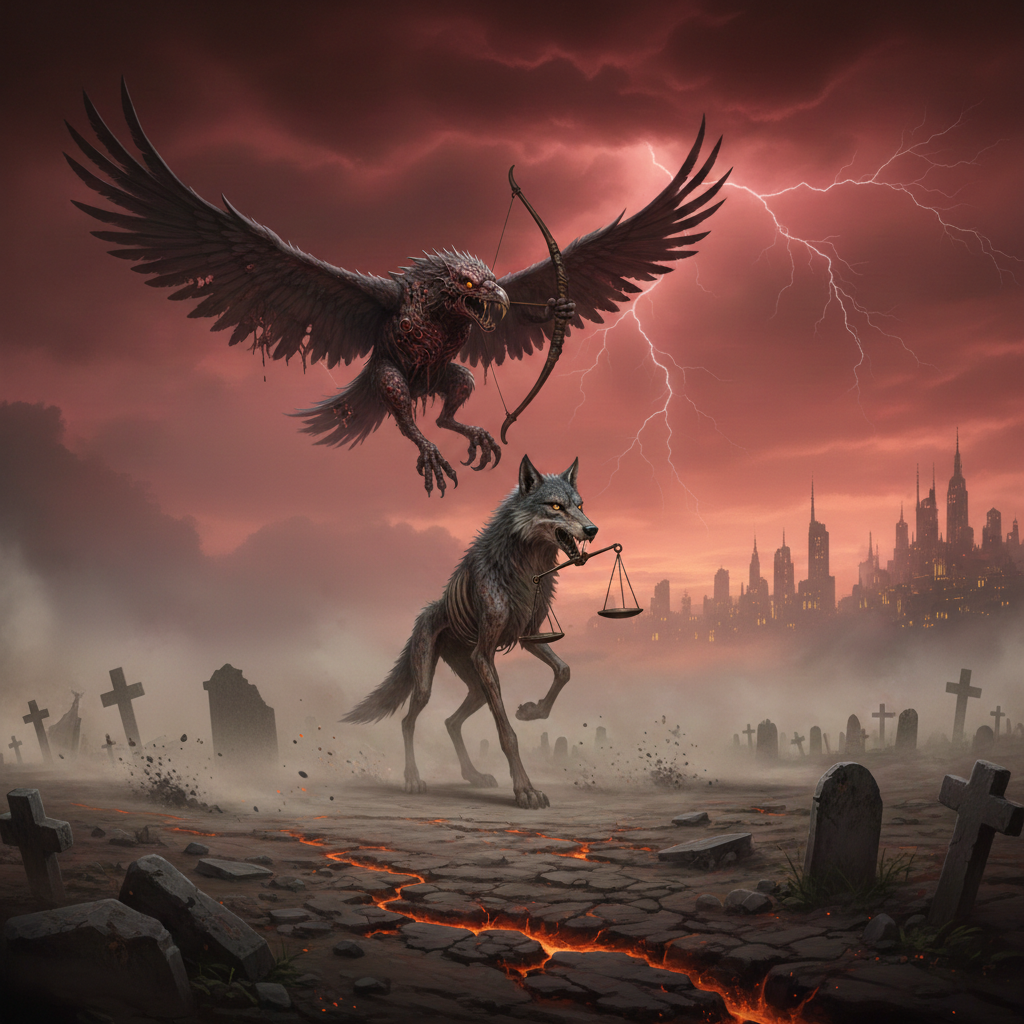
DES 6:5-6 — “And I saw, and behold a black horse (μέλας, melas); and the one sitting upon it had a scale (ζυγόν, zygon) in his hand. And I heard as a voice in the midst of the four living creatures saying: A measure of wheat for a denarius, and three measures of barley for a denarius; and the oil and the wine do not damage.”
| Element | Greek | Meaning |
|---|---|---|
| Black | μέλας (melas) | Darkness — scarcity |
| Scale | ζυγόν (zygon) | Weighing instrument — economic control |
| Denarius | δηνάριον (denarion) | A day’s wage |
A denarius buys one measure (χοῖνιξ, choinix — about 1 liter) of wheat or three of barley. Under normal conditions, a denarius would buy 8-12 measures. The price is inflated 8 to 12 times.
But: “the oil and the wine do not damage.” Luxury products are protected. Scarcity hits the basics (wheat, barley) but not the refined (oil, wine). The economy of the third horseman is an economy of structural inequality: the poor starve, the rich maintain their comfort.
Fourth horseman: Pale green
DES 6:7-8 — “And I saw, and behold a pale green horse (χλωρός, chloros); and the one sitting upon it, his name Death (Θάνατος, Thanatos), and Hades (ᾍδης, Hades) followed with him. And authority was given to them over a fourth of the earth, to kill with sword, with famine, with death, and by the beasts of the earth.”
| Element | Greek | Meaning |
|---|---|---|
| Pale green | χλωρός (chloros) | Pale-green, corpse-colored |
| Death | Θάνατος (Thanatos) | The only named horseman |
| Hades | ᾍδης (Hades) | World of the dead — accompanies |
| Fourth part | τέταρτον (tetarton) | Limited jurisdiction: 25% of the earth |
χλωρός is not the vivid green of vegetation — it is the yellow-green of decomposition. It is the color of dead flesh. The same adjective appears in DES 8:7 and 9:4 to describe vegetation, but applied here to a horse, the effect is macabre.
This is the only horseman with a name: Θάνατος. And the only one who brings a companion: ᾍδης. Death and Hades operate as a pair — one kills, the other collects.
The four colors as a system
When viewed together, the four colors reveal an institutional power cycle:
| Color | Function | Mechanism |
|---|---|---|
| White | Conquest | Military/imperial expansion |
| Red | Violence | Civil war, fratricide |
| Black | Economic control | Selective scarcity, inequality |
| Pale green | Death | Final result of the cycle |
The sequence is logical: first conquest (expansion), then violence (instability), then economic control (oppression), then death (collapse). It is the cycle of every empire. It is the cycle of every institutional power system in the códices.
The horsemen are not isolated future events. They are permanent mechanisms of the worldly system — summoned and authorized by the throne as part of the judgment.
The parallel with Zechariah
Zech 1:8 — “I saw by night, and behold a man riding upon a red horse, and he stood among the myrtle trees that were in the valley; and behind him red, sorrel, and white horses.”
Zech 6:2-3 — “In the first chariot, red horses; in the second, black horses; in the third, white horses; in the fourth, dappled and strong horses.”
The Unveiling reuses the imagery of Zechariah, but reorganizes the colors and assigns specific functions. What in Zechariah are celestial patrols, in the Unveiling become instruments of judgment.
Conclusion
The four horsemen of DES 6 are not characters — they are institutional functions encoded by color. White = conquest. Red = violence. Black = economic control. Pale green = death. The first horseman is not Christ — he carries a bow, not a sword; receives a stephanos, not diadems; goes out to conquer, not to judge.
The four colors operate as a cycle: expansion -> instability -> oppression -> collapse. The cycle is not future — it is perpetual. And each horseman is summoned by the throne: “Come!”
“You read. And the interpretation is yours.”