Public source text: WLC + Nestle 1904. Translation: Belem-2025 Bible translation – literal, rigid, straight from the public códices.
The Question the Text Already Answered
If you are reading chapter 13 of the Unveiling (the book tradition calls Revelation or Apocalypse) and you wonder who the Dragon is, know this: the text already answered. Not in chapter 13 — one chapter earlier.
The Unveiling does not hide identities. It un-veils. The very name of the book means this: ἀποκάλυψις (apokalypsis) — un-veiling, removal of the veil. The book exists to show who is who. And the Dragon is the most completely identified entity in the entire work.
The Text Speaks for Itself — UNV 12:9
In chapter 12, verse 9, the text provides four names for the same entity. No other being in the Unveiling receives so many identifications at once:
καὶ ἐβλήθη ὁ δράκων ὁ μέγας, ὁ ὄφις ὁ ἀρχαῖος, ὁ καλούμενος Διάβολος καὶ ὁ Σατανᾶς
“And was cast out the dragon, the great one, the serpent, the ancient one, the one called Devil and the Satan”
Four names. One entity:
| Name in Greek | How it reads | What it means |
|---|---|---|
| ὁ δράκων ὁ μέγας | ho drakon ho megas | the dragon, the great one |
| ὁ ὄφις ὁ ἀρχαῖος | ho ophis ho archaios | the serpent, the ancient one |
| ὁ καλούμενος Διάβολος | ho kaloumenos Diabolos | the one called Slanderer |
| ὁ Σατανᾶς | ho Satanas | the Adversary |
It is an identity report. The text does not want there to be any doubt. When you read “the Dragon” in chapter 13, you already know exactly who it is: Satan — the same being called Devil, the ancient serpent of Gênesis 3.
Further on, UNV 20:2 repeats the same formula, confirming it was not a narrative accident:
“He seized the dragon, the ancient serpent, who is the Devil and Satan”
Two verses. Same identification. Four names. One being.
What the Dragon Does in Unveiling 13
Now that we know who the Dragon is, the next question is: what does he do in chapter 13?
The answer is in UNV 13:2:
καὶ ἔδωκεν αὐτῷ ὁ δράκων τὴν δύναμιν αὐτοῦ καὶ τὸν θρόνον αὐτοῦ καὶ ἐξουσίαν μεγάλην
“And the dragon gave him his power and his throne and great authority”
He delegates. The Dragon does not act alone — he transfers three specific things to another entity (the beast that rises from the sea):
| What is transferred | Greek term | What it means in practice |
|---|---|---|
| Power | δύναμις (dynamis) | Ability to act, to produce effects |
| Throne | θρόνος (thronos) | Position of government, seat of authority |
| Authority | ἐξουσία (exousia) | Recognized right to exercise power |
Imagine a police chief who transfers three things to a subordinate: the weapon (power), the chief’s chair (throne), and the badge (authority). The subordinate now wields the same power as the chief — but with received power, not self-generated.
The Dragon is the chief. The beast from the sea is the subordinate. And chapter 13 is the record of that transfer.
The Chain of Command — Three Entities, Not One
Chapter 13 presents not one, not two, but three distinct entities operating in chain:
| Entity | Where it comes from | What it does | Who it is |
|---|---|---|---|
| The Dragon | Already in the scene (Unv 12) | Delegates power, throne and authority | Satan |
| The Beast from the Sea | Rises from the sea (UNV 13:1) | Receives power and rules | The Yahweh (יהוה — yhwh; trad. “Jehovah”1) system |
| The Beast from the Earth | Rises from the earth (UNV 13:11) | Performs signs and imposes the mark | Moses |
The text distinguishes the three with surgical precision. In UNV 13:2, the Dragon gives — the beast from the sea receives. If they were the same entity, the Greek would have used a reflexive construction (something like “gave to himself”). It did not. They are two distinct agents in a transaction.
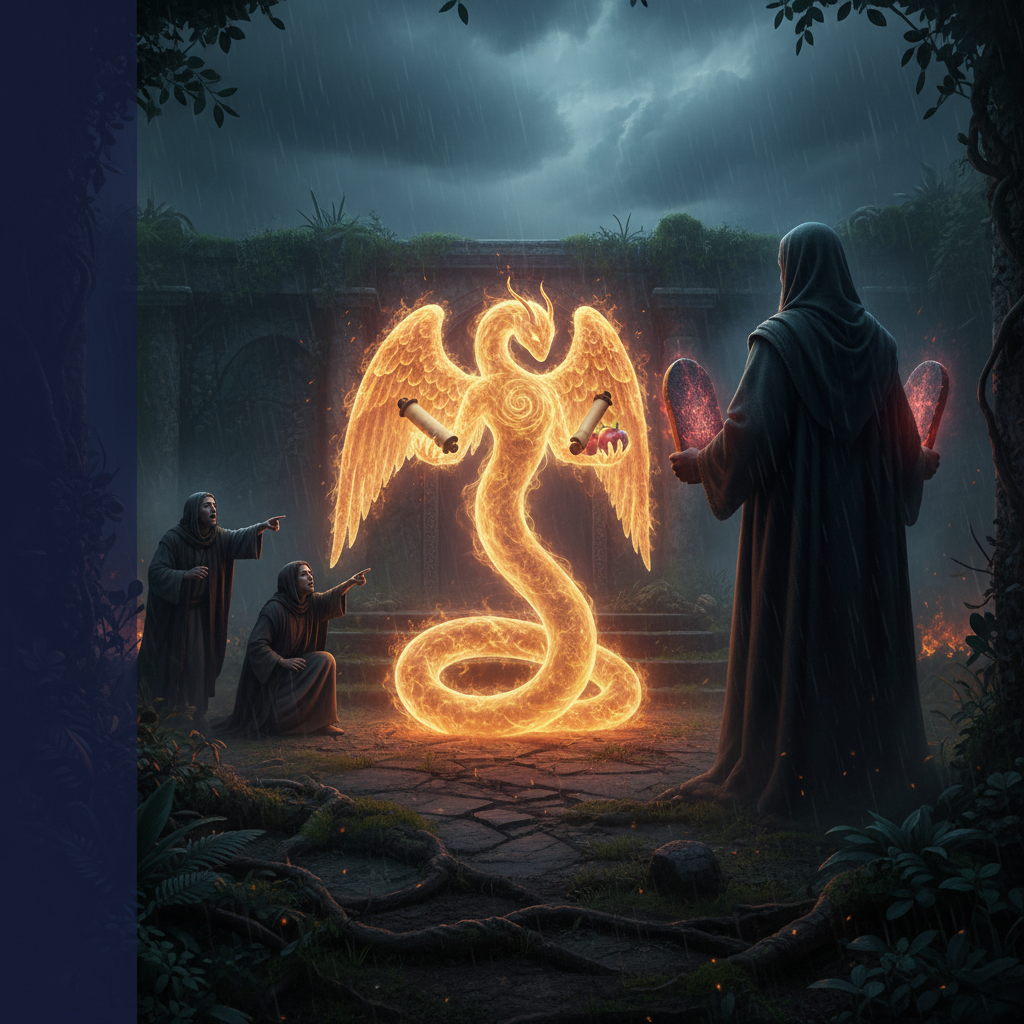
DRAGON (Satan)
  │
  ├── gives power, throne, authority
  ▼
BEAST FROM THE SEA (yhwh)
  │
  ├── exercises authority, is worshipped
  ▼
BEAST FROM THE EARTH (Moses)
  │
  └── performs signs, imposes the mark, directs worship upward
Each level operates with what it received. None is the original source. Power descends. Worship ascends. The system is a pyramid.
The Proof of Three Mouths
If any doubt remained about them being three separate entities, UNV 16:13 resolves it:
καὶ εἶδον ἐκ τοῦ στόματος τοῦ δράκοντος καὶ ἐκ τοῦ στόματος τοῦ θηρίου καὶ ἐκ τοῦ στόματος τοῦ ψευδοπροφήτου πνεύματα τρία ἀκάθαρτα
“And I saw coming out of the mouth of the dragon and out of the mouth of the beast and out of the mouth of the false prophet three unclean spirits”
Three mouths. Three spirits. Three origins. If they were the same entity, one mouth would suffice.
The Fingerprint — 7 Heads and 10 Horns
You may have noticed that the Dragon and the Beast from the Sea share the same “appearance”: 7 heads and 10 horns. This confuses many people. But forensic investigation detects a difference that a quick glance does not catch:
| Attribute | Dragon (UNV 12:3) | Beast from the Sea (UNV 13:1) | Scarlet Beast (UNV 17:3) |
|---|---|---|---|
| Heads | 7 | 7 | 7 |
| Horns | 10 | 10 | 10 |
| Color | πυρρός (fire-red) | none | κόκκινον (scarlet) |
| Crowns | On the heads (diadems) | On the horns | – |
| Origin | Heaven → earth → abyss | Sea | Abyss |
The Dragon has a color: fire-red (πυρρός, pyrros — from the same root as fire, πῦρ). The Beast from the Sea has no color described in the text. It is like a fingerprint: same shape (7 heads and 10 horns), but the color identifies who is who.
The Scarlet Beast of UNV 17:3 also has a color: κόκκινον (kokkinon, scarlet). Same shape (7+10). Same chromatic range (red). Same origin (abyss). The Scarlet Beast is not a fourth entity — it is the Dragon himself under another name, at another point in the narrative.
The Dragon and the Scarlet Beast — The Same Being
If the Dragon is Satan (UNV 12:9), and the Scarlet Beast has the same configuration and same color, the investigation concludes: they are the same being in different phases.
The Unveiling does this with other entities. Jesus, for example, is called “Lion of the tribe of Judah” (λέων, leon) in UNV 5:5 and “Lamb” (ἀρνίον, arnion) in UNV 5:6. Two completely different names for the same person — because the context changes. Lion = royalty. Lamb = sacrifice. Same person, different functions.
In the same way:
| Designation | Context | Function |
|---|---|---|
| Dragon (δράκων) | Heavenly war (UNV 12) | Direct combat, persecution |
| Scarlet Beast (θηρίον κόκκινον) | Earthly system (UNV 17) | Power base of the prostitute |
The color records the progression: pyrros (fire-red) is the color of active flame — the Dragon in combat. Kokkinos (scarlet) is the color of accumulated blood — the Dragon after centuries of operating through the system. The color matures as the crime matures: from the act to the trail.
The Dragon’s Destiny — Separate from the Others
The final destiny confirms the separation. The Beast from the Sea and the Beast from the Earth (called here “false prophet”) are captured and thrown into the lake of fire in UNV 19:20. The Dragon is not. He is imprisoned in the abyss for a thousand years (UNV 20:2-3), released briefly (UNV 20:7), and only then thrown into the lake of fire (UNV 20:10).
| Entity | Moment of sentence | Text |
|---|---|---|
| Beast from the Sea + False Prophet | UNV 19:20 | “Were thrown alive into the lake of fire” |
| Dragon (Satan) | UNV 20:2-3 | “Imprisoned in the abyss for a thousand years” |
| Dragon (Satan) | UNV 20:10 | “Thrown into the lake of fire” |
Three entities. Three separate destinies. Three different times. If they were the same entity, they would be punished together.
The Double Worship — UNV 13:4
The most revealing verse in chapter 13 is the one that records whom the people worship:
καὶ προσεκύνησαν τῷ δράκοντι ὅτι ἔδωκεν τὴν ἐξουσίαν τῷ θηρίῳ, καὶ προσεκύνησαν τῷ θηρίῳ
“And they worshipped the dragon because he gave authority to the beast, and they worshipped the beast”
Two acts of worship. Two objects. One motive: the delegation of power. The people worship the beast (because it exercises visible power) and the Dragon (because he delegated that power).
For the lay reader, the implication is direct: according to this text, all worship directed at the beast from the sea (the Yahweh (yhwh) system) is simultaneously worship of the Dragon (Satan). Not because the worshipper knows this — but because the chain of delegation so determines.
What Chapter 13 Reveals
Unveiling 13 is not a chapter about monsters rising from sea and earth. It is the organizational chart of a power system. The text presents:
- The boss — the Dragon (Satan), who delegates power
- The system — the Beast from the Sea (yhwh), which receives power and rules
- The executor — the Beast from the Earth (Moses), who implements signs, the mark, and worship
- The mechanism — delegation: power flows down, worship flows up
- The consequence — whoever worships the system, worships the boss of the system
One does not need to know Greek to understand this. Just read the text and ask: who gives, who receives, who executes?
The Dragon of Unveiling 13 has a name: Satan. Has a function: delegator. Has a destiny: lake of fire. Has a fingerprint: 7 heads, 10 horns, red color. And has an alias: the Scarlet Beast.
The text is clear. The Unveiling is not a book of mysteries — it is a book of revelations. The veil has been removed. The identity has been declared. The report has been issued.
Only one question remains: will you read what is written?
“You read. And the interpretation is yours.”
Artificial form: vowels from Adonai (אֲדֹנָי → a, o, a) placed over consonants YHWH — Masoretic qere perpetuum. Medieval Latin readers merged both, producing “YeHoVaH” — a hybrid that never existed as a Hebrew word. The most accepted academic reconstruction is Yahweh /jah.ˈweh/, based on Greek transcriptions (Ιαβε — Clement of Alexandria, ~200 AD; Ιαουε — Theodoret of Cyrus, ~450 AD), abbreviated biblical forms (Yah — הַלְלוּ יָהּ), theophoric names (Yahu/Yeho — Eliyahu, Yehoshua) and Samaritan oral tradition (Yabe/Yawe). ↩︎