The question no one compared
Public source text: WLC (Westminster Leningrad Codex) + Westcott-Hort 1881 + Nestle 1904. Translation: Belem-2025 Bible translation – literal, rigid, straight from public códices.
Exodus 15:11 — after the waters of the sea close over the Egyptians, Israel sings:
מִי כָמֹכָה בָּאֵלִם יהוה mi kamokha baelim yhwh “Who is like you among the gods, Yahweh (יהוה — yhwh; trad. “Jehovah”1)?”
Unveiling 13:4 — after the Beast rises from the sea, the whole earth worships:
τίς ὅμοιος τῷ θηρίῳ tis homoios to therio “Who is like the Beast?”
It is the same question. The Unveiling does not invent — it quotes. And the quotation is not vague. It is direct. It is structural. It is devastating.
Easter Egg #1: tradition reads Unveiling 13 as future prophecy. But the Unveiling is quoting the Exodus. It does not point forward — it points backward.
Part I — The three Beasts are distinct entities
1) The text presents three θηρίον (therion) — not one
The Unveiling does not describe a single “beast.” It describes three entities of the θηρίον type with distinct origins, profiles, and destinies:
| # | Entity | Source text | Heads | Horns | Color | Origin |
|---|---|---|---|---|---|---|
| 1 | Beast of the Sea | DES 13:1-10 | 7 | 10 | NO COLOR | sea (θάλασσα) |
| 2 | Beast of the Earth | DES 13:11-18 | 0 | 2 | NO COLOR | earth (γῆ) |
| 3 | Scarlet Beast | DES 17:3 | 7 | 10 | kokkinon (scarlet) | abyss (ἄβυσσος) |
The Dragon (DES 12:3) has the same configuration as the Scarlet Beast: 7 heads, 10 horns, red color (pyrros). And its prison is the abyss (DES 20:1-3) — the same origin as the Scarlet Beast (DES 17:8).
2) The Scarlet Beast is the Dragon — not the Beast of the Sea
DES 12:6,14 — the woman flees to the wilderness (ἔρημον), pursued by the Dragon. DES 17:3 — John sees the woman in the wilderness (ἔρημον), seated upon the Scarlet Beast.
Same location. Same woman. The one who was pursued by the Dragon now rides upon him. The “mystery” of DES 17:7 is not who the Beast is (already identified as Dragon in DES 12:9) — it is why the woman who was fleeing from him is now mounted on him.
3) The separation is axiomatic: sea ≠ abyss
DES 13:1 — the Beast of the Sea ascends from the sea (θαλάσσης). DES 17:8 — the Scarlet Beast ascends from the abyss (ἀβύσσου). DES 20:1-3 — the Dragon is imprisoned in the abyss (ἄβυσσον).
The origins are mutually exclusive. No passage attributes “sea” to the Dragon. None attributes “abyss” to the Beast of the Sea. And DES 13:2 confirms the functional separation:
“The Dragon gave it [the Beast of the Sea] his power, his throne, and great authority.”
One does not delegate power to oneself. They are two agents.
4) Three destinies at different times settle the matter
- DES 19:20 — Beast + False Prophet -> lake of fire first
- DES 20:2 — Dragon -> imprisoned in the abyss for 1,000 years after
- DES 20:10 — Dragon -> lake of fire last, where the others already were
One cannot join oneself. The three Beasts are distinct entities.
Easter Egg #2: tradition merges the three Beasts into a single “beast of the Apocalypse.” The text separates them with surgical precision — by color, by origin, by delegation, and by destiny.
Part II — Yahweh (yhwh) is born from the sea
5) The Beast of the Sea ascends from the θάλασσα — and Yahweh (yhwh) is born from the Red Sea
DES 13:1 — “and I saw a Beast ascending from the sea” (ἐκ τῆς θαλάσσης).
The obvious question: why “sea”? The answer is in the Exodus:
Ex 14:21-31 — Yahweh (yhwh) opens the Red Sea (יַם סוּף, yam suph). The waters divide. The Egyptians die. Israel crosses.
Ex 14:30-31 — “On that day Yahweh (yhwh) saved Israel from the hand of Egypt, and Israel saw the Egyptians dead on the shore of the sea. And Israel saw the great hand that Yahweh (yhwh) executed against Egypt, and the people feared Yahweh (yhwh) and believed in yhwh.”
It is at this moment — on the beach, before the bodies — that Israel begins to worship yhwh. The worship is born literally from the sea.
Ex 15:1 — “Then Moses and the children of Israel sang this song to yhwh.”
The Beast of the Sea ascends from the sea. Yahweh (yhwh) as object of worship is born from the sea. The θάλασσα of DES 13:1 is literal.
6) “Who is like you?” — the quotation that closes the investigation
Ex 15:11 — מִי כָמֹכָה בָּאֵלִם יהוה “Who is like you among the gods, Yahweh (yhwh)?”
DES 13:4 — τίς ὅμοιος τῷ θηρίῳ, καὶ τίς δύναται πολεμῆσαι μετ’ αὐτοῦ “Who is like the Beast, and who can wage war against it?”
The structure is identical:
- “Who is like X?” (rhetorical question of worship)
- Context: collective worship after a demonstration of power
And DES 13:4 includes: “they worshiped the Beast” (προσεκύνησαν τῷ θηρίῳ). Ex 15:1-21 is a song of worship to yhwh.
The worship of the Beast (DES 13:4) = the worship of Yahweh (yhwh) (Ex 15).
Easter Egg #3: you read DES 13:4 and think of a future dictator. The Unveiling reads Ex 15:11 and shows who was already worshiped that way.
Part III — The composite Beast: leopard, bear, lion
7) Yahweh (yhwh) is the only entity that self-attributes all three animals
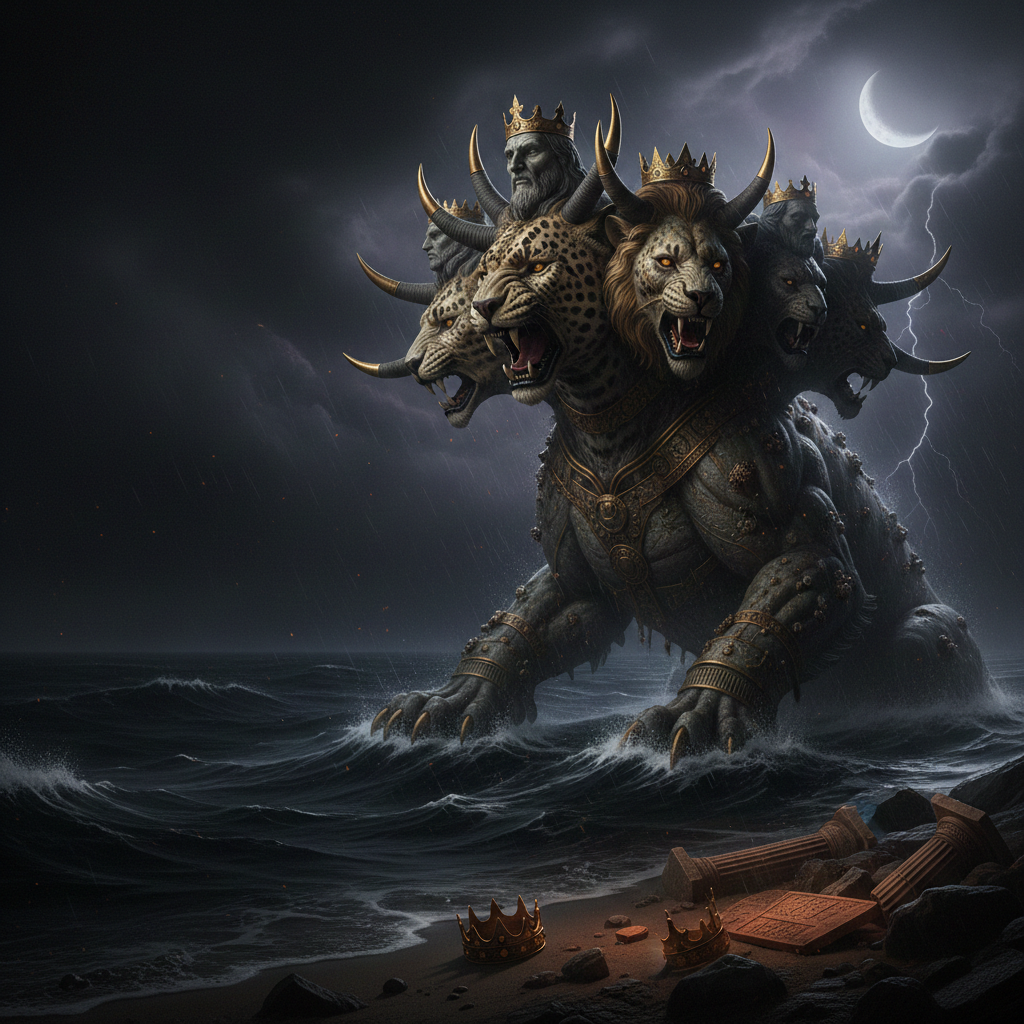
DES 13:2 — “The Beast that I saw was like a leopard, and its feet like those of a bear, and its mouth like the mouth of a lion.”
Tradition looks for empires (Babylon, Persia, Greece). The Hebrew text already has the answer:
Hos 13:7-8 — Yahweh (yhwh) declares in first person:
“I will be to them like a LION (לָבִיא, lavi); like a LEOPARD (נָמֵר, namer) by the way I will stalk them. Like a BEAR (דֹּב, dov) robbed of her cubs, I will meet them, and I will tear open the enclosure of their heart.”
The three animals. In the same passage. In the voice of yhwh. Self-attributed.
No other entity in the 66 canonical books describes itself simultaneously as leopard, bear, and lion. Only yhwh.
Easter Egg #4: tradition needs three empires to explain three animals. Yahweh (yhwh) needs a single verse.
Part IV — The 7 heads and the wounded head
8) The 7 heads are 7 patriarchs
DES 17:9 — “the seven heads are seven mountains” (ὄρη, ore = mountains, not hills). DES 17:10 — “and are seven kings” (βασιλεῖς).
Triple designation: heads = mountains = kings = founding patriarchs:
- Abraham 2. Isaac 3. Jacob 4. Levi 5. Judah 6. Joseph 7. Moses
Each patriarch is associated with a mountain in the OT. Each patriarch is a “king” in the sense of foundational authority of the Yahweh (yhwh) system.
9) The head wounded to death is Joseph
DES 13:3 — “One of its heads as if slain to death (ὡς ἐσφαγμένην εἰς θάνατον), and the wound of death of it was healed.”
Joseph:
- Wound: sold by his brothers, thrown into the pit (Gen 37:24-28) = “as if dead”
- Healing: elevated to governor of Egypt (Gen 41:39-44) = “wound healed”
- Reaction: “all the earth marveled” (DES 13:3) = the brothers and father marveled (Gen 45:3,26-27)
The verb ἐσφαγμένην (esphagmenen) means “slaughtered/slain” — not a sword blow. Joseph is the only patriarch whose narrative cycle fits: given up for dead -> resurfaces with power -> provokes collective astonishment.
10) Dt 33:15-16 — the verse that connects everything
Dt 33:16 — in Moses’ blessing over Joseph:
“And the goodwill of the one who dwelt in the BUSH, may it come upon the ROSH (ראש, head) of Joseph, and upon the NEZIR (נזיר, crown/separated one) of his brothers.”
Four terms converge in a single verse:
- Joseph — the wounded head (DES 13:3)
- ROSH (head) — κεφαλή of DES 13/17
- Ancient mountains (Dt 33:15) — ὄρη of DES 17:9
- NEZIR (separated/crowned) -> nezer hakodesh (נזר הקדש) = crown of holiness = 666 (axiom of the Enigma 666)
The bush is the same as Exodus 3:2 — where Yahweh (yhwh) manifests. The verse directly connects Joseph (wounded head) to the mountains, to the head, and to the nezer/nezir system that generates the value 666.
Easter Egg #5: search for “666” in online calculators. You will find Nero. Search in the codex: you find the priestly crown of Yahweh (yhwh) on the forehead of the high priest (Ex 28:36).
Part V — Verse by verse: the stress test
11) DES 13:1-10 tested against Yahweh (yhwh) — 11/11 overcome
Each verse of DES 13:1-10 was confronted with the thesis “Beast of the Sea = Yahweh (yhwh)”:
| Verse | Text | Result | OT Reference |
|---|---|---|---|
| DES 13:1 | Beast ascends from the sea | DEMOLISHED | Ex 14-15: Yahweh (yhwh) is born from the Red Sea |
| DES 13:2a | Leopard, bear, lion | DEMOLISHED | Hos 13:7-8: Yahweh (yhwh) self-describes with the three |
| DES 13:2b | Dragon delegates power (ἐδόθη) | OVERCOME | Passivum divinum — delegated authority |
| DES 13:3 | Head wounded to death | OVERCOME | Gen 37->41: Joseph (pit->governor) |
| DES 13:4 | “Who is like the Beast?” | DEMOLISHED | Ex 15:11: “Who is like you, Yahweh (yhwh)?” |
| DES 13:5 | Mouth speaking great things | OVERCOME | Dt 5:22-26: great voice of Yahweh (yhwh) at Sinai |
| DES 13:5 | 42 months of authority | OVERCOME | Num 33: 42 stations of the wilderness |
| DES 13:6 | Blasphemy against Theos | OVERCOME | Yahweh (yhwh) declaring himself Theos = blasphemy against the Creator |
| DES 13:7 | War against the saints | OVERCOME | Num 16:31-35; Lev 10:1-2: Yahweh (yhwh) kills the consecrated |
| DES 13:7 | Authority over every nation | OVERCOME | Ex 19:5: “all the earth is mine” |
| DES 13:10 | Captivity and sword | DEMOLISHED | Jer 15:2: Yahweh (yhwh) declares the four destinations |
4 demolished (direct quotation or self-description) + 7 overcome (textual coherence verified).
No verse resists. No verse points to another candidate.
12) Jer 15:2 = DES 13:10 — second direct quotation
Jeremiah 15:2 — Yahweh (yhwh) declares:
“Those for death, to death; those for the sword, to the sword; those for famine, to famine; those for captivity, to captivity.”
DES 13:10 —
“If anyone leads into captivity, to captivity he goes. If anyone kills with the sword, with the sword he will be killed.”
The Unveiling quotes Jeremiah. And in Jeremiah, the one speaking is yhwh.
Part VI — The hierarchy of identity
13) Yahweh (yhwh), Israel, and Judaism — entity, body, and product
The investigation reveals a three-layer hierarchy:
| Layer | Entity | Function |
|---|---|---|
| Yahweh (yhwh) | The Beast of the Sea | The entity worshiped |
| Israel | The body of the Beast | The people who serve Yahweh (yhwh) |
| Judaism | The product | Religious system created by Yahweh (yhwh) through Israel |
Yahweh (yhwh) is not synonymous with Israel. Israel is the instrument. Judaism is the resulting system. The Beast of the Sea is the entity that operates through Israel — just as the Dragon operates through the Beast of the Sea (DES 13:2).
The complete chain:
Dragon (Satan) -> delegates power -> Beast of the Sea (yhwh) -> uses -> Israel -> produces -> Judaism
DES 13:2 — “The Dragon gave it his power, his throne, and great authority.”
Yahweh (yhwh) operates with received power. The Yahweh (yhwh) system is not autonomous — it is delegated.
Easter Egg #6: tradition teaches that Yahweh (yhwh) is the name of the Creator. The Unveiling shows that Yahweh (yhwh) is the name of the one who received power from the Dragon to operate over Israel. The difference between Creator and operator is the difference between Theos and Beast.
Conclusion
The Beast of the Sea is not a Roman emperor, a future political leader, or a global economic system. The Beast of the Sea is the entity that Israel began to worship on the shores of the Red Sea, after the waters closed over the Egyptians.
Ex 15:11 — “Who is like you among the gods, Yahweh (yhwh)?” DES 13:4 — “Who is like the Beast?”
The same question. The same context of worship. The same entity.
The 7 heads are the 7 patriarchs. The wounded head is Joseph. The nezer hakodesh on the forehead of the high priest sums to 666. The three animals are Yahweh (yhwh)’s self-description in Hosea. The 42 months are the 42 stations of the wilderness. The captivity and the sword are a quotation of Jeremiah 15:2.
Stress test: 11/11 overcome. 4 demolished by direct quotation. 0 verses resisted.
The Unveiling does not prophesy the future — it unmasks the past.
Easter Egg Final: you have always read “Who is like the Beast?” as a question about military power. It is a liturgical question. It is the refrain of worship that Israel has sung since the Exodus. The Unveiling merely shows to whom Israel was singing.
Artificial form: vowels from Adonai (אֲדֹנָי → a, o, a) placed over consonants YHWH — Masoretic qere perpetuum. Medieval Latin readers merged both, producing “YeHoVaH” — a hybrid that never existed as a Hebrew word. The most accepted academic reconstruction is Yahweh /jah.ˈweh/, based on Greek transcriptions (Ιαβε — Clement of Alexandria, ~200 AD; Ιαουε — Theodoret of Cyrus, ~450 AD), abbreviated biblical forms (Yah — הַלְלוּ יָהּ), theophoric names (Yahu/Yeho — Eliyahu, Yehoshua) and Samaritan oral tradition (Yabe/Yawe). ↩︎