Public source text: WLC (Westminster Leningrad Codex) + Nestle 1904. Translation: Belem-2025 Bible translation — literal, rigid, directly from public códices.
Exclusive source: DOSSIE_FERA_DO_MAR — Consolidated Axiom 11/11 (Escola Desvelacional Forense Belem an.C-2039).
Premise
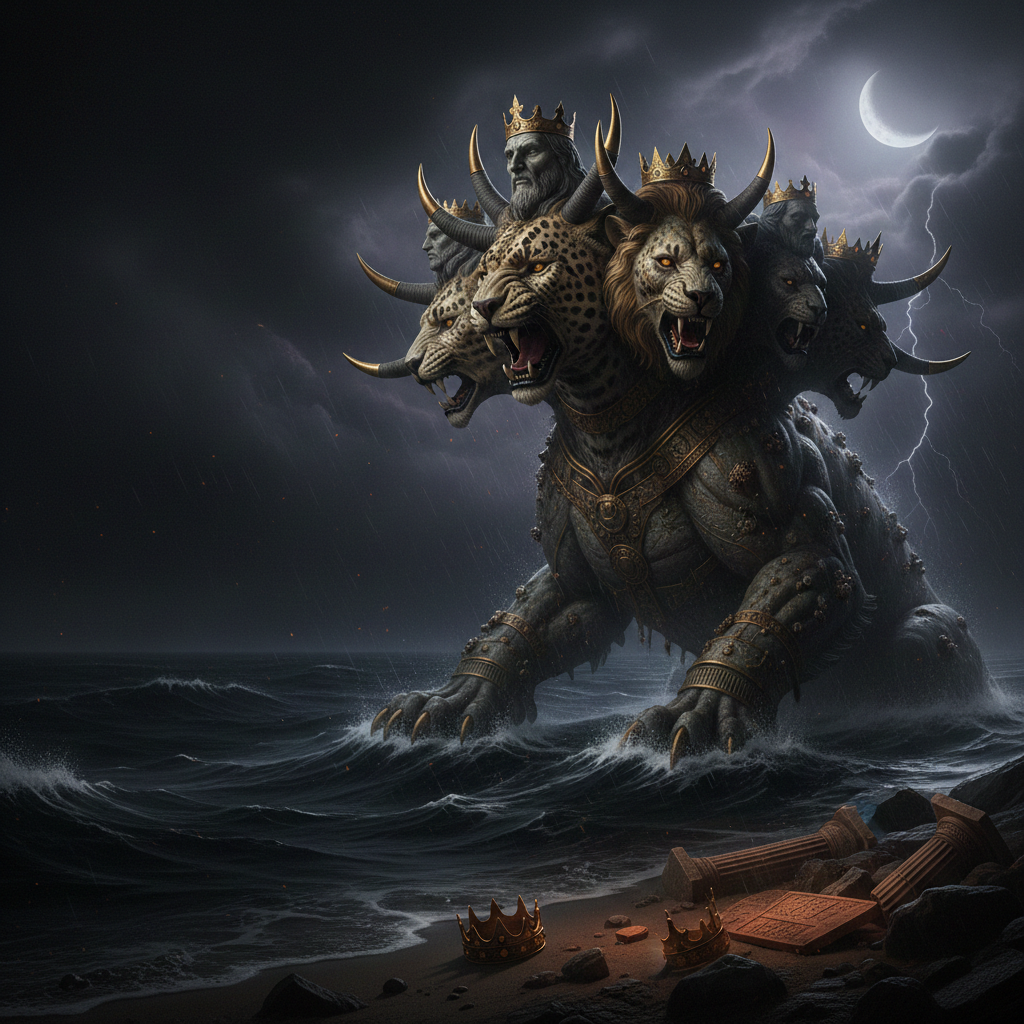
This article consolidates the forensic investigation into the seven heads of the Beast of the Sea (DES 13:1). The result is a resolved genealogical tree: seven patriarchs, seven dispensations, seven diadems. The beast is not born from Rome. It is born from the sea — and the first man to emerge from the waters was Noah.
The Text Under Investigation
DES 13:1 presents the beast:
kai eidon ek tes thalasses therion anabainon, echon kerata deka kai kephalas hepta, kai epi ton keraton autou deka diademata, kai epi tas kephalas autou onomata blasphemias kai eidon ek tes thalasses therion anabainon, echon kerata deka kai kephalas hepta, kai epi ton keraton autou deka diademata, kai epi tas kephalas autou onomata blasphemias “And I saw from the sea a beast rising, having ten horns and seven heads (kephalas hepta), and upon its horns ten diadems (diademata), and upon its heads names of blasphemy”
DES 17:9-10 decodes:
hai hepta kephalai hepta ore eisin […] kai basileis hepta eisin; hoi pente epesan, ho heis estin, ho allos oupo elthen “The seven heads are seven mountains […] and they are seven kings: the five have fallen, the one is, the other has not yet come”
Heads = Mountains = Kings. Three simultaneous designations for the same entities. The forensic investigation asks: which seven individuals in biblical history are simultaneously heads of lineage, foundational mountains, and kings of dispensation?
The Resolved Genealogical Tree
The answer lies in the OT genealogy itself. Seven patriarchs whose existence is a necessary condition for the institutional system of Yahweh (יהוה — yhwh; trad. “Jehovah”1):
| # | Head | Patriarch | Dispensation | Biblical Evidence |
|---|---|---|---|---|
| 1 | First | Noah | Post-diluvian covenant | Gen 6-9; the one who emerges from the sea |
| 2 | Second | Abraham | Election and promise | Gen 12, 15, 17; circumcision, land, offspring |
| 3 | Third | Isaac | Hereditary transmission | Gen 26:2-5; continuity of the promise |
| 4 | Fourth | Jacob | Nation and tribal identity | Gen 28, 32, 35; Israel, 12 tribes |
| 5 | Fifth | Judah | Royal lineage, scepter | Gen 49:10; 2Sam 7; the Davidic house is born here |
| 6 | Sixth | David | Monarchy and throne | 2Sam 5, 7; unified kingdom, eternal covenant |
| 7 | Seventh | Solomon | Temple, wisdom, 666 talents | 1Kgs 6-8; 10:14; the system in its final form |
Each head is not merely a man — it is an entire dispensation. Each diadem (diadema) upon the horns represents the delegated authority that operates within each patriarchal era.
Head 1 — Noah: The Beast Emerges from the Sea
vayyizkor Elohim et-Noach “And Elohim remembered Noah” — Gen 8:1
The beast rises from the sea (ek tes thalasses anabainon). Noah is the first human to emerge from the waters. The flood is the sea from which the beast is born. The narrative of Gen 6-9 provides the pattern:
| DES 13 Element | Noah/Gen Parallel |
|---|---|
| Beast rises from the sea | Noah emerges from the waters (Gen 8:13-18) |
| Names upon the heads (onomata) | Noah receives a named covenant (Gen 9:8-17) |
| First dispensation | First post-creation covenant |
Noah is called ish tsaddiq (“righteous man”) and tamim (“blameless”) in Gen 6:9. These are institutional titles — not merely moral. Noah inaugurates the system. He is the first head.
Head 2 — Abraham: The Election
vayyomer Yahweh (yhwh) el-Avram lekh-lekha me’artsekha “And Yahweh (yhwh) said to Abram: Go from your land” — Gen 12:1
Abraham inaugurates the second dispensation: election. One man is separated from among the nations. The promise of land, offspring, and blessing (Gen 12:1-3) creates the institutional DNA of the system. Circumcision (Gen 17) is the mark that distinguishes those who belong to the system from those who do not.
| Function | Institutional Contribution |
|---|---|
| Covenant | berit — Gen 15, 17 |
| Circumcision | Physical sign of belonging — Gen 17:10 |
| Offspring | zera (“seed”) — Gen 15:5 |
Head 3 — Isaac: The Continuity
“And Yahweh (yhwh) said […] sojourn in this land […] for to you and to your offspring I will give all these lands” — Gen 26:2-3
Isaac does not innovate — he transmits. His function is to ensure that the Abrahamic promise does not die with Abraham. The third head is the mechanism of heredity within the system. Without Isaac, the promise would be individual. With Isaac, it becomes generational.
Head 4 — Jacob: The Nation
lo Ya’aqov ye’amer od shimkha ki im-Yisra’el “Your name shall no longer be said Jacob, but Israel” — Gen 35:10
Jacob is renamed Israel — the name of the entire nation. He fathers twelve sons who become twelve tribes. The fourth dispensation is multiplication: from a family to a nation. Jacob transforms the promise system into a system of collective identity.
| From | To |
|---|---|
| Family (Abraham, Isaac) | Nation (Israel) |
| Elected individual | Elected people |
| Personal promise | National inheritance (nachalah) |
Head 5 — Judah: The Scepter
lo-yasur shevet miYhudah umechoqeq mibbein raglav “The scepter shall not depart from Judah, nor the ruler’s staff from between his feet” — Gen 49:10
Judah receives the fifth dispensation: royalty. The shevet (“scepter”) is a designation of sovereign power. The royal lineage is born here — not in David. David executes what Judah inaugurates. The entire royal house, from David to Zedekiah, is a functional extension of the fifth head.
Head 6 — David: The Throne
“And your house and your kingdom shall be established forever before you; your throne shall be established forever” — 2Sam 7:16
David institutionalizes the monarchy. The Davidic covenant (2Sam 7) is the moment when the patriarchal system gains a permanent throne. Not merely a scepter (Judah), but a kingdom (mamlakhah). David is the sixth head — the pillar of theocratic governance.
Head 7 — Solomon: The Temple and the 666 Talents
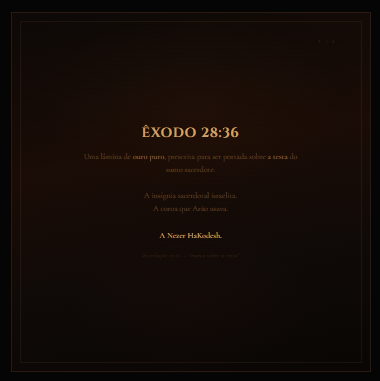
“And the weight of the gold that came to Solomon in one year was six hundred and sixty-six talents of gold” — 1Kgs 10:14
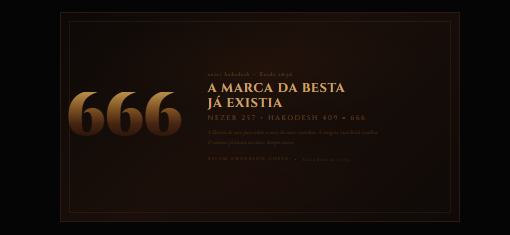
Solomon is the seventh and final head. He builds the Temple (1Kgs 6-8), formalizes the worship, centralizes the system. And he receives exactly 666 talents of gold per year — the number that DES 13:18 calls arithmos tou theriou (“number of the beast”).
| Contribution | Reference | Connection to DES |
|---|---|---|
| Temple built | 1Kgs 6:1 | The system in its final form |
| 666 talents/year | 1Kgs 10:14 | Number of the beast — DES 13:18 |
| Wisdom as a mark | 1Kgs 10:23-24 | sophia (“wisdom”) — DES 13:18 |
| All the earth comes to hear | 1Kgs 10:24 | ethaumasthe hole he ge — DES 13:3 |
The seventh head is the apex of the system. Solomon is the point where all previous dispensations converge: covenant (Noah), election (Abraham), transmission (Isaac), nation (Jacob), scepter (Judah), throne (David) — everything culminates in the Temple of Solomon.
Joseph — The Wounded and Healed Head (DES 13:3)
“And one of its heads as having been slain to death, and the wound of its death was healed”
Joseph is not one of the seven numbered heads — he is the event that happens to one of them. Within the lineage Jacob -> Judah, Joseph operates as the mechanism of systemic resilience. Sold by his brothers, presumed dead (Gen 37:31-33), and then elevated to absolute power in Egypt (Gen 41:39-44):
| Phase | Event | Reference | DES Parallel |
|---|---|---|---|
| Wound | Sold, presumed dead | Gen 37:28, 31-33 | hos esphagmenen eis thanaton |
| Healing | Elevated to governor | Gen 41:39-44 | he plege tou thanatou etherapeuthe |
| Astonishment | All the earth comes to Egypt | Gen 41:57 | ethaumasthe hole he ge |
The same verb sphazo (“slaughter”) that describes the Lamb in DES 5:6 describes the wounded head in DES 13:3. Joseph is the anti-type of the Lamb: both are slain and rise again, but the Lamb belongs to the Father, and the wounded head belongs to the beast.
Joseph demonstrates that the system of Yahweh (yhwh) is resilient — capable of absorbing destruction and rebuilding with amplified power. The wounded head is not a Roman emperor. It is the institutional capacity to survive its own death.
DES 17:10 — The Chronological Mapping
hoi pente epesan, ho heis estin, ho allos oupo elthen “The five have fallen, the one is, the other has not yet come”
The verb epesan (from pipto) means have fallen — institutional collapse, not biological death. Each “fall” is the functional exhaustion of a dispensation:
| Segment | Head(s) | Patriarch(s) | Status in the 1st century AD |
|---|---|---|---|
| “Five have fallen” | 1-5 | Noah, Abraham, Isaac, Jacob, Judah | Dispensations ended or absorbed |
| “The one is” | 6 | David | Davidic covenant operating (messianic expectation) |
| “Other has not come” | 7 | Solomon | Definitive Temple still future |
The first five dispensations fell: the Noahic covenant was absorbed by the Abrahamic; the Abrahamic election was absorbed by the Law; Isaac’s transmission fragmented in the exiles; Jacob’s nation divided in the schism; Judah’s scepter was emptied in 586 BC.
The sixth — David — is (estin, categorical present). In the 1st century AD, the Davidic covenant remained operative as messianic expectation. “Son of David” was the most politically charged title of the era.
The seventh — Solomon — has not yet come. Solomon’s Temple was destroyed. The Second Temple was a shadow. The final form of the system — Temple, wisdom, 666 — had not yet reached its definitive expression. And when it comes, it will remain a little while (oligon).
The Genealogical Tree Produces the System
The sequence is not random. It is institutional engineering:
Noah (primitive covenant)
  -> Abraham (election)
       -> Isaac (transmission)
            -> Jacob (nation)
                 -> Judah (scepter)
                      -> David (throne)
                           -> Solomon (temple + 666)
Each patriarch is a module of the system. Without Noah, no post-diluvian restart. Without Abraham, no election. Without Isaac, no heredity. Without Jacob, no nation. Without Judah, no royalty. Without David, no permanent throne. Without Solomon, no Temple.
Together, the seven produce the complete institutional system that the Unveiling calls the Beast of the Sea. The beast is not Rome. It is Yahweh (yhwh) — the system that emerges from the waters with seven patriarchal heads and ten tribal horns. AXIOM consolidated — stress test 11/11.
Connection to DOSSIE_FERA_DO_MAR
This genealogical tree is Evidence #4 of the consolidated Beast of the Sea dossier (stress test 11/11). The correspondence between the seven heads and the seven patriarchs simultaneously satisfies all three criteria of DES 17:9-10:
| Criterion | Fulfillment |
|---|---|
| kephalai (heads) | 7 patriarchs of the lineage |
| ore (mountains) | 7 foundational markers in the history of Israel |
| basileis (kings) | 7 holders of dispensational authority |
The beast is not a foreign entity. It is the genealogical product of the seven patriarchs — the institutional structure that becomes the operational instrument of yhwh.
Consolidated Table
| # | Patriarch | Dispensation | Contribution to the System | DES 17:10 |
|---|---|---|---|---|
| 1 | Noah | Post-diluvian covenant | Emerges from the sea; restart | Fallen |
| 2 | Abraham | Election and promise | Separation; berit; circumcision | Fallen |
| 3 | Isaac | Hereditary transmission | Generational continuity | Fallen |
| 4 | Jacob | Nation and identity | Israel; 12 tribes | Fallen |
| 5 | Judah | Royalty, scepter | Royal lineage | Fallen |
| 6 | David | Monarchy, throne | Unified kingdom; eternal covenant | Is (estin) |
| 7 | Solomon | Temple, wisdom, 666 | System in its final form | Has not yet come |
Conclusion
The seven heads of the Beast of the Sea are seven patriarchs — from Noah to Solomon — whose existence produced the institutional system of yhwh. Each head is a dispensation. Each diadem is delegated authority. Each “fall” is the functional exhaustion of a pillar.
Noah emerges from the sea — and the beast emerges from the sea. Solomon receives 666 talents — and the beast bears the number 666. Joseph is sold as dead and rises to power — and a head is mortally wounded and healed.
The genealogy is not accidental. It is the architectural blueprint of the beast.
The case is consolidated. The dossier is open for public scrutiny.
“You read. And the interpretation is yours.”
Artificial form: vowels from Adonai (אֲדֹנָי → a, o, a) placed over consonants YHWH — Masoretic qere perpetuum. Medieval Latin readers merged both, producing “YeHoVaH” — a hybrid that never existed as a Hebrew word. The most accepted academic reconstruction is Yahweh /jah.ˈweh/, based on Greek transcriptions (Ιαβε — Clement of Alexandria, ~200 AD; Ιαουε — Theodoret of Cyrus, ~450 AD), abbreviated biblical forms (Yah — הַלְלוּ יָהּ), theophoric names (Yahu/Yeho — Eliyahu, Yehoshua) and Samaritan oral tradition (Yabe/Yawe). ↩︎