The judge who wears the evidence of the crime committed against him
Public source text: WLC (Westminster Leningrad Codex) + Nestle 1904. Translation: Belem-2025 Bible translation — literal, rigid, straight from public códices.
DES 19:11-16 is one of the most cinematic scenes of the Unveiling. The sky opens. A horseman on a white horse appears. His eyes are flames of fire. His diadems are many. His name is unknown. His garment is soaked in blood. And from his mouth comes a sharp sword.
Tradition reads this scene as a future battle. The forensic investigation reads it as a judgment — and notes a detail that changes everything: the blood on the garment is there before the battle begins.
The sky opens — DES 19:11
Καὶ εἶδον τὸν οὐρανὸν ἠνεῳγμένον, καὶ ἰδοὺ ἵππος λευκός, καὶ ὁ καθήμενος ἐπ’ αὐτὸν καλούμενος Πιστὸς καὶ Ἀληθινός, καὶ ἐν δικαιοσύνῃ κρίνει καὶ πολεμεῖ. Kai eidon ton ouranon eneogmenon, kai idou hippos leukos, kai ho kathemenos ep’ auton kaloumenos Pistos kai Alethinos, kai en dikaiosyne krinei kai polemei. “And I saw heaven opened, and behold a white horse, and the one sitting upon it, called Faithful and True, and in righteousness he judges and wages war.”
The sky is ἠνεῳγμένον (eneogmenon) — perfect passive participle, the same grammatical state as the little book opened in DES 10:2. The sky was opened and remains open. It is not a crack. It is a permanent opening.
The horseman has two declared names:
| Name | Greek | Meaning |
|---|---|---|
| Faithful | Πιστός (Pistos) | Trustworthy, worthy of faith |
| True | Ἀληθινός (Alethinos) | Genuine, authentic (not merely “true” as opposed to false, but real as opposed to imitation) |
And two verbs that define his action:
| Verb | Greek | Function |
|---|---|---|
| Judges | κρίνει (krinei) | Judicial function |
| Wages war | πολεμεῖ (polemei) | Military function |
The order is significant: first judges, then wages war. Judgment precedes military action. The verdict comes before the execution.
The eyes and the diadems — DES 19:12a
οἱ δὲ ὀφθαλμοὶ αὐτοῦ φλὸξ πυρός, καὶ ἐπὶ τὴν κεφαλὴν αὐτοῦ διαδήματα πολλά hoi de ophthalmoi autou phlox pyros, kai epi ten kephalen autou diademata polla “And his eyes are a flame of fire, and upon his head many diadems.”
The eyes of flame of fire (φλὸξ πυρός) are the same as in DES 1:14 and DES 2:18 — the description of the Son of Man. The identity is consistent throughout the text.
The diadems (διαδήματα, diademata) are many (πολλά). Compare:
| Wearer | Diadems | Reference |
|---|---|---|
| Dragon | 7 diadems (on 7 heads) | DES 12:3 |
| Beast of the Sea | 10 diadems (on 10 horns) | DES 13:1 |
| Horseman | Many diadems | DES 19:12 |
The Dragon and the beast have limited numbers of diadems. The horseman has πολλά — no specified limit. The horseman’s authority exceeds the sum of the adversaries’ authorities.
The hidden name — DES 19:12b
ἔχων ὄνομα γεγραμμένον ὃ οὐδεὶς οἶδεν εἰ μὴ αὐτός echon onoma gegrammenon ho oudeis oiden ei me autos “Having a name written that no one knows except himself.”
This is the second name — and it is hidden. No one knows it (οὐδεὶς οἶδεν) except the horseman himself. The verb οἶδεν is the same as in DES 2:17 (the name on the white stone). The same exclusivity.
The horseman therefore has three names:
| # | Name | Visibility | Reference |
|---|---|---|---|
| 1 | Faithful and True | Public | DES 19:11 |
| 2 | Hidden name | Private (only he knows) | DES 19:12 |
| 3 | The Logos of Θεός | Declared | DES 19:13 |
Three names: one public, one private, one proclaimed. The horseman’s identity operates in three registers simultaneously.
The blood-soaked garment — DES 19:13
καὶ περιβεβλημένος ἱμάτιον βεβαμμένον αἵματι, καὶ κέκληται τὸ ὄνομα αὐτοῦ ὁ Λόγος τοῦ Θεοῦ. kai peribeblemenon himation bebammenon haimati, kai kekletai to onoma autou ho Logos tou Theou. “And clothed with a garment soaked in blood, and his name is called: the Logos of Θεός.”
The participle βεβαμμένον (bebammenon) is perfect passive of βάπτω (bapto) — “to dip, to dye.” The garment was soaked in blood and remains in that state. The blood is not a splash. It is total impregnation.
The critical question: whose blood is it?
The scene is prior to the battle. The horseman has not yet fought when he appears with the bloodied garment. The heavenly armies following him (DES 19:14) are dressed in white, clean linen — without blood. If the blood were from enemies, it would have to come from a previous battle. But the only prior “battle” of the Lamb in the narrative of the Unveiling is the slaughter.
| Evidence | Text | Conclusion |
|---|---|---|
| Blood on garment BEFORE battle | DES 19:13 (before 19:15-21) | Not enemy blood |
| Lamb “as slaughtered” | DES 5:6 (ὡς ἐσφαγμένον) | Marks of his own death |
| Armies without blood | DES 19:14 (white, clean linen) | Blood is exclusive to the horseman |
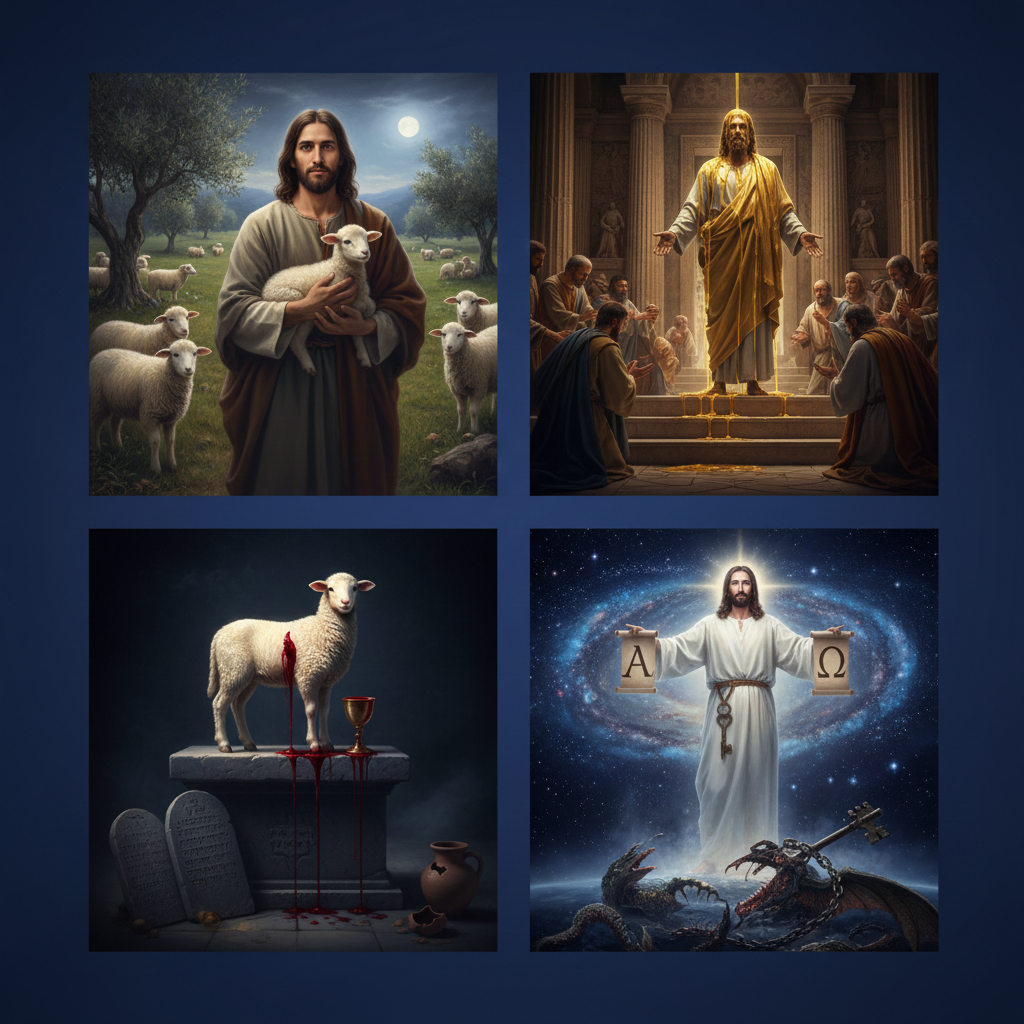
The blood on the garment is the horseman’s own blood. The slaughter of the Lamb in DES 5:6 is visible on the horseman’s garment in DES 19:13. He carries the evidence of the crime committed against him. The judge wears the proof of the injustice.
Easter Egg: tradition reads the blood as a trophy of war — enemy blood. But the narrative sequence contradicts this: the blood is on the garment before any combat. Isaiah 63:1-3 is frequently cited as a parallel (“why is your garment red?”), but in Isaiah the blood is from enemies AFTER the trampling. In DES 19, the blood is PRIOR to any action. The temporal sequence eliminates the direct parallel.
The weapon: the sword of the mouth — DES 19:15
καὶ ἐκ τοῦ στόματος αὐτοῦ ἐκπορεύεται ῥομφαία ὀξεῖα, ἵνα ἐν αὐτῇ πατάξῃ τὰ ἔθνη kai ek tou stomatos autou ekporeuetai rhomphaia oxeia, hina en aute pataxe ta ethne “And from his mouth proceeds a sharp sword, so that with it he may strike the nations.”
The sword (ῥομφαία, rhomphaia) is not in the horseman’s hand. It is in his mouth. It comes out from within him (ἐκπορεύεται, ekporeuetai = proceeds, emanates). The horseman’s weapon is speech. The Logos of Θεός judges with words.
The same rhomphaia appears in DES 1:16 (description of the Son of Man) and DES 2:12 (letter to Pergamum). The consistency identifies the horseman with the Son of Man from the opening letters.
| Secular horseman | Weapon | Method |
|---|---|---|
| Human horsemen | Sword in hand | Physical force |
| Horseman of DES 19 | Sword from mouth | Speech/pronouncement |
The horseman’s name is Logos — Word. And the Word judges by pronouncing. The sword is the pronouncement of the verdict.
The third name: ὁ Λόγος τοῦ Θεοῦ
The third name — “the Logos of Θεός” — is the only title that connects the horseman of DES 19 to the prologue of the Gospel of John:
Ἐν ἀρχῇ ἦν ὁ Λόγος, καὶ ὁ Λόγος ἦν πρὸς τὸν Θεόν, καὶ Θεὸς ἦν ὁ Λόγος En arche en ho Logos, kai ho Logos en pros ton Theon, kai Theos en ho Logos “In the beginning was the Logos, and the Logos was with Θεός, and Θεός was the Logos.” (John 1:1)
The Logos who “was in the beginning” now rides with a blood-soaked garment. The creator returns as judge. And the proof of injustice is on the robe he wears.
Conclusion
The horseman of DES 19 is not a conventional warrior. He is a judge who wears the evidence of his own sacrifice (blood on the garment before the battle), carries a weapon that is a pronouncement (the sword from the mouth), and bears three identities (public, hidden, and proclaimed). The blood on the garment is the Lamb’s own blood. The sword is the Word. The name is Logos.
The forensic investigation identifies: the one who was a victim of the system returns as the judge of the system. And the proof of the crime is on the judge’s own body — visible on the garment, indelible, prior to any sentence.
“You read. And the interpretation is yours.”